BRD format: key takeaways
- BRD full form is Business Requirements Document.
- BRD records the business needs and expected outcomes that a project addresses.
- It gives stakeholders clarity for making business decisions.
- It helps the delivery team establish goals and metrics for the project.
- BRD is useful when stakeholders have varied expectations of what the project covers.
- A requirements gathering template enables easier business changes and info tracking.
What is a BRD document?
A Business Requirements Document (BRD) is a structured document that explains why a project is needed, what it expects to achieve, and the requirements that must be addressed to meet those expectations.
A BRD connects a business problem to a proposed project outcome. It helps stakeholders agree on the project’s purpose before the project team defines the detailed solution.
In this blog, we’ll understand what is a BRD document, what a BRD contains, with practical examples and a template.
But before we get into the details, let’s look at the difference between a BRD vs FRD document.
Difference between BRD and FRD
FRD stands for Functional Requirements Document. It states the functional requirements and behavior of a project or a software system for achieving a goal.
A BRD and an FRD are related documents made to serve different business purposes. Both BRD and FRD are part of project documentation and help teams move from business expectations to detailed solution requirements.
| Basis | BRD | FRD |
| Full form | Business Requirements Document | Functional Requirements Document |
| Main focus | Business needs and expected outcomes | Detailed system functions and behavior |
| Key questions | Why is the project needed, and what must it achieve? | What must the solution do to meet the requirements? |
| Level of detail | Business-level overview | More detailed functional specifications |
| Primary audience | Business stakeholders, sponsors, project teams | Business analysts, developers, testers, and technical teams |
For example:
- A BRD may state that the business needs faster and more accurate sales reporting.
- FRD then specifies how users select reporting periods, filter sales data, generate reports, and export results.
The documentation process is set up according to the organization’s regulatory needs. Some organizations use separate BRDs and FRDs.
Others combine requirements into a single document or use user stories and acceptance criteria. Now let’s understand how a BRD is used in project management.
Importance of BRD in project management
The Business Requirements Document holds a wider purpose beyond completing a project checklist. It supports numerous important project management activities.
- Scope definition: BRD clarifies what the project is expected to deliver and what falls outside its boundaries.
- Stakeholder alignment: It gives the project professionals and stakeholders a shared reference for expectations.
- Planning and estimation: BRD provides clear requirements that help teams estimate the work, mark dependencies, and assess resource needs.
- Change control: A BRD lets the team compare new requests with the agreed requirements and assess their impact on the project.
- Acceptance and validation: Documented requirements help project stakeholders determine whether the delivered solution meets the original business need.
A BRD cannot eliminate every disagreement or prevent every scope change. Its value lies in making expectations visible so that decisions can be made strategically rather than through assumptions.
So let’s check out what a BRD document should include.
What should a BRD include?
Every BRD’s structure varies as per the organization and its project. But below are the common inclusions of a Business Requirements Document:
1. Executive summary and project background
- Start with a brief overview of the project and the business problem behind it. Explain the current situation, why a change is needed, and what opportunity the project is expected to address.
- Keep this section concise enough for a sponsor or senior stakeholder to understand the initiative without reading the entire document.
2. Business objectives and success criteria
- Describe what the business wants to achieve. Wherever possible, use measurable objectives rather than broad statements such as “improve efficiency.”
- The success criteria documented should explain how the team will evaluate whether the intended outcome has been achieved.
3. Project scope and deliverables
- Document what is included in the project and what is explicitly excluded.
- List the major deliverables and identify relevant assumptions, constraints, dependencies, and milestones. BRD must always establish the project boundaries.
4. Stakeholders and their requirements
- Identify the groups affected by the project and their role in providing requirements or approving decisions.
- Recording these needs helps in effective project management by identifying conflicts before they become issues.
5. Business requirements and priorities
- Record each requirement and explain its purpose and priority.
- Avoid vague statements to make clear and specific requirements for further guiding the analysis.
6. Risks and assumptions
- Document the limitations and assumptions that could affect the project.
- Separate confirmed facts from assumptions for validation before proceeding.
7. Approval and document control
- Include the document owner, date, and approval status.
- This helps everyone understand whether the requirements have been formally agreed upon.
BRDs also have a process for recording changes after approval. But the points above are the main pillars of what must be included in a BRD document. Now let’s see how to create a BRD document next.
How to create a BRD: step-by-step guide
Knowing the sections is useful, but the quality of a BRD depends on how the requirements are gathered and documented.
1. Understand the business problem
Communicate with the project sponsor and relevant stakeholders to understand the existing process, challenges, and the business outcome they want to achieve.
2. Gather requirements
Use stakeholder interviews and questionnaires to understand what different groups need.
After collecting initial requirements, review them with stakeholders for any missing information that needs validation.
3. Define project scope
Separate essential requirements from optional improvements.
Use a prioritization method and categorize requirements as high, medium, and low importance for the current project scope management.
4. Document requirements clearly
Write each requirement as a distinct and understandable statement. Ensure it is easy for the team and stakeholders to understand. Documenting clear details further enables identifying conflicting expectations.
5. Approve and maintain the BRD
Share this draft with the relevant stakeholders and resolve outstanding questions. Record any revisions and assess their impact when requirements change.
Further on, use the BRD as a reference during planning and change control, etc.
Ultimately, a BRD should remain useful throughout the project lifecycle rather than become an outdated document after initiation.
So let’s check out how to use a BRD document with a template and instructions.
BRD Format Template
The BRD format provides a structured guideline for project professionals to maintain the project requirements. It ensures the team accomplishes only the set objectives within the project’s scope.
This calls for a template that includes the components shown in the workflow and supports successful project completion. Below is the free BRD format template and instructions for use:
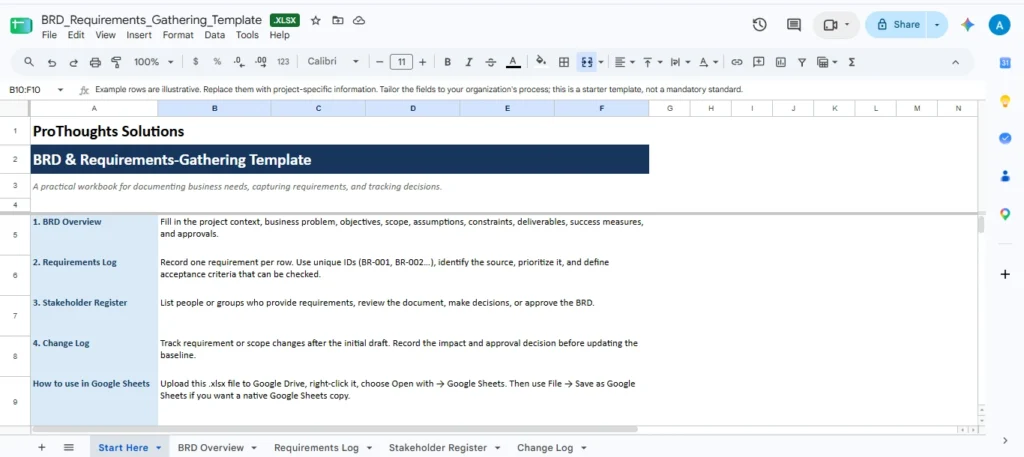
Download the free BRD template here
Step 1:
- Open the first sub-sheet of the BRD template.
- Add a basic overview of the project BRD, requirements log, name the stakeholder groups, and fill in a short summary for the change log.
- Add update notes in this section after every change your team makes.
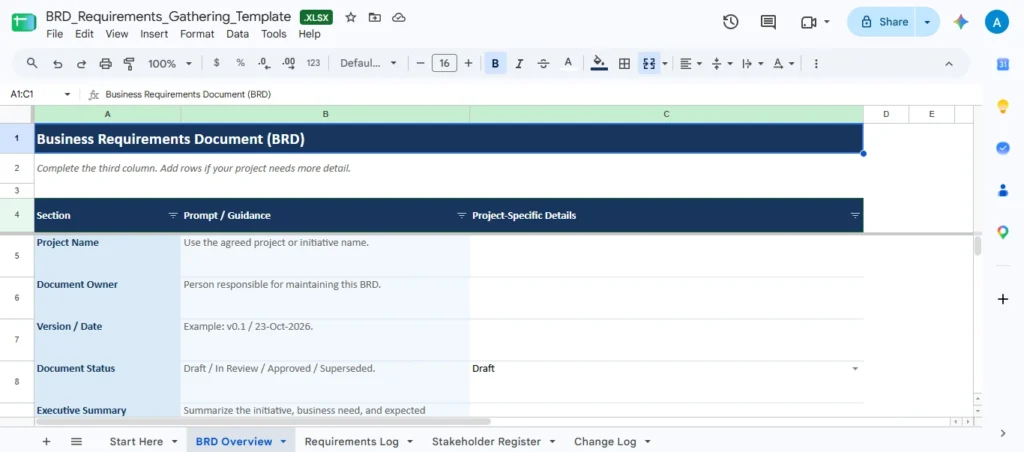
Step 2:
- Depending on your project, in the main BRD Overview sub-sheet, add details like this requirement list sample:
- Project Name
- Document Owner
- Version / Date
- Document Status
- Executive Summary
- Business Problem / Opportunity
- Success Measures
- Project Scope — In Scope
- Project Scope — Out of Scope
- Key Deliverables
- Acceptance / Validation Approach
- Etc.
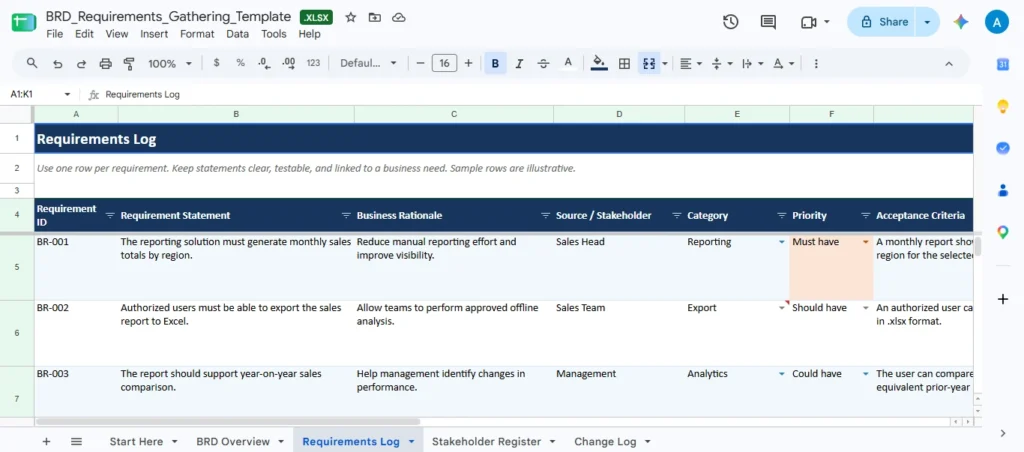
Step 3:
- Open the next sub-sheet named Requirements Log.
- Mention the Requirement ID and expand the Requirement Statement, Business Rationale, Source or Stakeholder, Category, and Priority, with the supporting Acceptance Criteria.
Step 4:
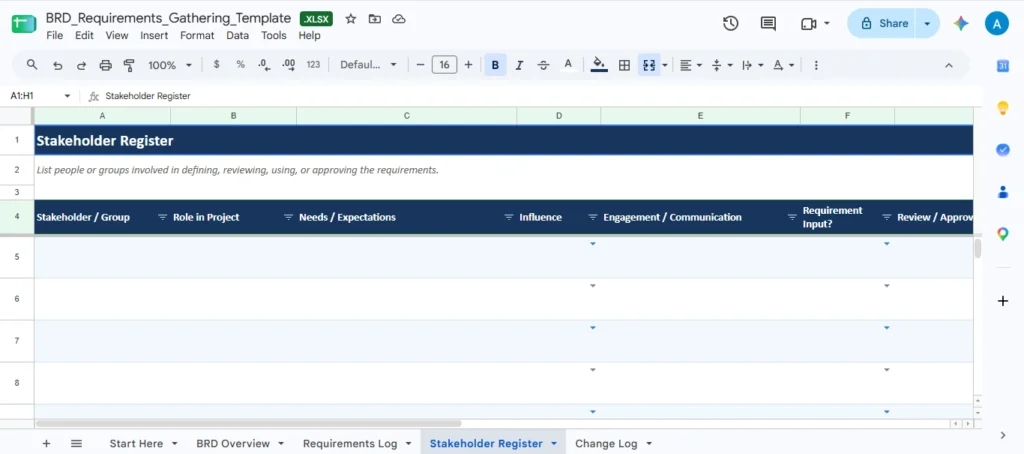
- Mention in-depth details of all the influencing stakeholders in the Stakeholder Register.
- Assign a project member to own or lead the initiative.
Step 5:
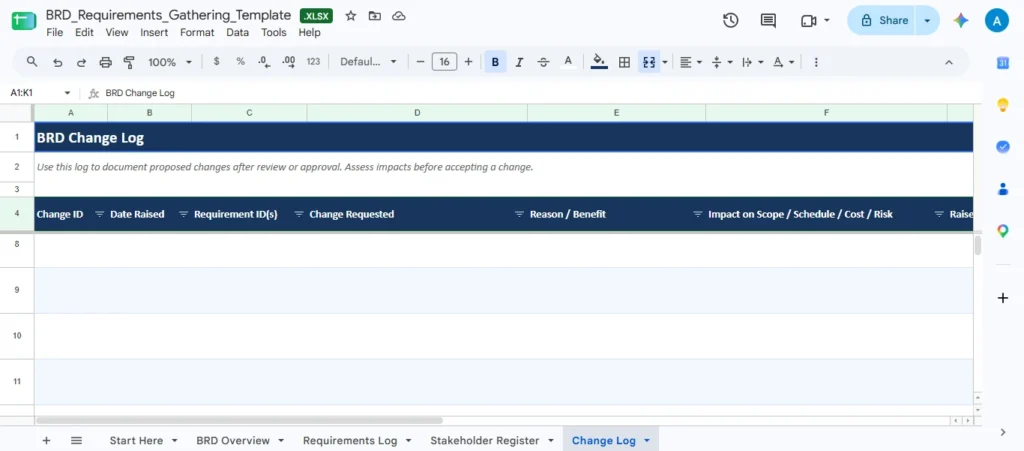
- Finally, use the Change Log sub-sheet to document proposed changes after approval.
- Precisely detail the proposed changes in the sheet.
The abovementioned instructions will help you fill the BRD template, use it to improve your project’s change process, and implement the document as a guideline for the team.
Conclusion
A Business Requirements Document establishes a common understanding of what a project needs to achieve and why those requirements matter.
BRDs are employed in initiatives where multiple stakeholders need a shared understanding of the requirements. They help with effective planning and clearer change management.
Explore our PMP certification training programs to advance your career!
BRD format: frequently asked questions
Here are some of the frequently asked questions on the BRD document in project management:
1. What is a BRD document used for?
A BRD documents a project’s business needs, objectives, scope, stakeholder expectations, and requirements.
It helps stakeholders agree on what the project must achieve and provides a reference for your project management plan and change control.
2. What is the full form of BRD in project management?
BRD stands for Business Requirements Document. It records the business problem a project addresses and its expected outcomes that guide the initiative.
3. What is the difference between BRD and FRD?
A BRD focuses on business needs and expected outcomes. An FRD describes the functional behavior required from the proposed solution.
The FRD provides more details about how the solution must behave to satisfy the business requirements.
4. Who prepares a BRD?
A business analyst leads BRD preparation and works with the project manager, end users, and other stakeholders. The specific owner depends on the organization’s processes and project structure.
5. What should a requirement list sample include?
A useful BRD requirement list includes:
- Unique ID
- Requirement statement
- Source
- Priority
- Ownership
- Acceptance criteria
- Status
Larger projects may also track dependencies and links to related requirements or test cases.