
Feasibility study: key takeaways
- A feasibility study assesses whether a project can achieve its objectives.
- It estimates the project’s likelihood of success against the given conditions and factors.
- The main types include technical, economic, operational, legal, and schedule feasibility.
- A feasibility analysis compares alternatives and identifies different risks to the project.
- A feasibility report documents the findings and recommends the next course of action.
- Feasibility checks must happen early in the project lifecycle.
Important Terms to Know
- Feasibility meaning -The usefulness of carrying out a proposed plan or project successfully.
- Feasibility study – A structured assessment of whether a proposed project is achievable and worth pursuing.
- Feasibility report – A document that presents the findings and recommendations from a feasibility study.
- Feasibility analysis – The process of evaluating a project’s usefulness by using relevant factors.
- Feasibility check – An assessment that identifies constraints or reasons a project may not succeed.
This blog covers the feasibility study meaning with examples, feasibility in project management, its types, and a step-by-step process of conducting a feasibility analysis.
What is a feasibility study?
A feasibility study is an assessment conducted to determine whether a proposed project can be completed successfully and whether pursuing it makes sense. It examines the resources, costs, technology, and operational requirements against other constraints involved before an organization commits to implementation.
It further brings these considerations together so decision-makers can evaluate the proposal using evidence rather than assumptions.
Feasibility study in project management
A feasibility study in project management is conducted in the initial stages of the project lifecycle. It often follows the earliest business case before detailed planning and execution.
Feasibility helps project managers determine whether the proposed solution can meet organizational objectives within the organization’s constraints. It also provides an opportunity to implement proper project risk management and consider alternative approaches before committing resources.
Let’s look at how a feasibility study works in a real project scenario, with feasibility study examples next.
Feasibility study examples
Let us consider the following scenario: A manufacturing company that wants to implement an inventory management system to reduce stock discrepancies and improve order fulfillment.
The company expects the system to improve inventory visibility. But the management needs to determine whether the proposed solutions are compatible with existing systems before approving the investment.
The project feasibility study here evaluates:
- Technical feasibility: Whether the new system will integrate with the company’s existing warehouse systems.
- Economic feasibility: Whether the expected savings justify software implementation and maintenance costs.
- Operational feasibility: Whether the employees adopt the new process without disrupting daily operations.
- Legal feasibility: Whether the system meets the data protection and regulatory requirements.
- Schedule feasibility: Whether the system can be set up before the main sales period.
This example shows that a feasibility study is not just about approving or rejecting a project, as it helps determine the most practical path forward.
Let’s check out the main types of feasibility studies next.
Types of feasibility study
Sometimes, a project can be feasible from a technical point of view, but if its financial feasibility exceeds the required budget and scope, then the project objectives may not be achievable. This is why feasibility needs to be evaluated from multiple perspectives.
Below we’ve listed the main types of feasibility:
1. Technical feasibility
Technical feasibility determines whether the organization has access to the technological resources required to deliver the project.
Example: A software implementation requires:
- System compatibility examinations
- Cybersecurity requirements
- Technical expertise
- Integration capabilities
2. Economic feasibility
Economic feasibility evaluates whether the expected benefits explain the costs and investment involved. Cost-benefit analysis as well as ROI support this assessment.
It considers:
- Development costs
- Implementation costs
- Operating expenses
- Expected savings
- Revenue opportunities
- Financial risks
3. Operational feasibility
Operational feasibility examines whether the proposed solution will work within the organization’s existing processes. It also determines whether the employees and other stakeholders can adopt it.
Operational feasibility is important because a new system could offer excellent features, but its benefits could amount to no use if employees cannot use it effectively.
4. Legal feasibility
Legal feasibility checks whether the project complies with relevant laws, regulations, licenses, contracts, and industry requirements.
This is important for projects that involve using personal information or financial data and regulated business activities.
5. Schedule feasibility
Schedule feasibility evaluates whether it is reasonable to assume the project can be completed within the given timeframe. It considers:
- Resource availability
- Task dependencies
- Lead times
- Approvals
- Constraints
Some projects may also require environmental, market, or social feasibility assessments depending on their nature and impact.
These assessments ultimately provide a complete picture of the project viability. The project team must document the right information to get real results. Next, we’ll look at the components of a feasibility study and what to include in it.
What to include in a feasibility study?
A feasibility study structure can vary depending on numerous variables and the project environment. Small internal initiatives may require a short assessment. While large investments may need detailed financial modeling, technical reviews, and market research.
Below are the main components of a feasibility study:
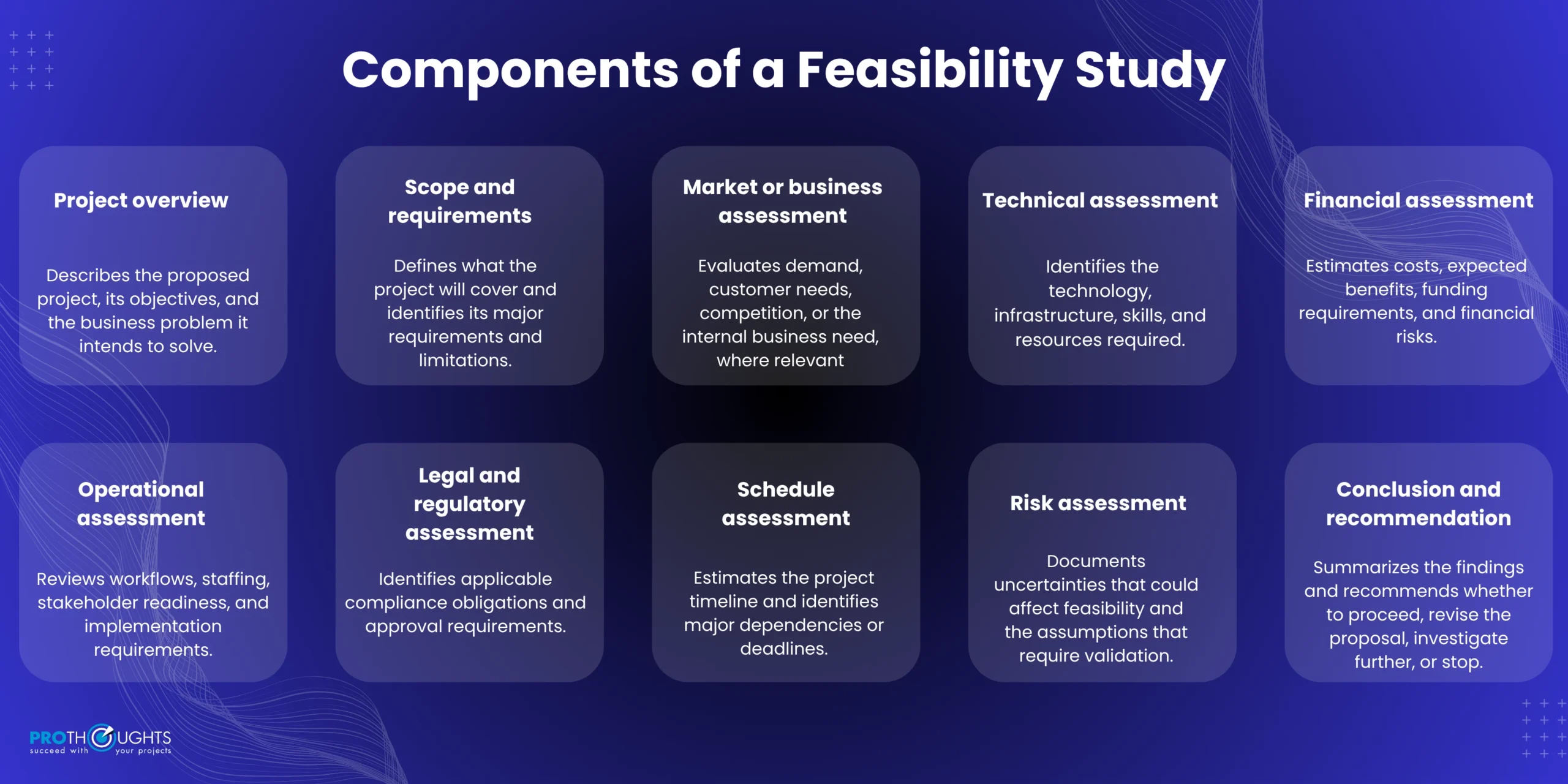
The abovementioned components form the foundation of the feasibility analysis. The next step is to evaluate the information and turn it into a decision. Now let’s see how to conduct a feasibility analysis.
Feasibility analysis: 7 step-by-step process
A feasibility analysis is the process of examining the evidence behind a proposed project to determine whether it is practical and worthwhile. The following are the seven steps of a feasibility analysis:
Step 1: Define the project objectives
Identify the problem the project intends to solve and the outcomes to be delivered. Define the project scope, expected benefits, and key success criteria.
Clear objectives help the team assess the technical or financial feasibility of a solution that addresses the actual business need.
Step 2: Gather relevant information
Collect the information needed to assess the proposal and record the assumptions that will support stakeholders in making decisions.
This may include:
- Project stakeholder requirements
- Cost estimates
- Resource availability
- Technical specifications
- Market research
- Regulatory requirements
Step 3: Evaluate the available alternatives
Avoid assuming that the first proposed solution is the only viable option. Compare alternatives to build an internal solution or outsource the work for implementing the project in phases.
The comparison should consider the same objectives and evaluation criteria wherever possible.
Step 4: Assess the different types of feasibility
Evaluate the different types of feasibility. Add other assessments where the project’s nature requires them.
Include all details in your project documentation. Add the evidence and limitations identified in each area rather than relying on a general opinion that the project seems achievable.
Step 5: Estimate costs, benefits, and risks
Calculate the investment and ongoing costs. Then compare them with expected benefits. Consider the following that could change the outcome:
- Potential delays
- Resource constraints
- Adoption challenges
- Other risks
Use realistic estimates to compare different scenarios and examine how changes in assumptions affect the project’s viability.
Step 6: Consolidate the findings
Bring the results together in a feasibility report. Highlight the main findings and conditions that must be met before implementation.
This helps stakeholders distinguish between manageable issues and constraints that may make the project impractical.
Step 7: Recommend a course of action
Recommend how the project should proceed as proposed or undergo further investigation based on the findings.
The final decision should consider the evidence as well as the organization’s strategic priorities and risk tolerance.
Once the analysis is complete, the findings must be communicated to the relevant professionals and stakeholders. This is where the feasibility report becomes important.
So let’s understand the feasibility report’s meaning and the key points in the upcoming section.
What is a feasibility report?
A feasibility report is a document that presents the findings of a feasibility study. It explains what was assessed, the evidence considered, the limitations identified, and the recommended course of action.
A thorough feasibility report includes:
- Executive summary
- Project background and objectives
- Scope and methodology
- Findings from the feasibility assessments
- Cost-benefit analysis
- Key risks and assumptions
- Alternative solutions
- Recommended next steps
The report should be clear enough for stakeholders to understand why a recommendation has been made. It should also distinguish confirmed information from estimates that need further validation. Next, we’ll take a quick look at a feasibility check.
What is a feasibility check?
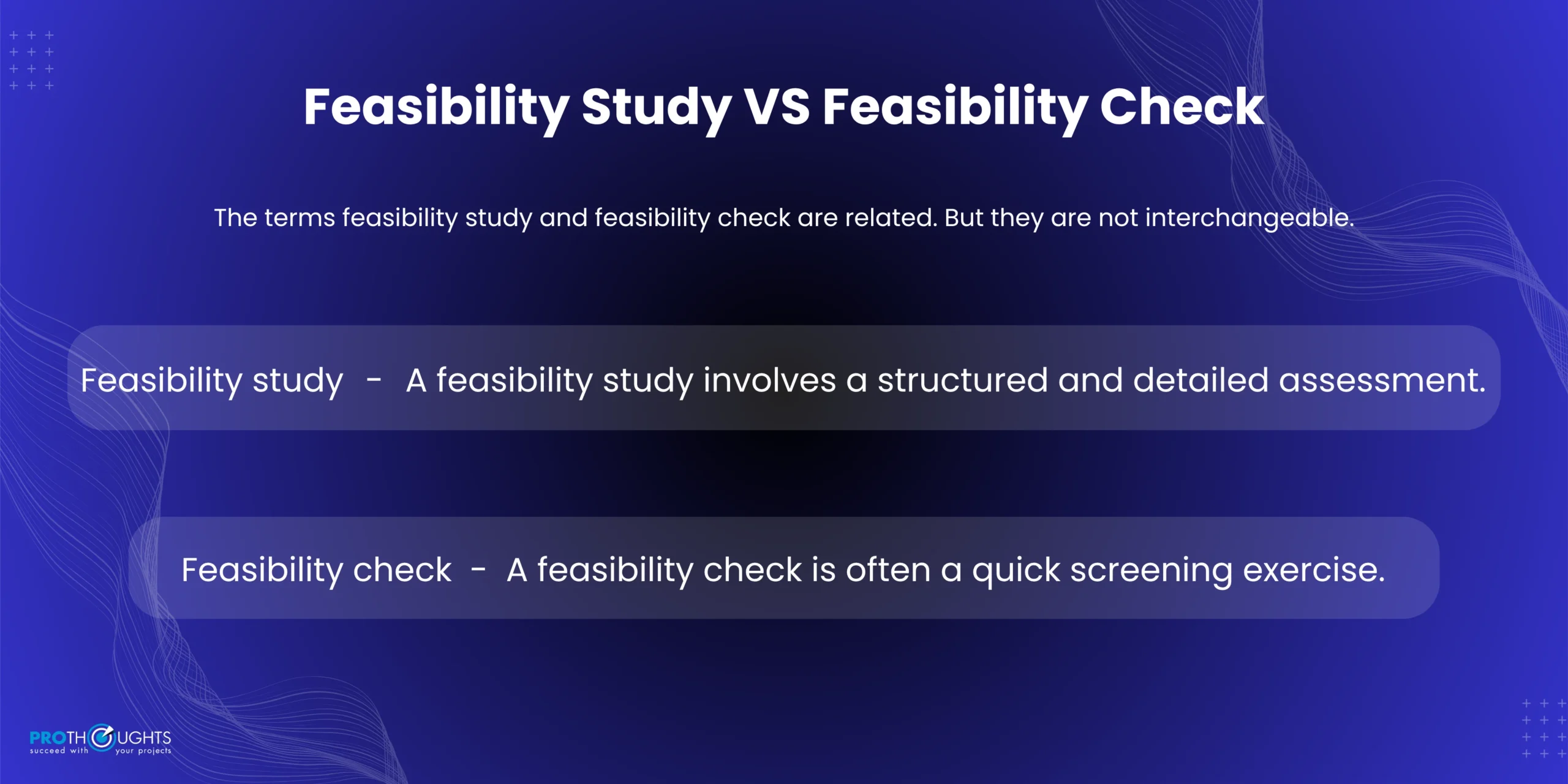
A feasibility check is a preliminary review of whether an idea appears practical before the team invests time and money in a detailed study. It may involve checking budget, technical requirements, resource availability, major deadlines, and legal or operational barriers.
Feasibility study vs Feasibility check
Conclusion
A feasibility study helps project managers determine whether a proposed project is practical before committing significant resources. It aids teams in identifying potential problems early and making more informed decisions.
Its recommendations can help an organization avoid unsuitable investments and identify the changes needed to make a promising project viable.
So check out the ProThoughts PMP certification training to upgrade your project management career prospects!
Feasibility study: FAQs
Below are some of the frequently asked questions on feasibility study:
1. What is meant by a feasibility study?
A feasibility study is a detailed and structured assessment that determines whether a proposed project is practical to achieve and worth pursuing.
2. What are the four types of feasibility?
The four types of feasibility are technical, economic, operational, and schedule feasibility.
3. What is a feasibility report?
A feasibility report is a document that summarizes different assessments to decide whether a proposed project should proceed. It includes findings, assumptions, costs, risks, alternatives, and recommendations.
4. What are the types of feasibility?
The main types of feasibility are technical, economic, operational, legal, and schedule feasibility.
5. What are the seven steps in conducting a feasibility study?
The steps to conduct a feasibility analysis are:
- Define project objectives
- Gathering relevant information
- Evaluating alternatives
- Assessing feasibility areas
- Estimating costs and benefits
- Consolidating findings
- Recommending a course of action
6. When should a feasibility study be conducted?
A feasibility study should be conducted early in the project lifecycle. It must come before major resources are committed. It may also be revisited if significant changes in scope or other business conditions affect the project’s viability.