Project coordinator: Key takeaways
- Project coordinators support daily project activities.
- Strong organization and communication skills are important.
- Common tasks include scheduling, documentation, reporting, and follow-ups.
- Project coordinators work closely with project managers.
- Tools like Jira and excel support project coordination.
- Project coordinator roles exist across many industries.
- CAPM and PMP certifications can support career growth.
- Experience can lead to broader project management roles.
What is a project coordinator?
A project coordinator is someone who works with project managers, team members, clients, etc. Unlike a PMP project manager, a project coordinator typically focuses on two major things.
- Coordination (as the same stands for it)
- Administrative support.
Although the roles include planning, tracking, reporting, and stakeholder communication. Also, the exact responsibilities differ based on the organization and size of the project.
Next, let’s see what a project coordinator does.
What does a project coordinator do?
Here we have mentioned 10 common roles and responsibilities of a project coordinator –
1. Coordinate project activities
A project coordinator has to do a tactical day-to-day process of –
- Keeping tasks
- Schedules
- Keeping team memes aligned
Follow up with the team members and organize activities across the project. Make sure everything is working as per the plan and running smoothly.
2. Maintain project schedules
Project coordinators help by keeping project schedules accurate and up-to-date. This is done by tracking –
- Key milestones
- Deadlines
- Meetings
- Planned activities
You also need to check whether scheduled tasks are progressing as expected. If dates change, you update the relevant schedules and communicate those changes to the team.
3. Organize project documentation
Project coordinators manage the documents created throughout a project. These can include –
- Project plans
- Meeting notes
- Status reports
- Requirements
- Trackers
- Project records
This helps to keep files organized. Ensure the team members can find the information they need.
4. Support project meetings
Project coordinators handle the administrative work around project meetings. Project coordinators are responsible to –
- Schedule meetings
- Prepare agendas
- Share relevant documents beforehand
During meetings, a project coordinator needs to record key discussions with action items. Afterward, you circulate the meeting minutes and track follow-up activities.
5. Track project progress
A project coordinator collects regular updates from project team members. Then track
- Completed work
- Pending activities
- Upcoming deadlines
- Other progress details
These updates keep the project manager in line with the current project status. Project coordinators also consolidate this information into weekly or monthly status reports.
6. Coordinate communication
Project coordinators keep communication organized across the project team. By sharing updates, meeting information, documents etc.
7. Track risks, issues, and dependencies
Depending on the organization, project coordinators may maintain risk, issue, and dependency logs.
Record important details such as
- Owners
- Deadlines
- Status
- Required actions
Project coordinators also follow up with responsible team members for updates. Serious risks or issues are usually escalated to the project manager or relevant stakeholder.
8. Coordinate with vendors and external teams
Some projects involve suppliers, contractors, consultants, or other external partners. Project coordinators communicate with these parties about
- Schedules
- Documents
- Meetings
- Deliverables
- Pending information
Project coordinators help track commitments and follow up. Especially when information or deliverables are delayed. This keeps external activities aligned with the overall project schedule.
9. Support project reporting
Project coordinators assist project managers with preparing project reports and presentations. Collection of information from different team members is required. Then the information needs to be organized into a clear format.
10. Follow up on action items
Project meetings usually create several tasks that require follow-ups. Project coordinators track these action items and record the owner with the expected completion date. You have to follow up with the team members for updates and keep the action tracker current.
If you are looking to get into a project coordinator role. The next section explains the job description of a project coordinator. Using this information, you can enhance your resume and add on relevant skills.
Project coordinator job description
A project coordinator job description generally explains the responsibilities, qualifications, skills, and expectations associated with the position.
Here’s how a typical project coordinator job description includes –
Job title: Project coordinator
Role summary: Supports project planning, coordination, documentation, communication, and progress tracking. While working closely with the project manager and project team.
Key responsibilities:
- Coordinate project activities and schedules
- Maintain project documentation
- Schedule meetings and record minutes
- Track deadlines and action items
- Collect project updates
- Prepare status reports
- Coordinate communication between stakeholders
- Maintain risk and issue information
- Support project planning and reporting
- Assist the project manager with day-to-day project activities
Typical requirements:
- Bachelor’s degree or relevant qualification
- Strong organizational skills
- Good written and verbal communication
- Ability to manage multiple priorities
- Familiarity with project management tools
- Basic understanding of project management principles
- Attention to detail
Note: Requirements vary considerably by employer. So candidates should review the individual job posting rather than assuming every project coordinator position.
The next section covers all the skills that a project coordinator needs.
Skills needed to become a project coordinator
Project coordinators are required to have a mix of organizational, communication, and project management skills.
| Skill | Why It Matters |
| Organizational skills | Helps manage schedules, documents, meetings, trackers, and follow-ups at the same time. |
| Communication | Helps coordinate with project teams, managers, clients, vendors, and other stakeholders. |
| Time management | Helps prioritize tasks, manage deadlines, and follow up on pending activities. |
| Documentation | Helps maintain accurate project records, meeting notes, reports, requirements, and other documents. |
| Problem-solving | Helps address scheduling conflicts, missing information, delayed activities, and communication gaps. |
| Project management tools | Familiarity with tools such as Jira, Microsoft Project, Asana, Trello, Monday.com, and Excel helps manage project information. |
| Basic project management knowledge | Understanding scope, schedules, milestones, dependencies, risks, and stakeholders helps support project activities effectively. |
In our next section, we will go through the qualifications of a project coordinator.
Project coordinator qualifications
There is no single qualification that applies to every project coordinator job.
Employers generally look for:
- A bachelor’s degree in business, management, project management, engineering, IT, or a related field
- Internship or entry-level project experience
- Knowledge of project management methodologies
- Experience with project management software
- Strong communication and organizational skills
- Professional certifications that demonstrate project management knowledge
Professional certifications can also support candidates who are building their project management knowledge.
- CAPM certification is relevant for you if you are just starting off your project management career.
- PMP certification is more suited to established project management experience.
Project coordinator jobs & open portals
Project coordinator jobs are available across many industries. Common sectors include information technology, construction, engineering, healthcare, etc. Current job listings also show roles across different experience levels and locations in India.
| Information technology | Consulting | Healthcare |
| Construction | Marketing | Government and public-sector organizations |
| Engineering | Manufacturing | Finance |
The job title can also vary. Similar roles may appear under titles such as:
- Project administrator
- Project support coordinator
- Project assistant
- Project management coordinator
- Program coordinator
- PMO coordinator
- Project analyst
The responsibilities can overlap, but the exact role depends on the employer.
Where to find project coordinator jobs
You can search for project coordinator openings across several job portals. Look for both “project coordinator” and related titles such as “project administrator” or “PMO coordinator.”
- LinkedIn Jobs – Search project coordinator roles by location, experience, industry, and work type. [project coordinator job portal]
- Naukri – Search Project Coordinator openings across different cities and industries. [project coordinator job portal]
- Indeed – Browse Project Coordinator vacancies and filter them by location and experience. [project coordinator job portal]
- Glassdoor – Search for Project Coordinator roles while also reviewing company information and salary details. [project coordinator job portal]
Job availability keeps on changing on a frequent basis. We recommend checking these portals regularly for new openings.
Now that you know the job description for a project coordinator. It is equally important to know how much a project coordinator earns.
Project coordinator salary
The project coordinator’s salary varies based on several factors, including:
- Country and location
- Industry
- Years of experience
- Company size
- Technical skills
- Scope of responsibilities
- Education and certifications
Project coordinator salary in India
| Experience | Typical salary range |
| Entry level, 0–2 years | ₹2.5–₹4.5 LPA |
| 2–5 years | ₹3.5–₹6.5 LPA |
| 5+ years | ₹5–₹8 LPA+ |
(Source: Glassdoor)
Note: Project coordinator salaries vary based on experience, location, industry, company size, and responsibilities.
Certifications, project management skills, and relevant software knowledge support career progression.
Let’s learn what’s the difference between a project coordinator and a project manager.
Project coordinator vs project manager
Although project coordinators and project managers work closely together. Both have different responsibilities.
A project coordinator supports project execution through coordination, documentation & tracking.
A project manager takes broader responsibility for planning, decision-making, delivery, and project outcomes.
Here’s a table explaining project coordinator vs project manager –
| Project coordinator | Project manager |
| Supports project coordination | Leads project delivery |
| Maintains schedules and documentation | Manages scope, schedule, budget, and delivery |
| Tracks updates and action items | Makes project-level decisions |
| Supports communication | Manages stakeholder expectations |
| May assist with risks and issues | Accountable for managing project risks and issues |
| Usually an early-career role | Usually requires greater project experience |
The responsibilities can overlap, particularly in smaller organizations. In the next section, we will see what a project coordinator’s career path looks like.
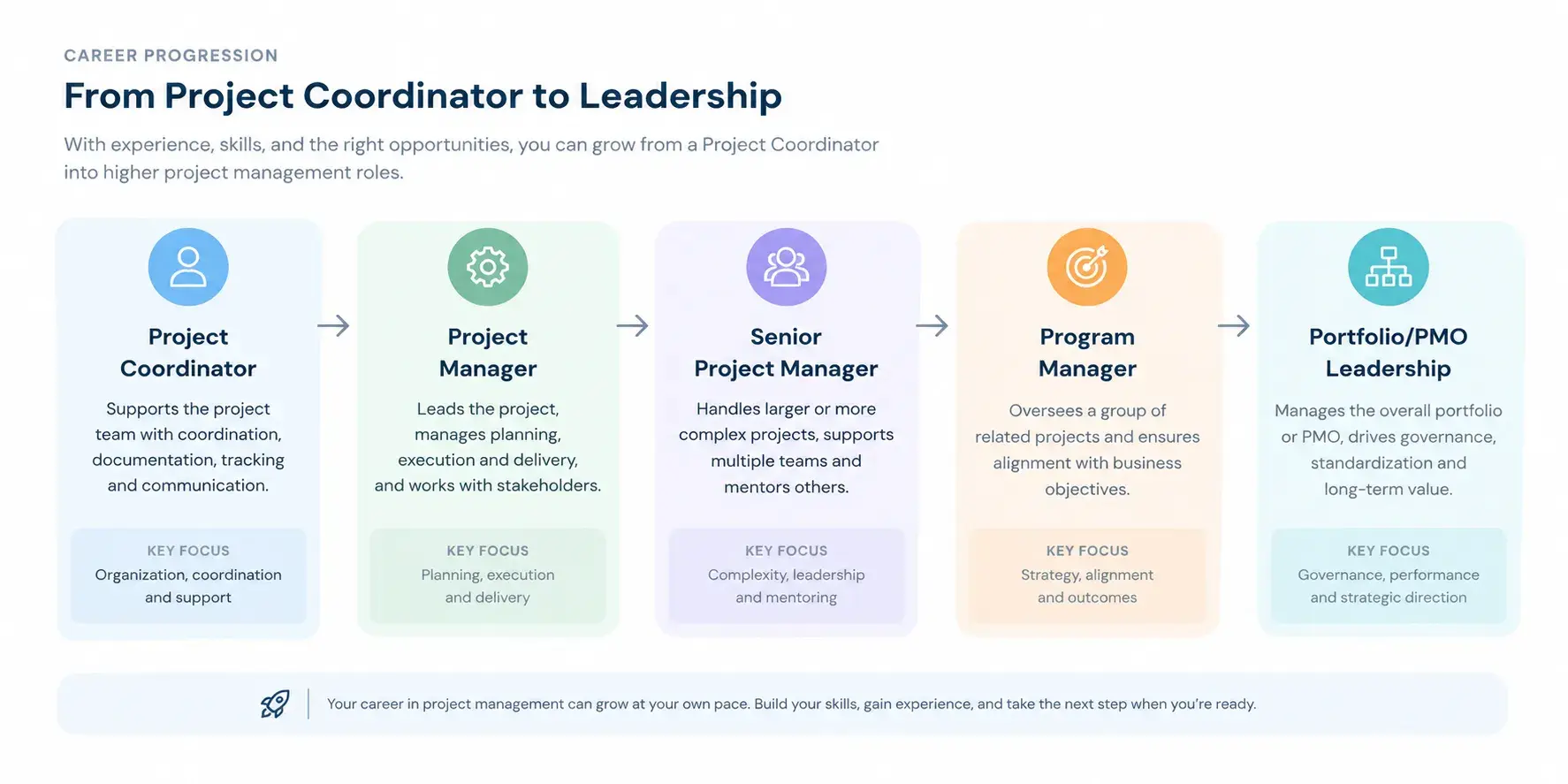
Project coordinator career path
A project coordinator can be an entry point into project management. This is how a possible career path for a project coordinator is –
Conclusion
In summary, a project coordinator is viewed as a right-hand assistant to the project manager. Although their authority and project scope management differ.
The role of connect many of the daily activities that are involved in project delivery.
If you are starting a career in project management. Understanding the responsibilities and skills can help identify suitable opportunities. You can accordingly plan our your next career step.
FAQs on project coordinator
Here are some commonly asked questions on project coordination.
1. What does a project coordinator do?
A project coordinator supports
- Project planning
- Scheduling
- Documentation
- Communication
- Reporting
- Day-to-day coordination
2. What is the difference between a project coordinator and a project manager?
A project coordinator generally supports project activities and coordination. While a project manager has broader responsibility for managing and delivering the project.
3. What qualifications are needed to become a project coordinator?
Requirements vary by employer, but many positions ask for a relevant degree, organizational and communication skills, project management knowledge, and familiarity with project tools.
3. Can a fresher become a project coordinator?
Yes. Some project coordinator positions are created as entry-level or early-career roles. Internships, academic projects, relevant tools, and project management training help candidates demonstrate relevant skills.
4. How much does a project coordinator earn?
Project coordinator salaries vary by – location, industry, experience, and employer. Current local salary data should be checked because compensation changes over time.
5. What tools does a project coordinator use?
Common tools include –
- Spreadsheets
- Project scheduling software
- Collaboration platforms
- Document management systems
- Project management tools such as jira or microsoft project.