Project synopsis in project management – key takeaways
- A project synopsis provides a high-level project overview.
- Clear objectives define what the project should achieve.
- Scope establishes what the project will cover.
- Deliverables describe the outputs the project should produce.
- Timelines and milestones provide schedule visibility.
- Risks highlight issues that could affect project delivery.
- A synopsis supports approval and detailed project planning.
- It is shorter and less detailed than a project management plan.
A project synopsis is like a summary of the project. It gives the stakeholders a concise overview of the proposed project. The purpose of having a project synopsis is to explain the aims of the project team.
It also helps to understand how the project team plans to deliver the project goals. In project management – a synopsis works as an early planning document.
A project synopsis does not need to contain every project detail. Its purpose is to present the project clearly and establish a foundation for detailed planning.
What is a project synopsis?
A project synopsis is a short document that summarizes the key aspects of a proposed project.
From a project management perspective, it usually explains:
- What the project will deliver
- Why the project is required
- What problem it will address
- Who the key stakeholders are
- What the project objectives are
- What work falls within the project scope
- What resources are required
- How the project will be executed
- When major activities and milestones are expected
- What outcomes the project should produce
Think of a project synopsis as a high-level project roadmap.
For instance – a company plans to implement a new customer relationship management system.
The synopsis explains the
- Business problem
- Project objectives
- Scope
- Expected
- Deliverables
- Implementation approach
- Timeline
- Key stakeholders
- Expected business outcomes
The detailed project management plan would contain much more information later.
Why is a project synopsis important in project management?
A project synopsis is important because it provides a short, clear summary of a project’s core elements.
It also gives the project manager a structured starting point for planning. Here are some reasons why project synopsis is important in project management.
1. Creates a shared understanding
Different stakeholders often have different expectations about a project.
A synopsis puts the basic project information into one document. This aligns the stakeholders around the project’s purpose, scope, and expected outcomes.
2. Clarifies project objectives
A project synopsis defines what the project is expected to achieve. Clear objectives also make it easier to develop project deliverables and success criteria later.
3. Establishes the initial scope
Scope creep often starts when project boundaries are unclear.
A synopsis identifies what the project intends to cover. It can also mention major items that are outside the initial scope.
4. Supports project approval
Sponsors and decision-makers need enough information to evaluate a proposed project.
A synopsis gives everyone a concise view of the – business need, expected outcomes, resources, timeline, and approach.
5. Supports detailed planning
Once the project receives approval, the information in the synopsis can support more detailed planning.
The project manager can – develop schedules, budgets, resource plans, risk registers, communication plans, and other project documentation.
Here’s a detailed blog on risk register in project management.
Project synopsis format
There is no single format that applies to every project. The structure depends on the organization, project type, industry, and purpose of the document.
A practical project synopsis format can include:
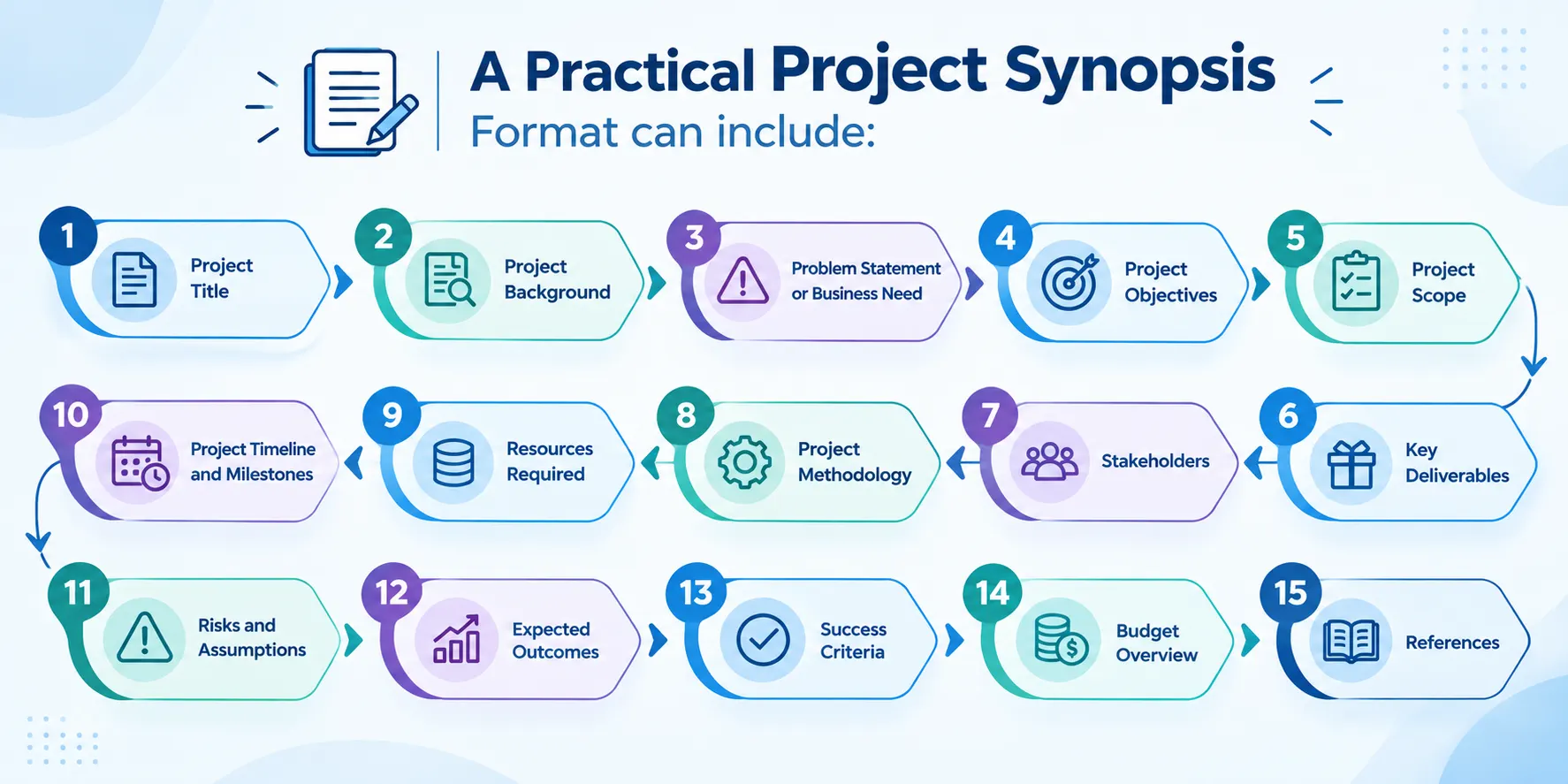
Not every project needs all these sections. Smaller projects can use a shorter format.
1. Project title
The project title should clearly communicate the project’s purpose. Avoid titles that are too broad.
Example:
“Customer relationship management system implementation.”
This title immediately tells stakeholders what the project involves. Also, a project title should also remain consistent across project documents.
2. Project background
The background explains why the project is being proposed. It should provide enough context without becoming a long business history.
The background gives stakeholders an idea before they read the project objectives.
3. Problem statement / business need
The problem statement identifies the issue that the project intends to address. A strong problem statement describes the current situation. Rather than simply presenting the solution.
4. Project objectives
Project objectives explain what the project intends to accomplish. To set decent and straight objectives.
For example:
- Implement a centralized CRM platform.
- Consolidate existing customer records.
- Reduce duplicate customer information.
- Improve access to customer data.
- Provide standardized sales and service reports.
- Train relevant employees before system rollout.
Objectives should connect directly to the identified business problem.
5. Project scope
The project scope lays out the boundaries of the project. It explains what the project will cover. Plus, it helps to prevent uncontrolled expansion.
For the CRM implementation, the scope could include:
In Scope
- CRM platform configuration
- Customer data migration
- User access setup
- Basic reporting
- Employee training
- System testing
- Production deployment
Out of Scope
- Development of a completely new CRM platform
- Major changes to unrelated business systems
- Long-term system maintenance after project closure
Clearly defining scope gives the project team a reference point during execution.
6. Key deliverables
Deliverables are the outputs the project is expected to produce.
For the CRM project, these could include:
| Deliverable | Description |
| Configured CRM | CRM system configured for business requirements |
| Migrated Data | Existing customer data transferred into the system |
| Reports | Standard management and sales reports |
| Training Materials | User guides and training resources |
| Tested System | System tested against agreed requirements |
| Production Launch | CRM released for operational use |
Deliverables should connect directly to the project objectives.
7. Key stakeholders
Project stakeholders are people or groups who are important to the project. As they are who affect the project or are affected by its outcome.
Depending on the project, stakeholders could include:
- Project sponsor
- Project manager
- Client
- Business users
- Project team
- IT team
- Vendors
- Senior management
- Customers
The synopsis does not need a detailed stakeholder register. It should identify the main groups involved.
8. Project methodology
The methodology explains how the project will be managed and delivered. The appropriate approach depends on the project.
For a predictive project – the synopsis may describe
- Sequential planning
- Design
- Development
- Testing
- Deployment
For an agile project – it can mention
- Iterative delivery
- Product increments
- Sprint planning
- Reviews
- Continuous feedback
For example:
The project will follow an agile approach. Requirements will be prioritized in a product backlog and delivered through planned iterations. Stakeholders will review completed increments and provide feedback throughout the project.
The methodology should reflect how the team actually intends to work.
9. Resources required
Resources are needed to complete project activities and deliver the expected outcomes.
A project synopsis could briefly identify:
- Project manager
- Business analyst
- Technical team
- Subject matter experts
- Testing team
- Training resources
- Software or technology
- External vendors
Resource details can be expanded later in the project management plan.
10. Project timeline and milestones
The timeline provides a high-level view of the project schedule.
Instead of listing every task, the synopsis can show major phases and milestones.
| Project Phase | Duration | Key Milestone |
| Requirements | 2 weeks | Requirements approved |
| Configuration | 4 weeks | Configuration completed |
| Data Migration | 2 weeks | Data migration completed |
| Testing | 2 weeks | User acceptance completed |
| Training | 1 week | Users trained |
| Deployment | 1 week | CRM launched |
The exact timeline should reflect the project’s actual requirements.
11. Risks and assumptions
A project synopsis can include major risks and assumptions at a high level.
For example:
| Risk | Potential Impact |
| Poor data quality | Delays during migration |
| Limited user availability | Slower requirements validation |
| Vendor delays | Impact on implementation schedule |
| Resistance to change | Lower adoption after launch |
Assumptions could include stakeholder availability, timely approvals, access to required data, and vendor support.
The detailed risk register can be developed after project initiation.
If you want to know more about risk registers, we recommend reading our blog – Risk registration in project management.
12. Expected outcomes
This section explains what the project should achieve after completion.
For the CRM project, the expected outcomes could include:
- Centralized customer information
- Better access to customer records
- Improved reporting
- Reduced duplicate records
- Better visibility into sales activities
- Improved user access to customer information
The expected outcomes should connect to the original business need.
13. Success criteria
Success criteria define how the project outcome will be assessed.
For example:
The CRM implementation will be considered successful when the agreed customer data has been migrated, required users have completed training, critical testing issues have been resolved, and the system has been approved for production use.
This is more useful than simply stating that the project should be “successful.”
14. Budget overview
A project synopsis can provide a high-level budget estimate when financial approval is relevant.
For example:
| Cost Area | Estimated Cost |
| Software License | ₹5,00,000 |
| Implementation | ₹3,00,000 |
| Training | ₹75,000 |
| Data Migration | ₹1,00,000 |
| Contingency | ₹75,000 |
| Estimated Total | ₹10,50,000 |
These figures are illustrative. The detailed project budget should include the assumptions and calculations behind the estimates.
15. References
Include the sources used while preparing the synopsis.
These could include:
- Business requirement documents
- Organization policies
- Technical documentation
- Research papers
- Industry reports
- Vendor documentation
- Project management standards
Use the organization’s required citation format.
Project Synopsis Sample
Here is a project synopsis sample for a project management scenario.
Project Title
Customer Relationship Management System Implementation
Project Background
The organization currently uses multiple spreadsheets and systems to manage customer information. This creates difficulties in maintaining consistent records and preparing reports.
The project will implement a centralized CRM platform to improve customer data management and reporting.
Problem Statement
Customer information is stored across different systems. Teams spend additional time locating and updating records. Management also lacks a centralized view of customer information.
Project Objectives
The project aims to:
- Implement a centralized CRM system.
- Migrate approved customer data.
- Improve customer information accessibility.
- Provide standardized reports.
- Train relevant users before deployment.
Project Scope
The project will cover CRM configuration, data migration, testing, user training, and production deployment.
It will not include development of a new CRM platform or major changes to unrelated systems.
Key Deliverables
The major deliverables will include:
- Configured CRM platform
- Migrated customer database
- Standard reports
- User training materials
- Tested system
- Production deployment
Methodology
The project will use an agile delivery approach. Requirements will be prioritized and delivered through iterations. Stakeholders will review completed work and provide feedback during the project.
Timeline
The project is expected to take approximately 12 weeks.
Major milestones include requirements approval, configuration completion, data migration, user acceptance testing, training, and production launch.
Expected Outcomes
The project is expected to provide centralized customer information and improve reporting. It should also reduce duplicate records and make customer information easier to access.
Project synopsis example
Consider another example involving a website redesign project.
Project title
Corporate website redesign project
Business need
The existing website has an outdated design and difficult navigation. The organization wants to improve usability and provide clearer access to its products and services.
Objective
The project aims to redesign the website and improve its navigation, content structure, and user experience.
Scope
The project includes:
- Website structure redesign
- User interface design
- Content migration
- Front-end development
- Testing
- Search engine optimization
- Website deployment
It excludes development of a new e-commerce platform.
Major deliverables
- Approved website structure
- Final UI designs
- Updated website content
- Developed website
- Tested website
- Production launch
Major milestones
- Project kickoff
- Website structure approval
- Design approval
- Development completion
- User acceptance testing
- Website launch
This example shows how a project synopsis connects the business need with objectives and milestones.
Project synopsis vs project management plan
A project synopsis and project management plan are not the same document.
| Project Synopsis | Project Management Plan |
| Provides a high-level overview | Provides detailed management guidance |
| Usually prepared during initiation | Developed during project planning |
| Explains the project concept | Explains how the project will be managed |
| Summarizes scope and objectives | Defines detailed scope management |
| Gives high-level timeline | Contains detailed schedule information |
| Identifies major risks | Contains detailed risk management |
| Suitable for stakeholder review | Used by the project team throughout execution |
In simple terms, the synopsis explains what the project is and why it matters. The project management plan explains how the project will be managed and delivered.
Project synopsis vs. project report
A project synopsis describes the proposed project at a high level. A project report provides detailed information about the project and its results.
| Project Synopsis | Project Report |
| Focuses on the proposed project | Focuses on completed project work |
| Usually prepared early | Usually prepared later |
| Summarizes objectives and scope | Documents execution and results |
| Provides high-level planning information | Provides detailed project information |
| Supports initial review | Supports final evaluation and documentation |
For example, a synopsis could state that a CRM system will be implemented.
The final project report includes document the implementation activities, testing results, issues, changes, costs, lessons learned, and final outcomes.
Project synopsis checklist
We have made a project synopsis checklist for you. This checklist helps you confirm that your document covers enough details.
Project synopsis: check the following:
- Is the project title clear?
- Is the business need explained?
- Is the problem statement specific?
- Are the objectives measurable where possible?
- Is the scope clearly defined?
- Are major deliverables listed?
- Are key stakeholders identified?
- Is the methodology appropriate?
- Are major resources identified?
- Are important milestones included?
- Are significant risks documented?
- Are expected outcomes clear?
- Are success criteria defined?
- Is the budget included when required?
- Are references properly documented?
Before you submit or present your synopsis. Review each section to make sure everything is clearly defined.
This checklist helps identify gaps before detailed project planning begins.
Conclusion
The strongest project synopsis is specific and practical. It defines what the project intends to achieve and establishes clear boundaries for the work.
It should provide enough information for stakeholders to understand the project without becoming a detailed project management plan.
Once the project receives approval, the synopsis can provide a useful foundation for detailed planning and project execution.
Frequently asked questions
Here are some commonly asked questions on project synopsis in project management.
1. What is a project synopsis in project management?
A project synopsis is a concise document that summarizes a proposed project. It typically covers the business need, objectives, scope, deliverables, etc.
2. How do you write a project synopsis?
Start by explaining the business problem or need. Define the project objectives and scope. Then describe the –
- Deliverables
- Stakeholders
- Methodology
- Resources
- Timeline
- Risks
- Expected outcomes
3. Can a project synopsis include project risks?
Yes. A synopsis can include major risks that could affect – project feasibility, schedule, cost, or outcomes. Detailed risks can then be documented in the project’s risk register.
4. Should a project synopsis include a project timeline?
Yes. A high-level project timeline helps stakeholders understand the expected project duration and major milestones.
Detailed activities and dependencies can be added to the project schedule later.
5. Is a project synopsis the same as a project report?
No. A project synopsis provides an overview of the proposed project. A project report documents the project in greater detail and outcomes.