Decision making in project management: Key Takeaways
- You need proper decision making skills to keep the projects moving smoothly.
- A better decision saves funds and time and decreases risks.
- There are 3 types of decision in project management: Strategic, tactical, and operational
- Tools and AI helps in making decisions fast
- Poor decisions cause work to stay pending
- Models and techniques help make better, structured choices.
Introduction
Project managers have always been under pressure to make fast decisions, even though some things are not clear or when priorities change and stakeholders change their expectations. That is why project managers must be skilled enough in decision making in project management.
This blog talks about how decision making in project management works. And with the right method, any project manager can make decisions in a proactive way in today’s modern world. So let’s read along without wasting any time.
What is decision making in project management?
Decision making in project management is about choosing the right options and making the right call at the right time and place to keep proper functioning of the project.
When a decision is taken well, it helps the project manager to manage uncertainties properly, use funds smartly, and tackle any issues bravely. A smart project manager depends on instinct, but more than that, it also depends on logical thinking with a clear vision to make any decisions.
Importance of decision making in project management
It is vital to maintain that decision-making can be counted as one of the most essential parts of the project management framework. First and foremost, project management competency in decision-making at the right time and within the scope of available information is highly significant for project performance.
Here’s why decision making in project management in important:
- Saves time and resources: It becomes easier for a project manager to make the right decisions in the shortest time possible hence enhancing resource allocation and avoiding wastage.
- Mitigates risks: Where there is an early decision, then some potential problems characteristic of certain phases can be solved in advance and before they interfere with major processes of the project.
- Boosts team morale: This is true because when decisions are made in public and where everyone has a chance to have his say, then people develop a sense of belonging and are more inclined to have ownership of the final decision made.
- Enhances stakeholder confidence: Correct and logical decisions guarantee that stakeholders are informed on the progress of the project and what it seeks to achieve. Proper decision-making is used in the project to show that the project is in the right hands hence earning the trust of the people involved.
These benefits make decision-making indispensable, and mastering it is key for anyone pursuing a PMP Certification or an advanced Project Management Course.
Types of Decisions in Project Management
A variety of decisions must be made by project managers during the project. Three main groups can be used to classify these decisions:
1. Strategic Decisions
Tactical decisions have fewer consequences and are usually made more frequently than strategic ones and they define the general course of the project. It is strategic because they are strategic choices and this determines the overall project goals, project scope, and its relevance to the organization. Furthermore, strategic decisions may involve considerations of risk, resources, and time factors before arriving at certain conclusions.
For instance, in a large IT project, to build a software application in-house. Or creating a software program internally is a strategic decision in a major IT project.
For this reason, these decisions determine the overall project management framework and significantly contribute to its success or failure.
2. Tactical Decisions
Tactically, decisions are related to task assignments, changing project timelines, or control over the budgets. They frequently address particular issues while also being suited to the project’s overall strategy.
For example, if one of the team members had to withdraw from the project for some reason for short-term or long-term. The project manager must choose if the workload of the person leaving should be assigned among other team members. If it would be effective to hire another member. In the long run, this tactical decision guarantees that progress on a project moves forward despite the interruptions.
Additionally, tactical actions involve problem-solving, constantly, in decision-making, and they have to be done rapidly. They can see that project success was aligned with the targets set during the strategic planning phase and did not deviate due to external factors.
3. Operational Decisions
Operational decisions involve problem-solving, task structuring, and managing team interactions within an organization. Management decisions deal with issues relating to the day-to-day working of the project.
A clerk supervising construction must decide how to avoid delays caused by equipment breakdown. Like leasing new equipment, adjusting the schedule, or reallocating resources.
Therefore, these are the decisions that influence the flow of the project and help avoid significant problems originating from seemingly insignificant factors.
Decision-Making Models in Project Management
Project managers use structured models that direct the process. This is to negotiate the complex nature of decision-making.
These models help project managers analyze their options and make the best decisions:
1. Rational Decision-Making Model
The rational decision-making model is a resource, the planning of which implies a project management approach to achieving any goals and objectives. This model is especially helpful for those decisions where each factor in the situation is taken into account and analyzed.
Steps Involved:
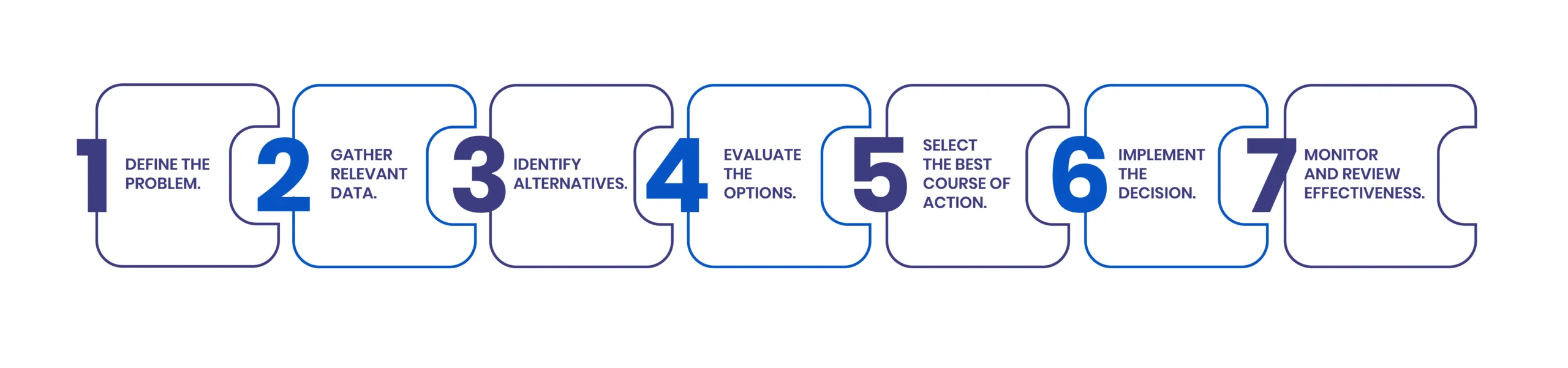
The rational model is particularly popular in PMP certification programs because it promotes the utilization of reason and analytical abilities. This reduces the uncertainties and probabilities of failure in the decision-making processes in this model.
2. Intuitive Decision-Making Model
The intuitive decision-making model, on the other hand, rests solely on the project manager’s hunches and prior knowledge. Generally, this model is applied where time is restricted or where there is inadequate information for analysis.
For instance, when working on a project that has been charged a little behind schedule. The project manager should look into the problem by integrating more HRs.
Intuitive decision-making benefits experienced project managers, though it’s less formal than the rational model.
3. Vroom-Yetton Decision-Making Model
The Vroom-Yetton model is more centered on the amount of participation others ought to have in decision-making. It gives direction on when a project manager should make decisions solely on their own.
Here are some factors you should consider:
- How critical is team buy-in for the decision?
- Does the decision require specific expertise, that only of certain team members?
- What’s the duration for the decision-making?
- What is the impact of the decision on the team and the project’s outcome?
For instance, a project manager who needs to set work hours for the team in the next sprint can apply the Vroom-Yetton model to determine whether to involve the employees or make the decision alone. This model helps project managers quickly address input needs.
4. Group Decision-Making
This is ideal when stakeholders’ views or many people are affected. When group decisions are made, the process can take a little longer.
In a project meeting, the team may discuss solutions for addressing a pressing issue during implementation. Lastly, the members of the group have to decide on what the best way of handling the situation is.
Techniques for Effective Decision Making
The following strategies and techniques by project managers to ensure effective decision-making are as follows:
1. SWOT Analysis
SWOT analysis is a useful tool that allows project managers to recognize internal and external factors that can impact their choices. It also determines how the project managers can balance the risks and rewards of implementing different strategies for solving problems.
For instance, a project manager building a new product.
2. Cost-Benefit Analysis
Project managers apply cost benefit analysis to evaluate the costs, and the benefits of decisions. It helps them to compare the advantages and disadvantages.
For example, a project manager uses CBA to compare software costs with the expected benefits of improved team efficiency.
3. Monte Carlo Simulation
They help the project managers assess the impact of a decision and its possible results based on probability distributions. This technique assists in estimating the cost of risks associated with various potential decisions and outcome possibilities.
For instance, in a construction project, a project manager can apply Monte Carlo simulations to estimate the probability of delays depending on various factors, including, perhaps, weather conditions or supply issues.
4. Brainstorming and Workshops
Group discussions or brainstorming in particular help the members to share their opinions. This is to get important input from each of the team members.
These sessions also improve stakeholder engagement within teams, which may improve decision-making processes and results.
A project manager can hold a brainstorming session to develop the best strategy for managing risks in a sensitive project.
The Role of Tools and Technology in Decision Making
Project management software like Microsoft Project, Asana, and Jira help managers track progress, assess data, and connect with team members. It also gives useful information and enables the project manager to make the right decisions in the quickest time possible.
AI and ML help project managers predict risks, allocate resources, and create optimal plans. The application of these technologies is capable of greatly improving the decision-making skills of a project manager.
It is crucial to determine when and how to apply all of these tools in day-to-day project management, which is critical for those undergoing PMP training.
Examples of decision making in project management from various industries
1. Construction
Problem: A project manager who is managing a construction project of a residential building saw a delay because of a lack of raw materials.
Decision made: Instead of waiting, they chose to contact a slightly expensive local suppliers and got the raw materials
Impact: The project will go as planned and on time and avoid big cost overruns later.
2. IT Sector
Problem: A project manager handling a software project, where the client keeps asking for more changes.
Decision made: The project manager chose to start with changing the control process. Instead of saying yes to everything.
Impact: This helps in avoiding scope creep.
3. Health sector
Problem: A hospital is starting a new patient management system. But in the middle, the team realizes the system is not user friendly with staff.
Decision made: The project manager decides to pause and retrain the team while customizing the interface.
Impact: Better adoption and fewer errors after launch.
Conclusion
Another essential element of effective project management is decision-making. Every decision made by the project manager controls the overall project outcome. Using SDM, techniques, and tools, a project manager makes informed decisions to meet project goals. The PMP Certification Online Training programs offered at our institution can help you take your skill in decision-making to the next level and aid in your professional progress.
FAQs:
1. What are the 5 C’s of decision making in project management?
A. The 5 C’s of decision making are:
- Clarity
- Context
- Choices
- Consequences
- Commitment
2. What are the 5 steps of decision-making?
A. The 5 steps are as follows:
- Figure out the issues
- Collect information
- Find options
- Choose the best one
- Implement action and review
3. What are the 7 stages of decision-making?
A. The 7 stages of decision making are:
- Figure out the issues
- Set goals
- Gather data
- Find the solutions
- Find options
- Make decision
- Check the results