
Key Takeaways on Extreme Programming in Agile
- Extreme programming (XP) is a popular software development framework.
- It shifts the focus from traditional methods to agile and short, iterative delivery.
- Extreme programming works on improving output quality with customer feedback.
- It applies key practices directly to the software development process through continuous testing.
- There are five key extreme programming values and principles.
- XP further provides detailed guidance on the project or software lifecycle.
- Extreme programming benefits modern organizations operating in dynamic project, software, and business environments.
Extreme programming is a software development approach, developed in the 90s for quick and high-quality software production. It is also represented as XP and emphasizes five key values of simplicity, communication, feedback, respect, and courage.
Extreme programming in agile is one of the most trusted and implemented frameworks by organizations today. Its goal is to encourage managers and teams to respond positively to change at any point of the project lifecycle or software development.
So let’s explore in detail what is extreme programming in agile, its advantages and values. We will also look at extreme programing practices in agile and how agile processes in software engineering and extreme programming interact.
What is Extreme Programming?
Extreme programming was introduced by Kent Beck as a software development practice that pairs programming with continuous feedback. It is also known as XP. Extreme programming aims for effective software production through quality testing, frequent releases, continuous feedback-improvement loop, and customer involvement.
Extreme programming places an emphasis on direct communication between customers and developers. Here, the refinements are presented through user stories, as the discussions and frequent feedback aid teams in determining the next action steps.
Now let’s understand what is extreme programming in agile methodology.
What is Extreme Programming in Agile Methodology
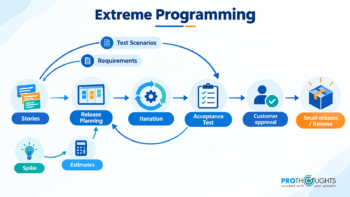
Although extreme programming is an agile approach, it is more specific than agile itself. XP applies practices to processes by defining practices that help teams consistently build, test, and improve output.
In essence, extreme programming in agile operates through building small software or products, testing them, getting feedback, adding improvements, re-releasing the product, and repeating this process.
XP further encourages teams to act on the most important functions first and continue refinement as they learn more. This makes extreme programming in agile project management methodology beneficial when the requirements are uncertain and likely to change throughout the development lifecycle.
Next, let’s take a quick glance at some of the benefits of extreme programming in agile.
Extreme Programming in Agile Benefits
Extreme programming can provide several benefits to users, regardless of whether they are a team of software developers or a project manager and the project team. The extreme programming in agile benefits are stated below:
-
Faster Feedback
Extreme programming creates multiple opportunities to identify problems early in the product or software lifecycle. The testing, code reviews, and customer feedback with frequent releases provide information throughout rather than only at the end.
-
Better Software/ Output Quality
Practices such as test-driven development, pair programming, and continuous integration lead to various quality checks during the development phase.
The team does not simply build the software or product and test it later. Hence, extreme programming considers quality throughout the development cycle.
-
Easier Response to Changing Requirements
The opportunity to incorporate new information at any phase of the development cycle is available for the team with extreme programming approach.
This benefit is especially useful when customers are still refining what they need. It allows the team to modify the project instead of redesigning or scrapping it.
-
Greater Customer Involvement
Under the extreme programming method, customers or the customer representatives get to participate in the production phase. This reduces misunderstandings around requirements and allows questions to be resolved through collaboration.
-
Improved Team Collaboration
Most processes under extreme programming involve working in close collaboration with other team members. This helps avoid isolated work environments and inadequate communication. XP also encourages clear shared responsibilities among all team participants.
-
Reduced Technical Debt
Regular checks and refactoring with simple designs help teams avoid unnecessary complexity in the software and processes. This enables smooth productivity, leading to improved output quality.
Hence, teams adopting the extreme programming agile methods can benefit in the above-mentioned ways. However, each product and software can have its own set of requirements, challenges, and advantages too.
Up next, let’s understand the extreme programming values.
Extreme Programming Values
The five core extreme programming values rely on internal factors. It aims to increase the value of the existing processes and team expertise. The five extreme programming values are explained below:
-
Simplicity
Extreme programming teams aim to build the simplest solution that meets the current requirements. It focuses on removing complexity rather than creating poor or incomplete software.
It also encourages teams to avoid spending time on unnecessary features and prioritize meaningful work. Simple design also makes software easier to understand, test, modify, and maintain.
-
Communication
Regular communication between developers, customers, testers, project stakeholders, and other team members is one of the core pillars of extreme programming (XP).
Extreme programming emphasizes active and direct collaboration among different teams over lengthy document sharing.
-
Feedback
Feedback allows the team to understand whether the software development is moving in the right direction. Feedback comes from automated tests, customers, other developers, and iteration here. Earlier feedback further aids teams in responding to changes and corrections in extreme programming.
-
Respect
Every person involved in the project contributes to the outcome. Extreme programming hence emphasizes respect between developers, customers, and other team members.
Respect further supports better collaboration and allows for a better work and project environment where the facts and information can be shared without conflicts.
-
Courage
Courage encourages the participants to address problems instead of hiding them. This is important because team members need to be honest about what is working and what isn’t during continuous improvement.
The extreme programming values ultimately support simple yet effective work. Next, we’ll explore the agile processes in software engineering and extreme programming.
Agile Processes in Software Engineering and Extreme Programming
The relationship between agile processes in software engineering and extreme programming becomes clearer when we look at how XP approaches development. A typical extreme programming cycle includes the following:
1. Planning
Customer requirements are represented through user stories. The team discusses priorities, estimates the work involved, and determines what must be included in the upcoming iteration or release. The project plan is formed as per the requirements.
Extreme programming also uses the concept of the planning game, where customers and developers collaborate on priorities and planning.
2. Designing
Extreme programming favors simple design and avoids unnecessary upfront complexity. The team designs what is required for the current functionality and improves the design through refactoring as the system evolves.
3. Coding
Development begins on the selected user stories. Practices such as pair programming, coding standards, collective code ownership, and continuous integration can be used to maintain quality and shared responsibility.
4. Testing
Testing is a continuous process under the extreme programming process. It places strong emphasis on automated unit testing and acceptance testing. Test-driven development can also be used for developers to create tests before writing the corresponding production code.
5. Listening
The development team continues to listen to customer feedback to learn how the software performs. This feedback then influences the next cycle and creates a continuous loop rather than a one directional development process.
Traditional software development may divide work into long phases. Extreme programming instead keeps these activities close and connected through short iterations. These activities are repeated throughout the project rather than completed only once.
Next, let’s look at some of the best extreme programming practices in agile!
Extreme Programming Practices in Agile
The extreme programming practices in agile are what make XP distinctive compared with broader agile approaches. Some of the extreme programming in agile practices include:
-
Test-Driven Development (TDD)
Developers write an automated test in TDD before writing the production code required to satisfy it. This creates immediate feedback and helps keep the implementation focused on the required behavior.
-
Pair Programming
Two developers work together on the same piece of code. One may write the code while the other reviews and thinks through the implementation, with the roles changing as needed.
Pair programming can also improve knowledge sharing across the team beyond quality assurance of the code enhancement.
-
Continuous Integration
Developers integrate code frequently rather than allowing large amounts of work to remain isolated for long periods. This makes it easier to identify conflicts and defects earlier.
-
Refactoring
Refactoring involves improving the internal structure of code without changing its intended behavior. It helps teams remove unnecessary complexity and poor structure before these problems become more difficult to address.
-
Small Releases
Extreme programming encourages teams to release usable functionality in small increments. The team can deliver smaller pieces to observe how they work and gather feedback for improvement. Instead of waiting for a large release containing many features.
-
Simple Design
The team avoids designing functionality that is not required. The goal is to keep the architecture and code as simple as possible while still meeting the current requirements.
-
Collective Code Ownership
The codebase belongs to the team rather than being divided into isolated areas that only specific developers can modify. This reduces knowledge gaps and allows the team to respond more quickly when priorities change.
-
Coding Standards
The team follows common coding conventions so that code remains easier to read, review, modify, and maintain.
-
On-site Customer
Extreme programming emphasizes having a customer or customer representative involved closely with the development team.
The customer can answer questions, clarify requirements, prioritize features, and participate in acceptance activities.
-
Planning Game
The planning game brings the customer and development team together to decide what should be built and when. It connects customer priorities with the team’s technical capacity.
-
System Metaphor
A shared metaphor or simple conceptual model can help developers understand the overall structure of the system and maintain consistency in naming and design.
-
Sustainable Pace
XP also emphasizes maintaining a sustainable working pace instead of relying on continuous overtime. The idea is that exhausted developers are unlikely to consistently produce high-quality software.
These practices are not a checklist. They work best when viewed as a connected system.
When Should You Use Extreme Programming?
Extreme Programming may be suitable when:
- Requirements are expected to change frequently.
- The development team is relatively small and collaborative.
- The customer or customer representative can work closely with the team.
- Software quality and frequent testing are important.
- Automated testing is practical.
- The team needs frequent releases.
- The project benefits from short feedback cycles.
Extreme programming can be more difficult to apply when customer involvement is limited. Teams are highly distributed without suitable collaboration practices. Requirements demand extensive upfront project documentation, or the project environment requires rigid processes and approvals.
Research on extreme programming has also highlighted its historical strength in small team-oriented environments and its challenges when applied directly to larger and more complex projects without tailoring the practices.
Extreme Programming vs Scrum
Extreme programming and scrum are both associated with agile but they solve different problems.
- Scrum provides a framework for organizing and managing complex product development through roles and events, and iterative work.
- Extreme programming focuses more on software engineering practices and how development work is performed.
This is why the two approaches must not be treated as competing choices. An organization can use Scrum to organize the team’s work. While incorporating extreme programming engineering practices such as pair programming, TDD, continuous integration, and refactoring.
Conclusion
Extreme programming in agile is built around the idea of developing software in small increments to get feedback. Maintain quality continuously and adapt throughout the lifecycle as you learn.
Extreme programming is still relevant due to its strong focus on the technical side of agile development. As it provides concrete practices for writing, testing, integrating, and improving software and other project practices.
So enroll in the PMP certification training and PMI-ACP certification training to improve your agile career prospects!
FAQs on Extreme Programming in Agile
Here are some of the frequently asked questions on extreme programming in agile answered:
1. What is agile extreme programming?
Agile extreme programming (XP) is a software development methodology that aims to improve the quality of software. It is built upon agile values and agile principles. Extreme programming in agile encourages responsiveness to change in customer demands and promotes flexibility in processes.
2. What is the extreme programming method?
The extreme programming method is an agile software development approach. It involves practices such as:
- Test-driven development
- Pair programming
- Continuous integration
- Refactoring
- Small releases
- Simple design
- Continuous customer feedback
3. Is extreme programming the same as agile?
No. Agile is a broader approach to software development. While extreme programming is one specific agile framework. It provides more detailed guidance around software engineering practices.
4. Is extreme programming still relevant?
Yes. Extreme programming is very relevant in modern-day dynamic project and business environments. It can be combined with other agile practices depending on other variables. Project managers and team leads apply extreme programming practices for smooth adaptation to changes.
5. What are the extreme programming values?
There are five core extreme programming values. They are:
- Simplicity
- Communication
- Feedback
- Respect
- Courage
The extreme programming principles provide detailed guidance around the above-mentioned values.