The PMBOK Guide 8th Edition, releasing in April 2026, gets the best of the earlier PMBOKs but progresses on the principle-based structure of the latest PMBOK (7th Edition).
The majority of changes can be grouped into four main categories:
- Key Term and Concept updates,
- Principles refinement,
- Reintroduction of Process Groups as “Focus Areas”, and
- Project Management Performance Domain updates.
A Snapshot of the Change from 7th to 8th Edition
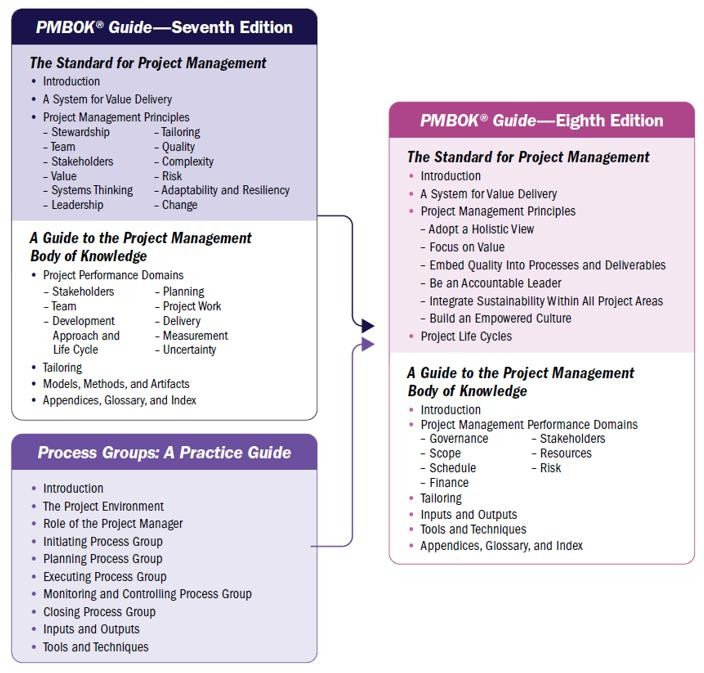
The following diagrams show a snapshot of the changes made from the 7th Edition to the 8th Edition.
Project Management Principles
The diagram below illustrates the new principles of the 8th Edition and how they have transitioned or combined from the 7th Edition.
| Seventh Edition Principles | Eighth Edition Location | Rationale | |
| 1 | Navigate Complexity |
Merged Principle: Adopt a Holistic View
|
The interactions of a project’s organisations, stakeholders, and geographies represent a complex system. Success requires practitioners to “zoom out” to see the related constraints and changes.
|
| 2 | Recognise, Evaluate, and Respond to System Interactions | ||
| 3 | Effectively Engage with Stakeholders |
Merged Principle:
Focus on Value + Stakeholders Project Management Performance Domain |
Value is the fundamental driver of projects. Value exists only when stakeholders are understood and then guided through the changes the project experiences and fosters. Deeper discussion of stakeholder engagement is emphasised as a project management performance domain.
|
| 4 | Focus on Value | ||
| 5 | Embrace Adaptability and Resiliency | ||
| 6 | Enable Change to Achieve the Envisioned Future State | ||
| 7 | Build Quality Into Processes and Deliverables | Refined Principle: Embed Quality Into Processes and Deliverables | Quality is a dimension that spans both outputs described in performance domains and outcomes. |
| 8 | Create a Collaborative Project Team | Refined Principle: Build An Empowered Culture |
Building an empowered culture involves the project team environment and effective collaboration with all stakeholders. |
| 9 | Demonstrate Leadership Behaviours |
Merged Into Principle:
Be an Accountable Leader |
Clarify which leadership behaviours drive project success. Intentional stewardship is one such behaviour and relates to professional accountability.
|
| 10 | Be a Diligent, Respectful, and Caring Steward | ||
| 11 | Tailor Based on Context | Migrated to the Tailoring Section | While tailoring is a key concept for project success, practitioners prefer it to be discussed through concrete management mechanics and examples. |
| 12 | Optimize Risk Responses | Migrated to Risk Project Management Performance Domain |
While managing potential threats and opportunities is core to project success, practitioners prefer it to be discussed through concrete mechanics, in relation to other principles and performance domains. |
Summary Comparison Between the 7th Edition and the 8th Edition
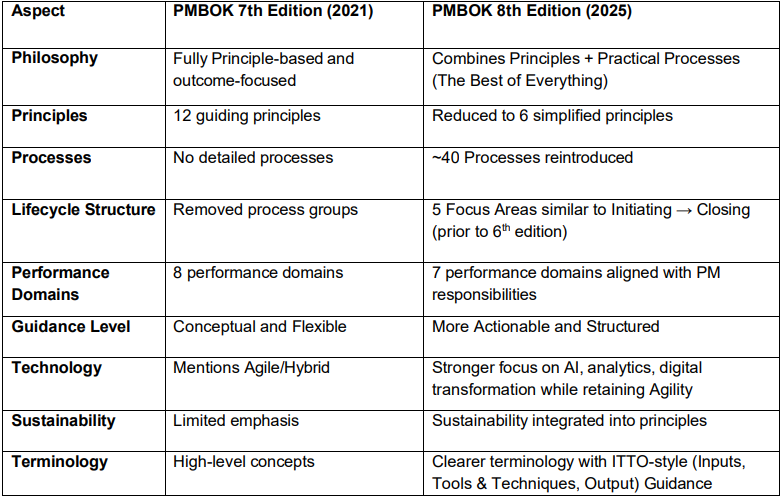
The table below summarises exactly the difference between the 7th edition and the 8th edition of the PMBOK.
Performance Domains Updated
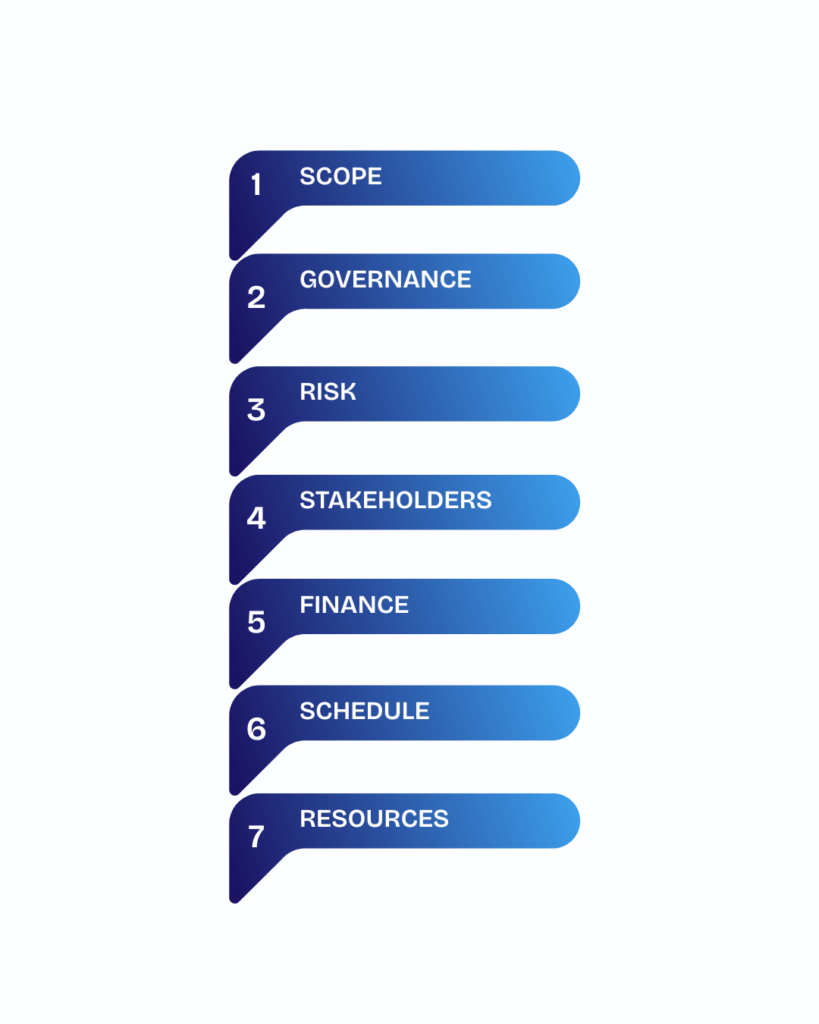
1. PMBOK 7: 8 performance domains (Team, Stakeholders, Development Approach, etc.)
2. PMBOK 8: 7 domains aligned with practical responsibilities like
- Governance
- Scope
- Schedule
- Finance
- Risk
- Resources
- Stakeholders
This makes mapping to real project tasks easier
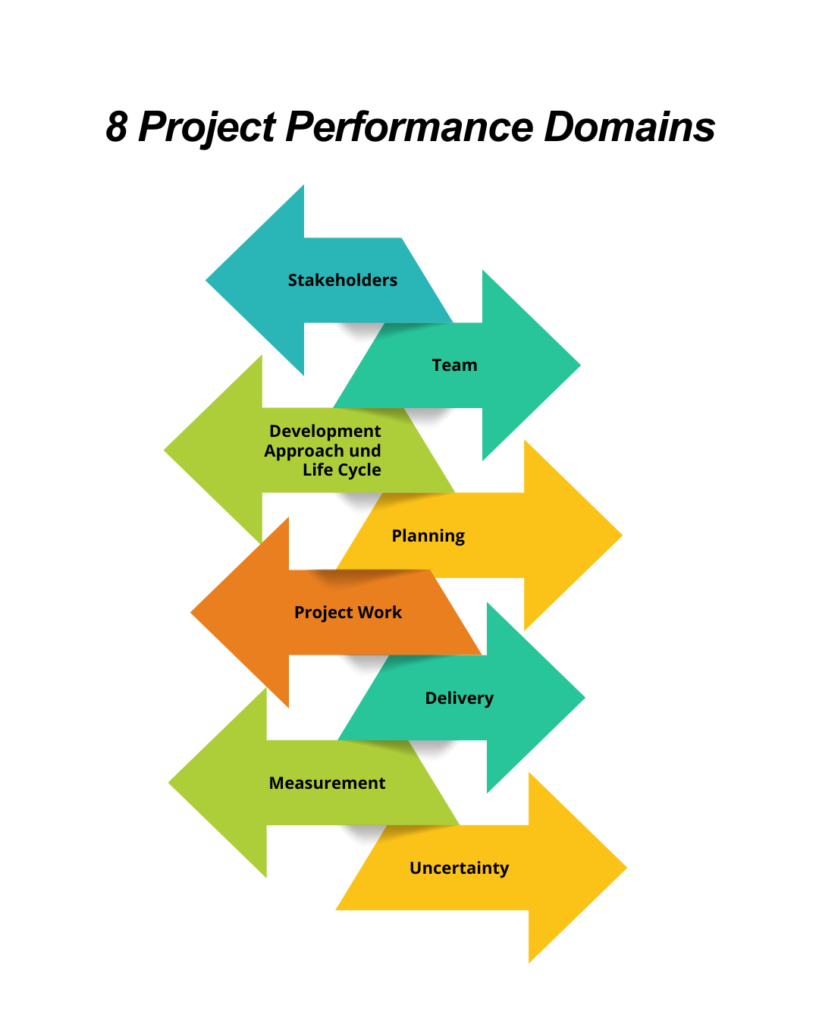
The diagram below suggests the 8 Performance Domains, which were created in the 7th edition
1. PMBOK 7 removed the Classic Process Groups.
2. PMBOK 8 introduces 5 “Focus Areas” that resemble the earlier lifecycle:
- Initiating
- Planning
- Executing
- Monitoring & Controlling
- Closing
These are flexible categories rather than strict phases.
Reintroducing Process Groups as Focus Areas
This edition presents five Project Management Focus Areas: Initiating, Planning, Executing, Monitoring and Controlling, and Closing. Historically, these five Focus Areas were presented as logical categories of a formal project
management processes, known as the Project Management Process Groups.
Reintroducing Processes
1. PMBOK 7 removed processes completely, focusing on mindset and outcomes.
2. PMBOK 8 brings back around 40 processes with guidance on:
- Inputs
- Tools & techniques
- Outputs
This helps practitioners understand how actually to execute project work. The focus is based on familiarity, action, and application.
Updated Performance Domains
Performance Domains Updated
1. PMBOK 7: 8 performance domains (Team, Stakeholders, Development Approach, etc.)
2. PMBOK 8: 7 domains aligned with practical responsibilities, like:
- Governance
- Scope
- Schedule
- Finance
- Risk
- Resources
- Stakeholders
This makes mapping to real project tasks easier
- Project Management Knowledge Areas are fields or areas of specialization that are
commonly employed when managing projects. They are historically defined in prior editions
as a set of processes associated with a particular topic. This edition synthesizes those
Knowledge Areas with other accepted concepts into the seven project management
performance domains. - Project management Processes are a formalized series of logically connected activities
that manage a project throughout its life cycle. This edition includes a selection of 40
nonprescriptive processes that can be adapted to varied approaches, life cycles, and
environments
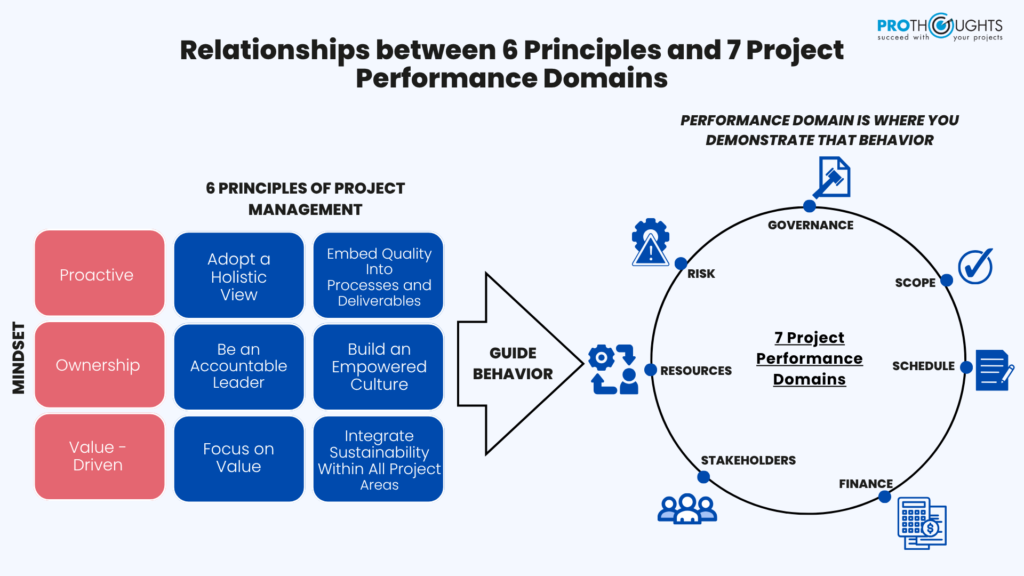
The 7 Performance Domains in 8 th Edition:
The 7 Performance domains in the new 8th Edition are as follows:
A project management performance domain is a group of related processes that are critical for the effective delivery of project value. These performance domains are interactive, interrelated, and interdependent areas of focus that work in unison to achieve the desired project results. There are 7 project management performance domains presented in this guide, without specific weighting or order:
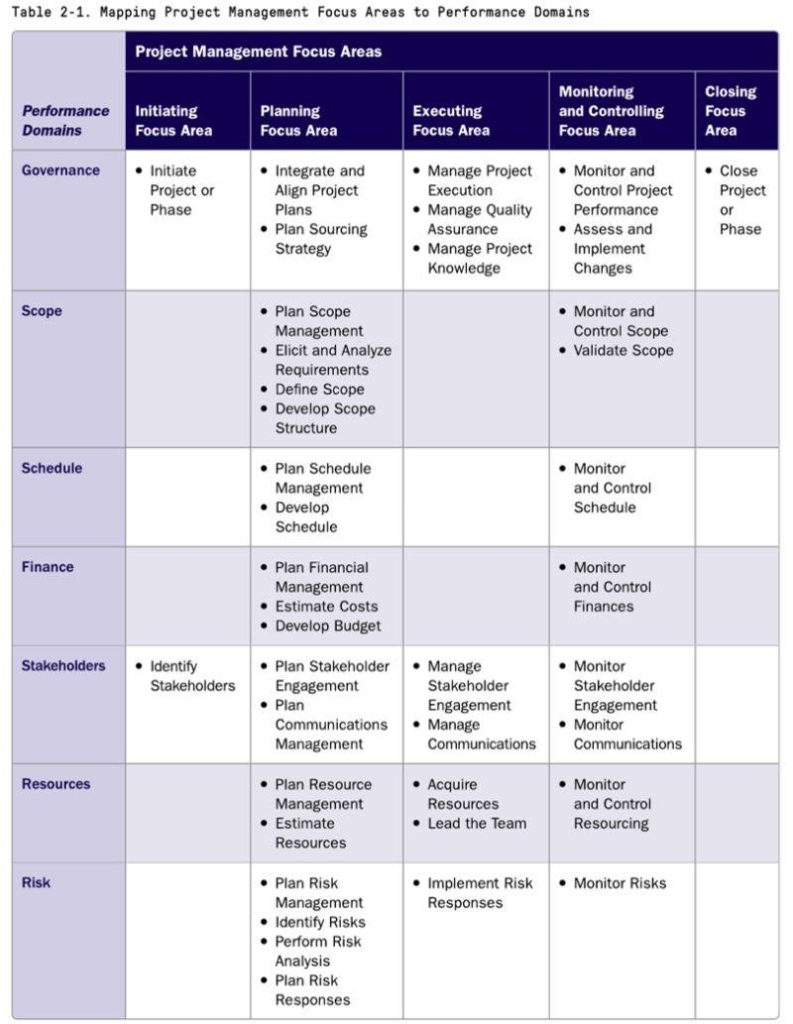
Mapping Project Management Focus Areas to Performance Domains
The table gives a great snapshot of how the new Focus Areas are mapped to the Performance Domains. This table is going to be on every project manager’s desktop in the near future
Modern Project Trends Added
PMBOK 8 reflects modern project environments and is in line with the current trends. PMI has incorporated these modern trends and is providing a comprehensive project management learning for project practitioners.
The following trends are included in the PMBOK 8th edition:
- AI and predictive analytics
- Digital Transformation
- Sustainability Considerations
- Data-driven Decision Making
These updates align project management with current technology trends
Topics shifted/added to Annexure:
The following topics have been shifted/added to the Annexure of PMBOK 8 th edition.
- Appendix X2 — Project Management Offices (PMO- shifted to Annexure)
- Appendix X3 — Artificial Intelligence (added new)
- Appendix X4 — Procurement (shifted to Annexure)
Simple Way to Understand the Shift
If we wish to summarise what the PMBOK has compared to earlier editions, here is what we feel:
- PMBOK 6: Process-heavy
- PMBOK 7: Principle-heavy
- PMBOK 8: The Best of Everything. What was eternally applied and worked, makes a return to PMBOK. It suggests an approach of what worked and can be applied to create excellence in Project Management.
Conclusion
PMBOK retains everything that worked while having a forward-looking approach to a principle-based product.
The feedback from various project managers has helped PMI to incorporate the best things that have worked
in the field of project management, with the reintroduction of Process Groups as “Focus Areas” and the 40
processes with the ITTO methodology. The PMBOK also incorporates the latest trends, such as AI, Digital
Transformation and Sustainability, to make the PMP certification a valid and proven gold standard for the
project management community.
The PMBOK 8th edition is a great knowledge base for aspirants and practitioners who are looking to build
excellence in Project Management.
ProThoughts welcomes these changes in the new edition, which reflect the modern outlook while retaining
the old traditional roots. ProThoughts has incorporated the new changes in their new material and endeavours
to provide a better experience, as always, with the PMBOK 8th edition.
Please call us at +91 9137309091 or email us at info@prothoughts.co.in for any queries, and we will be happy to assist you.