
Principles of management: Key takeaways
- The principles of management were introduced by Henri Fayol
- All 14 principles are crucial when managing organizations
- Frederick Taylor introduced the principles of scientific management
- Scientific management improves workplace efficiency through standardized processes
- Fayol focused on overall organizational management
- While Taylor emphasized productivity and operational efficiency
- These principles are widely applied across different industries
- Although management principles provide a strong foundation, managers should adapt them to changing business environments
- Learning both Fayol’s and Taylor’s theories helps managers build effective teams
Management is something that everyone is aware of in the corporate world. There are different levels of management. But in order to understand how management actually works. We will understand the principles of management.
A French engineer and management theorist, Henri Fayol introduced these principles of management. He observed that successful organizations shared one common trait. They all followed a structured approach to managing.
These principles are universal and applicable to all various types of organizations. In this guide, we will learn each of Henri Fayol’s 14 principles with practical examples.
The 14 principles of management by Henri Fayol
Henri Fayol introduced 14 principles of management in 1916 to help organizations improve efficiency, coordination, and productivity.
Even though these principles were created over a century ago. They remain relevant in today’s workplaces. Below are the 14 principles of management with examples.
1. Division of work
Division of work means assigning tasks based on employees’ skills and expertise. When an employee is exceptionally good with certain skills. That employee should be allocated tasks that match the skills. This helps people to perform jobs more efficiently.
Example – in a software company, developers write code, testers identify bugs, and designers create user interfaces instead of one person handling every task.
2. Authority and responsibility
Authority and responsibility are things that are in the hands of the upper management. While making any decisions with authority, management also needs to understand that they stand accountable for the outcomes as well. Authority and responsibility go hand in hand.
Example – a PMP project manager assigns tasks, approves budgets, and is responsible for delivering the project on time.
3. Discipline
Discipline refers to employees following the rules set by the organization. It can be anything, the policies, ethical standards, and company culture. There must be mutual respect between employees and management to support a disciplined workplace.
Example – employees follow attendance policies, meet deadlines, and comply with workplace safety regulations.
4. Unity of command
Unity of command refers to individuals having to report/receive instructions from one manager or team lead only. Rather than having multiple heads or seniors to be reporting to. When there’s a proper unity of command, it becomes easier to avoid confusion and conflicting priorities.
Example – a marketing executive reports only to the marketing manager instead of receiving separate instructions from multiple department heads.
5. Unity of direction
Activities with the same objective should follow one plan under one manager. This keeps everyone aligned toward a common goal.
Example – a product launch campaign is managed by one marketing leader who coordinates advertising, social media, and public relations activities.
6. Subordination of individual interests to organizational interests
The interests of the organization should take priority over individual preferences or personal gains.
Example – an employee supports a team project deadline even if it requires adjusting personal work preferences.
7. Remuneration
All the employees should receive fair and reasonable compensation for the work being delivered. When workers are rewarded appropriately, the quality of work automatically improves. With that, the employee motivation and job satisfaction also rise.
Example – a company offers competitive salaries, annual bonuses, and performance incentives to recognize employee contributions.
8. Centralization
Centralization refers to the extent to which decision-making authority is concentrated with senior management. Organizations should choose the right balance between centralized and decentralized decisions.
Example – a multinational company allows branch managers to handle local operations while major financial decisions remain with the headquarters.
9. Scalar chain
A scalar chain is the formal line of authority. This defines the communication from top management to the lower levels. A clear reporting pattern and structure improves coordination.
Example – an employee reports to a team leader, who reports to the department manager, who reports to the director.
10. Order
Order refers to placing the right people and resources in the right positions. Having an organized workplace improves the level of efficiency. The higher the level of efficiency, the lesser the delays.
Example – a warehouse stores inventory in designated locations, making products easy to locate and dispatch.
11. Equity
Equity, with the name itself, we can understand what it means. It means that managers should treat employees fairly, respectfully, and without discrimination. Fair treatment builds a sense of trust and loyalty in the employees.
Example – a company evaluates promotions based on genuine performance. Rather than personal relationships or favoritism.
12. Stability of tenure of personnel
Organizations should be good at retaining skilled employees whenever there’s a chance. Lower employee turnover improves productivity and preserves organizational knowledge.
Example – a company offers career development programs and internal promotions. This genuinely encourages employees to stay long-term.
13. Initiative
Employees should be encouraged to share their unique take and ideas. They should be allowed to take responsibilities for improvements. This promotes a culture of innovation and engagement.
Example – a customer service representative suggests a new ticket management process that reduces response times.
14. Esprit de corps
Esprit de corps is a French phrase that translates to “spirit of the body.” It means promoting team spirit, trust, and unity among everyone. Strong teamwork contributes to higher morale and better organization performance.
Example – a company organizes cross-functional projects and other team building activities. This helps in strengthening collaboration across various departments.
Principles of scientific management by Frederick Taylor
The principles of scientific management were introduced by Frederick Winslow Taylor. Also known as the father of scientific management.
In his 1911 book – The Principles of Scientific Management.
Taylor proposed a quite systematic approach to improving workplace productivity. By using scientific methods instead of traditional work practices.
The four principles of scientific management
Frederick Taylor developed four key principles to improve organizational efficiency and employee productivity.
1. Science, not a rule of thumb
Managers should replace traditional methods based on experience or guesswork with scientifically tested processes. Every task should be studied to identify the most efficient way of performing it.
Example – a manufacturing company measures the time required for each production step. And develops a standard operating procedure to reduce delays and improve output.
2. Scientific selection and training
Organizations should carefully select employees based on their skills. Accordingly, provide proper training to help them perform efficiently.
Example – a customer support company recruits candidates with strong communication skills. Provides structured training before assigning them to live customer interactions.
3. Cooperation between management and workers
Both managers and employees should work together. This ensues that the scientific methods are followed. Mutual cooperation improves productivity and reduces workplace conflicts.
Example – production managers regularly meet with factory workers. Discuss the process improvements and resolve operational challenges.
4. Equal division of work
The management should focus on the overall planning and supervision of the work. Employees should concentrate on executing assigned tasks.
When everyone has a clear division of responsibilities, it improves efficiency.
Example – in a construction project, project managers prepare schedules and allocate resources. Engineers and technicians carry out the work according to the plan.
Difference between Fayol’s principles and Taylor’s scientific management
Understanding these differences helps managers choose the right approach for different business situations.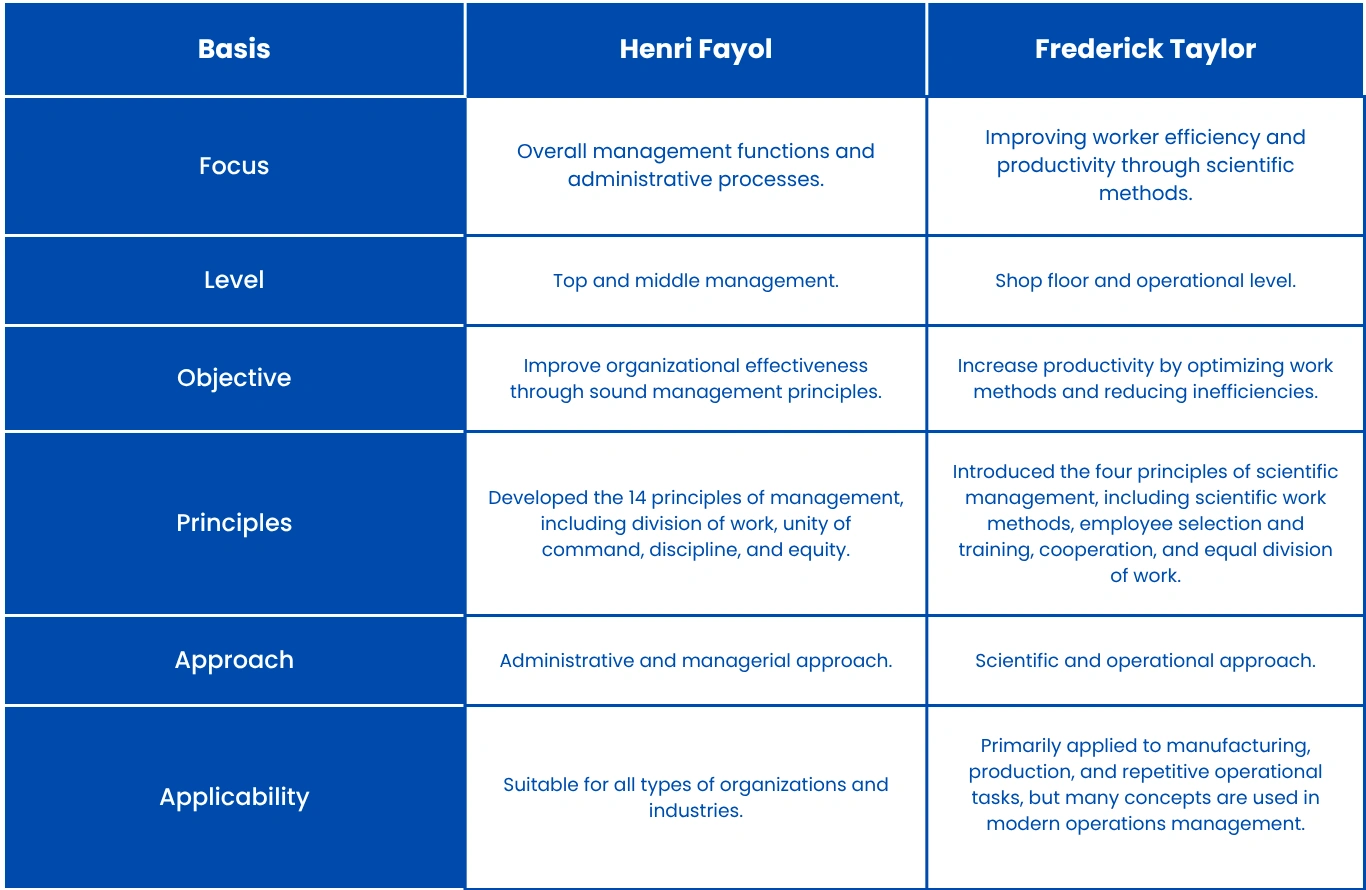
Henri Fayol emphasized how organizations should be managed. While Frederick Taylor focused on how work should be performed efficiently. Together, their theories laid the foundation for modern management practices.
Importance of principles of management
Regardless of the industry, the principles of management come into use for managers who handle day-to-day operations and long-term planning.
- Better decision-making: The management principles provide a quite structured approach to solve problems. Managers can evaluate situations objectively and align with the organization’s goals.
- Efficient resource utilization: Organizations do not have unlimited resources. Like time, money, equipment, and manpower. Management principles help allocate these resources properly.
- Improved teamwork: When the principles of management are used correctly. It helps the manager as well as the team to have clearer roles and responsibilities. Which creates better communication and collaboration.
- Better employee motivation: As the principles encourage fair treatment, appropriate rewards, and opportunities. It directly increases employee satisfaction. Motivated employees are more engaged and committed to achieving organizational goals.
Advantages of principles of management
Management principles offer a wide array of benefits that help organizations. Here we will discuss the top 5 advantages of principles of management.
- Universal applicability: Management principles are relevant across industries. They can be adapted to businesses of any size.
- Improved coordination: Clearly defined responsibilities and communication channels help departments work together effectively.
- Better planning: Management principles support systematic planning by helping managers set objectives.
- Consistency in decisions: A very common set of management principles encourages managers to make fair and consistent decisions. This helps in building employee trust and supports organizational stability.
- Higher efficiency: With reduced duplication work and improved communication. Management principles help organizations achieve better results with available resources.
Limitations of principles of management
Although management principles provide valuable guidance. They are not always the universal solutions for every situation. Managers must consider the specific circumstance of the organization before applying the principles.
- Not rigid rules: Principles of management are just guidelines rather than a hard and fast rule. Organizations should adapt them based on culture and operational needs.
- Depends on the business environment: The environment of the business influences how management principles are applied. A strategy that works well in one organization. Does not necessarily mean that the same strategy will be effective in another.
- Human behavior varies: Each employee has different personalities, motivations, and a way of working. Managers cannot solely rely on the principles of management to address each human resource challenge.
Applications of principles of management in modern organizations
The principles of management are not just limited to large corporations or traditional businesses. Although the workplaces have changed significantly. The core principles developed by Henri Fayol still remain relevant.
IT companies
Technology companies use management principles to coordinate software development, product launches, and cross-functional teams.
For example – the principle of unity of direction ensures developers, designers, and testers work toward the same product goals.
The principle – division of work helps team members to focus on specialized tasks. This improves quality and productivity.
Manufacturing
Manufacturing organizations rely on management principles to –
- Maintain quality
- Reduce waste
- Optimize production.
Order ensures materials, equipment, and workers are organized efficiently. Discipline helps maintain safety standards and consistent production processes.
Healthcare
Hospitals and healthcare organizations use management principles to deliver safe and efficient patient care.
Unity of command ensures every healthcare professional reports to the appropriate supervisor. And it also reduces confusion during critical situations.
Startups
Startups operate in an agile manner; everything is fast-changing and requires quick decisions. Centralization and decentralization help founders balance decision making. Strong teamwork is supported by esprit de corps.
Remote and hybrid workplaces
Remote and hybrid teams depend on clear communication and well-defined responsibilities.
Scalar chain establishes structured communication channels. While unity of direction keeps distributed teams aligned with business objectives.
Best books if you want to learn the principles of management
When you are on your path to build a strong foundation in management. Choosing the right principles of management book is vital.
The books mentioned below are widely recommended for students, aspiring managers, and business leaders.
| Book name | Author | Best for |
| General and Industrial Management | Henri Fayol | Understanding the original 14 principles of management and classical management theory. |
| The Principles of Scientific Management | Frederick W. Taylor | Learning the fundamentals of scientific management, workplace efficiency, and productivity improvement. |
| Principles of Management | Harold Koontz and Heinz Weihrich | Business students and management professionals looking for comprehensive coverage of planning, organizing, leading, and controlling. |
| Management | Stephen P. Robbins and Mary Coulter | Beginners who want practical examples, case studies, and modern management practices. |
| Management: Tasks, Responsibilities, Practices | Peter F. Drucker | Managers seeking insights into leadership, innovation, decision-making, and organizational effectiveness. |
| The Practice of Management | Peter F. Drucker | Professionals interested in management principles from a strategic and leadership perspective. |
These books cover both foundational and contemporary management concepts.
Frequently asked questions
Here are some commonly asked questions regarding the principles of management.
1. What are the principles of management?
The principles of management are the most basic rules created to run a business in a structured way. These principles are best known as the 14 rules of Henri Fayol. There are topics like division of work, authority and responsibility, and unity of command.
2. What is the definition of principles of management?
The principles of management act as a roadmap for managers to carry out projects. Lead their teams effectively so the company can reach its goals.
3. What are the 14 principles of management by Henri Fayol?
These are the 14 principles of management, foundational rules that help organizations operate efficiently –
- Division of work
- Authority and responsibility
- Discipline
- Unity of command
- Unity of direction
- Subordination of individual interest
- Remuneration
- Centralization
- Scalar Chain
- Order
- Equity
- Stability of tenure of personnel
- Initiative
- Esprit de corps
4. What is the difference between Fayol and Taylor?
Fayol and Taylor were pioneers of classical management theory. Henri Fayol is known as the father of general management. While F.W. Taylor is known as the father of scientific management. General management focuses on broader organizational structure and administration. Scientific management focuses on worker efficiency and task optimization.
5. Why are management principles important?
The principles of management are crucial because they give practical insights to managers. It ensures optimum utilization of resources, and promote scientific decision-making.
6. Are Fayol’s principles still relevant today?
Yes, all 14 principles of management by Henri Fayol still remain highly relevant. Although they need a bit of modernization. As modern workplaces favor decentralized agility. While traditional workplaces had rigid hierarchies. Here are the core concepts like
- Division of work
- Unity of command
- Esprit de corps
Remain essential for operational efficiency and teamwork.
7. Which book is best for learning principles of management?
The “best book” honestly depends on whether you want a textbook or a practical guide. For university-level theory, “Management” by Stephen P. Robbins and Mary A. Coulter.
For a practical guide, we recommended Peter Drucker’s foundational classic, “Management: Tasks, Responsibilities, Practices.”