Project manager duties – Key takeaways
- Project managers’ duties include planning, organizing, and coordinating project work.
- The duties change depending on the project nature and goal.
- A project manager should have multiple skill sets with respect to the designation.
- Project managers spend a significant amount of time communicating and solving.
- A PMO’s duties revolve around supporting standardization, governance, reporting, and project oversight.
- Assistance project managers work under project managers, supporting planning, coordination, etc.
What does a project manager do?
A project manager is responsible for helping the project move from an ideation to an outcome. Although it sounds quite simple, it is most definitely not. There’s a lot happening between those two major points.
A project manager needs to fully understand what the project is supposed to deliver. Then understand each team member’s strength. Accordingly, break the work into manageable activities.
Then build a solid schedule, coordinate with people, monitor costs, etc. All this while having to deal with any changes that come along the way.
A project manager cannot expect the project to go exactly according to the plan.
Anything can happen, and the project manager should be capable enough to make it workout. A task gets delayed, requirements change, stakeholders change their goal, and maybe an important team member becomes unavailable. A project manager has to go through all of these situations and make the project successful.
The role is not simply about creating a project plan and checking whether everyone is following it.
In this article we will explore all the project management duties and responsibilities.
Project manager duties and responsibilities
Project manager duties can vary from one organization to another. But several responsibilities are common across industries. Here are some common project manager duties:
1. Defining the project
Before the team starts working, the project manager needs to understand what the project is actually trying to achieve.
This includes clarifying:
- Project objectives
- Expected deliverables
- Scope
- Major requirements
- Key stakeholders
- Constraints
- Success criteria
A clear understanding at the beginning makes it easier to make decisions later.
2. Creating the project plan
Once the project direction is clear, the project manager works with the team to develop a practical project management plan.
The plan may cover:
- Activities and tasks
- Milestones
- Schedule
- Resources
- Budget
- Dependencies
- Risks
- Communication
- Quality expectations
The goal is not to create a document that sits in a folder. (Still, project documentation is a must!)
The plan should help the project team understand what needs to happen, when it needs to happen, and who is involved.
3. Managing the project schedule
Schedule management is one of the most visible project manager duties. The project manager tracks planned dates, dependencies, milestones, etc. This is done to understand whether the project is moving as per the expectation.
For instance – if development cannot begin until requirements are approved, that dependency needs to be visible.
A delay in requirements approval directly impacts the development. Which further leads to a delay in testing and the final delivery date.
4. Managing the project team
A project manager coordinates people who may have different skills, responsibilities, priorities, and working styles.
This can involve:
- Assigning responsibilities
- Coordinating activities
- Clarifying expectations
- Removing obstacles
- Supporting collaboration
- Tracking progress
- Addressing conflicts
- Keeping the team focused on project objectives
Project managers do not necessarily do the technical work themselves. Their job is often to create the conditions in which the people doing that work can succeed.
5. Managing project scope
Scope tells the team what is included in the project and, just as importantly, what is not.
Without proper project scope management, projects can slowly collect additional requirements.
A stakeholder may request a new feature. Another team may ask for an additional project report. A customer may want an extra change.
Although, they seem like a tiny change. Together, these significantly affect the overall schedule, cost, and resources.
Therefore, it is important for the project manager to evaluate everything beforehand. The PM should make sure everyone follows the organization’s change management process before making any changes.
6. Managing the budget
Project managers may also be responsible for monitoring project costs.
Depending on the organization, this can include tracking:
- Planned costs
- Actual costs
- Resource costs
- Procurement costs
- Budget changes
- Forecasts
The purpose is not simply to make sure money is being spent.
It is to understand whether the project is financially aligned with the approved plan and whether changes could affect the budget.
7. Managing project risks
Projects are bound to have uncertainty; even the most well-planned project can go south. The only difference is that some risks are pretty obvious from the beginning. Others appear during the project.
A project manager’s duty is to work with the team to identify potential risks. And assess them, plan responses, and monitor them throughout the project.
A project manager works with the team to identify potential risks, assess them, plan responses, and monitor them throughout the project.
For instance, when you are in a risk situation like – A critical supplier may deliver equipment late.
Your possible response should be –
- Either identify an alternative supplier
- Or build additional time into the procurement schedule.
Project risk management is not about predicting everything that can go wrong. Instead, it is about preparing for uncertainty before it becomes a huge problem.
8. Managing stakeholders
Projects usually involve more people than the project team.
There may be customers, sponsors, senior management, vendors, business teams, users, and other stakeholders.
Each group may care about something different.
A project manager helps keep these stakeholders informed and aligned through appropriate communication.
This can include:
- Status meetings
- Progress reports
- Presentations
- One-to-one discussions
- Decision logs
- Project dashboards
- Escalations
Good stakeholder management can prevent small misunderstandings from becoming major project issues.
9. Communicating project information
Communication takes up most of the project manager’s time. Everyone in the team needs to know
- What needs to be done.
- What has changed.
- What is blocking their work?
But the senior management wants a different view. They want to know if the project is on track. If there are any major concerns in the project. Whether they need to take any decisions.
So, the information is different for each stakeholder. But the objective is the same. Everyone should have enough information to make the right decisions and support the project.
10. Monitoring and controlling project performance
A project manager needs to compare actual progress with the project plan.
This can include monitoring:
- Schedule performance
- Cost performance
- Scope
- Deliverables
- Risks
- Issues
- Quality
- Resources
When something moves away from the plan, the project manager works with the relevant people to understand why and determine what action is needed.
11. Managing issues
Project issues are inevitable; they are a part of every project. No matter how well you plan the project out. Something will eventually go wrong.
In order to understand the difference between a risk and an issue. Make this distinction point.
- A risk is something that may happen – notice the future tense here? It hasn’t occurred it. It may or it may not.
- An issue is something that has already happened and needs fixing now.
For instance –
- The supplier has missed the delivery date.
- A supplier may miss the delivery date.
What do you reckon? Which option is indicating risk, and which one’s indicating issue?
Option A is an issue, and option B is a risk.
The way you deal with both of these factors is different. With a risk, you are preparing yourself and your team for something that could happen.
With an issue, you already have the problem in front of you that needs attention.
Suppose the supplier has missed the delivery date. The project manager now needs to understand what this means for the project. Does it affect another activity? Does it affect the schedule? Do you need another supplier? Does the customer need to be informed?
This is where issue management becomes important.
The project manager works with the relevant people to understand the impact. Then identify possible solutions, assign actions, and follow up until the issue is resolved or properly managed.
12. Managing changes
No project goes exactly according to the original plan.
Requirements change. Priorities change. Customers ask for something different. Sometimes the business itself changes while the project is still underway.
As a project manager, you cannot simply accept every change and add it to the project. You need to understand what that change does to the project.
For instance – imagine a customer asks for one additional feature. It sounds simple enough. But that feature needs development, testing, additional resources, and perhaps a change in the delivery date.
Project manager job duties
The phrase “project manager job duties” is used in job descriptions, but the actual duties can be much broader than a list of tasks.
A typical project manager may be expected to:
- Develop project plans
- Define project activities
- Create and maintain schedules
- Coordinate project resources
- Assign responsibilities
- Monitor project progress
- Track budgets and costs
- Manage risks and issues
- Coordinate stakeholders
- Conduct project meetings
- Prepare status reports
- Manage changes
- Support quality management
- Coordinate vendors and external partners
- Maintain project documentation
- Escalate important issues
- Track project deliverables
- Support project closure
The exact combination depends heavily on the organization and the type of project.
A project manager working on a construction project may spend significant time coordinating contractors and procurement.
A software project manager may spend more time coordinating development, testing, product, and business teams.
The title is the same. The day-to-day work can be very different.
Assistant project manager job duties
An assistant project manager generally supports the project manager with the planning, coordination, tracking, and administrative work required to keep the project moving.
Typical assistant project manager job duties may include:
- Updating project schedules
- Tracking task completion
- Preparing meeting agendas
- Recording meeting minutes
- Following up on action items
- Maintaining project documentation
- Preparing status reports
- Coordinating with team members
- Tracking risks and issues
- Supporting stakeholder communication
- Monitoring project deliverables
- Helping with resource coordination
- Supporting project meetings
- Updating project management tools
An assistant project manager may also take responsibility for specific parts of a project.
As experience grows, these responsibilities can expand toward independently managing smaller projects or project workstreams.
Project management office duties
Not every organization has a Project Management Office, commonly called a PMO.
Where a PMO exists, its responsibilities can extend beyond the work of an individual project manager.
The project management office duties may include:
- Establishing project management standards
- Developing templates and processes
- Supporting project governance
- Maintaining project reporting standards
- Monitoring project portfolios
- Supporting resource management
- Maintaining project documentation
- Providing project management guidance
- Tracking project performance
- Supporting audits and compliance
- Managing project management tools
- Sharing best practices across projects
The distinction is important. A project manager is generally focused on managing a project.
A PMO focuses on supporting, governing, standardizing, or overseeing projects across an organization.
If you are looking to build a formal PMO expertise. Explore our PMOCP certification training.
It covers PMO strategy, design, operations, performance, etc.
Project manager vs assistant project manager
The two roles can overlap, especially in smaller organizations, but their level of responsibility is usually different.
| Project manager | Assistant project manager |
| Leads the project | Supports project leadership |
| Owns overall project coordination | Supports day-to-day coordination |
| Manages major risks and issues | Tracks and escalates risks and issues |
| Communicates with key stakeholders | Supports stakeholder communication |
| Oversees scope, schedule, and budget | Helps track scope, schedule, and budget |
| Makes or facilitates major project decisions | Provides information needed for decisions |
| Accountable for overall project delivery | Supports successful project delivery |
The exact division depends on the organization’s structure.
What does a project manager do every day?
There is no single routine that applies to every project manager. One day may involve a team meeting and schedule review.
Here’s a small overview of what a project manager has to do throughout the day.
A typical day might include:
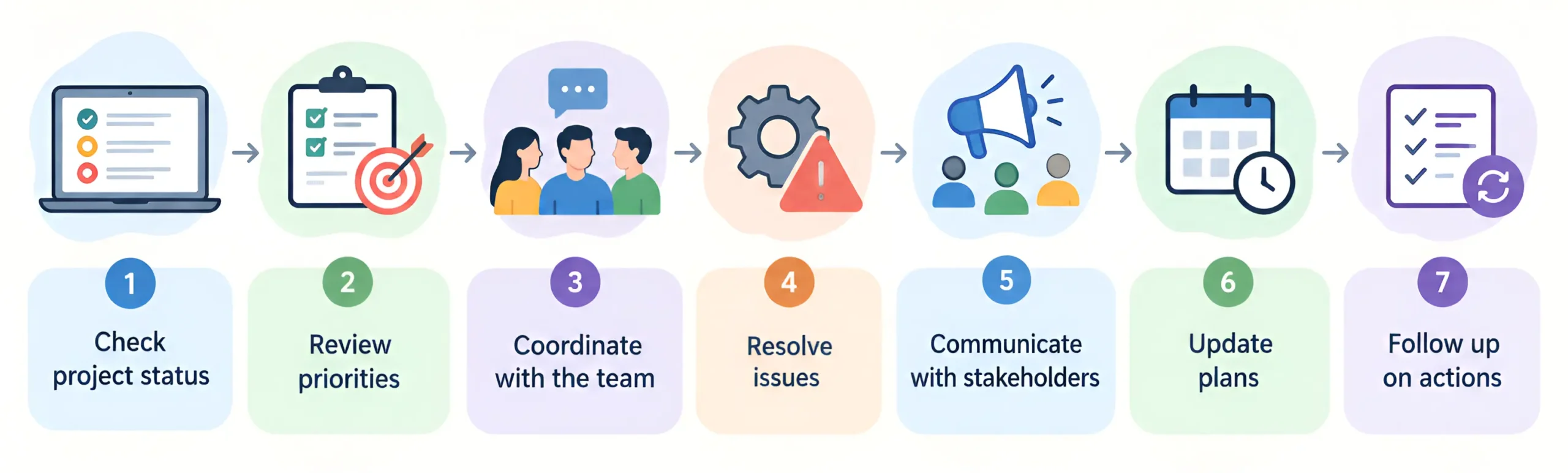
Apart from this –
- Resolving a resource problem
- Discussing a change request with a stakeholder
- Reviewing project costs
- Preparing a status report
Also are an important part of a project manager’s duty.
The important part is that project management involves both planning and responding.
Skills needed to handle project manager duties
Managing projects requires more than knowing project management terminology.
Here are some must-have project management skills –
| Communication | Negotiation | Risk management |
| Leadership | Decision-making | Conflict management |
| Organization | Time management | Analytical thinking |
| Problem-solving | Stakeholder management | Adaptability |
Technical knowledge can also be important, particularly when working in specialized industries.
However, the project manager does not need to be the person who knows every technical detail.
The bigger responsibility is understanding enough to coordinate the work. Ask the right questions, identify dependencies, and help the team make informed decisions.
Project manager duties and the PMP exam
Project manager duties are very closely linked with the broader concepts covered in PMP certification.
PMP candidates are expected to understand the project management fundamentals. Such as –
- Project planning
- Stakeholder engagement
- Team management
- Risk
- Scope / scope creep
- Schedule
- Cost
- Quality assurance
- Project delivery.
However, the role of a project manager is not simply about memorizing processes.
Real projects require judgment.
A project manager needs to understand what is happening, consider the available options, communicate with the right people, and take appropriate action based on the situation.
That practical side of project management is what makes the role more than a checklist of duties.
Conclusion
Project manager duties cover much more than creating schedules and conducting meetings.
A project manager has several roles and responsibilities other than managing people. To explain it in short. A PMP project manager guides everyone and the project through all the phases.
Although the responsibilities vary depending on the organization and project size. An assistant project manager supports many of the project manager’s activities. While a PMO provides standards, governance, reporting, and organizational support across multiple projects.
Frequently asked questions regarding project manager duties
Here we have listed and answered some commonly asked questions on project manager duties.
1. What are the main duties of a project manager?
The main project manager duties include –
- Planning the project
- Managing scope
- Schedule
- Budget
- Resources
- Risks
- Issues
- Stakeholders
- Communication
- Project performance
2. What does a project manager do daily?
A project manager’s daily activities include –
- Checking project progress
- Coordinating teams
- Resolving issues
- Communicating with stakeholders
- Reviewing schedules
- Updating project plans
3. What are assistant project manager job duties?
Assistant project manager duties generally include –
- Supporting schedules
- Documentation
- Meetings
- Reporting
- Task tracking
- Stakeholder coordination
- Risk and issue tracking.
4. What are project management office duties?
PMO duties may include –
- Project governance
- Standards
- Templates
- Reporting
- Portfolio oversight
- Resource support
- Documentation & project management guidance.
5. Is a project manager responsible for the entire project?
The project manager has overall responsibility for coordinating and managing the project. Although accountability and decision-making authority vary by organization.
6. Do project managers need technical skills?
Technical knowledge can be useful, particularly in specialized industries. But project management also requires strong communication, leadership, organization, problem-solving, and stakeholder management skills.