Key takeaways
- Janitor AI is a character-focused AI chatbot platform.
- You can chat with existing characters or create your own.
- Character profiles shape personality, tone, and responses.
- Janitor AI supports roleplay and creative storytelling.
- External AI models can power conversations through integrations.
- Your experience depends on the model and character setup.
- You should avoid sharing sensitive personal information.
- Project managers can learn from character-based AI experimentation.
- AI skills are becoming relevant across project workflows.
AI chatbots have upgraded beyond simple “question and answer tools”. They can create AI characters, build fictional scenarios, and hold actual conversations for specific personalities.
So, what is Janitor AI, and how does it differ from tools such as ChatGPT or Claude?
Janitor AI is a character-based AI chatbot platform. You can use it to interact with existing AI characters or create your own. Each character can have a defined personality, background, speaking style, and scenario.
The platform is a popular AI tool for roleplay and creative storytelling. You can also use it for brainstorming, character development, and conversational experiments.
In this blog you will understand what Janitor AI is – how it works, its main features, use cases, limitations, and safety considerations.
What is Janitor AI?
Janitor AI is an AI chatbot platform focused on character-based conversations.
Traditional AI assistants usually start with a general-purpose assistant. You ask a question, provide instructions, or request an output.
Janitor AI takes a different approach. You select or create a character with a specific identity. The character can have personality traits, background information, communication patterns, and scenario instructions.
For example, you could create a fictional detective character. You could define the character’s personality, history, vocabulary, and behavior. You could then interact with that character within a specific scenario.
This makes Janitor AI more focused on interactive conversations and roleplay.
You can also find community-created characters covering different themes. These include fictional personalities, fantasy characters, anime-inspired characters, game characters, and original creations.
The platform therefore works less like a standard AI assistant. It functions more like a customizable environment for AI-driven conversations.
How does Janitor AI work?
Janitor AI uses AI language models to generate responses based on your conversation. The basic process is pretty straightforward.
First, you select an existing character or create one. The character contains information that helps establish its identity and behavior.
You then start a conversation with that character.
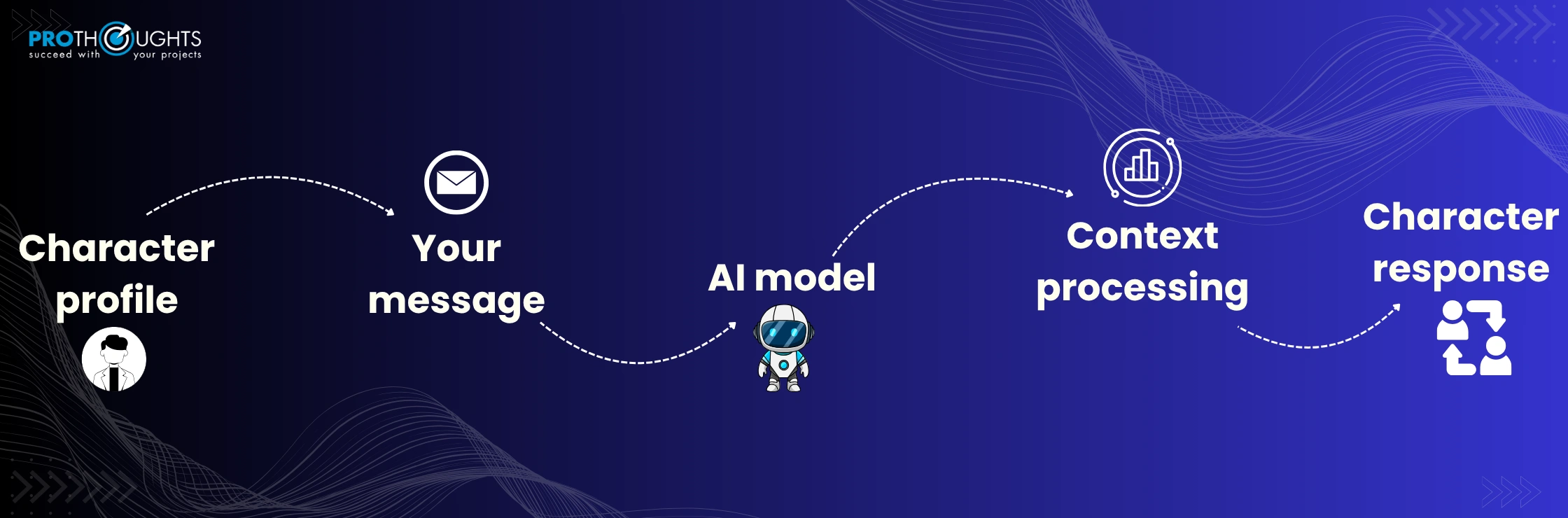
Your message becomes part of the conversational context. The AI model processes that context along with the character’s instructions. It then generates a response that attempts to match the defined personality and scenario.
Here’s how the workflow looks like –
The quality of the response depends on several factors. These include the character instructions, conversation context, model capabilities, and configuration.
A detailed character profile generally gives the AI more information to follow. A vague profile provides less guidance about how the character should behave.
Janitor AI has also supported connections with external AI models. This gives advanced users more flexibility over the model powering conversations.
Key features of Janitor AI
Several features make Janitor AI different from general-purpose AI assistants. Here are some key features to look into
1. Character based conversations
Character-based conversations are the foundation of Janitor AI. Instead of starting with a blank AI assistant, you can select a character with a predefined personality.
Characters can cover different categories, such as:
- Fictional characters
- Anime-inspired personalities
- Fantasy characters
- Game characters
- Original characters
- Storytelling characters
- Roleplay personalities
You can browse available characters and choose one based on your preferred scenario.
This approach gives AI conversations a more structured context.
2. Custom character creation
You can also create your own AI character. Character creation lets you define information such as:
- Character name
- Personality
- Background
- Appearance
- Speech style
- Scenario
- Behavioral traits
- Example dialogue
These instructions help establish how your character should communicate.
For example, you could create a fictional project manager character. You could define the character as analytical, direct, risk-focused, and highly organized.
You could then use that character for simulated project discussions.
The same concept works for creative writing. You could create a fictional detective, historical personality, fantasy character, or original protagonist.
The more specific your character setup is, the clearer the intended behavior becomes.
3. Roleplay and storytelling
Roleplay is one of Janitor AI’s strongest use cases. You can create a scenario and interact with a character within that setting. The AI responds based on the available conversation context and character instructions.
For writers, this creates an interactive way to explore dialogue. Instead of writing every conversation manually, you can simulate how different characters might respond.
You can also test different scenarios before developing a story further.
4. External AI model integration
Janitor AI has also provided options for connecting external AI models. This matters because the underlying language model influences response quality.
Different models handle context, instructions, creativity, and long conversations differently. Advanced users therefore get more flexibility when model integrations are available.
Your setup could involve Janitor AI as the character interface while an external model handles response generation.
This separation is important.
- The character defines the conversational behavior.
- The language model generates the actual response.
5. Character memory and context
AI characters need conversational context to maintain continuity. When you continue a conversation, previous messages provide information about the scenario. This helps the model produce responses that remain relevant.
However, AI memory has limitations.
Long conversations can eventually exceed the model’s available context. Important details can also be forgotten or interpreted incorrectly.
For this reason, you should not treat AI character memory as permanent human-like memory.
How to use Janitor AI
Getting started with Janitor AI generally involves a few basic steps. We have elaborated on the the same in 5 basic steps
Step 1: Create an account
Visit the Janitor AI platform and create your account.
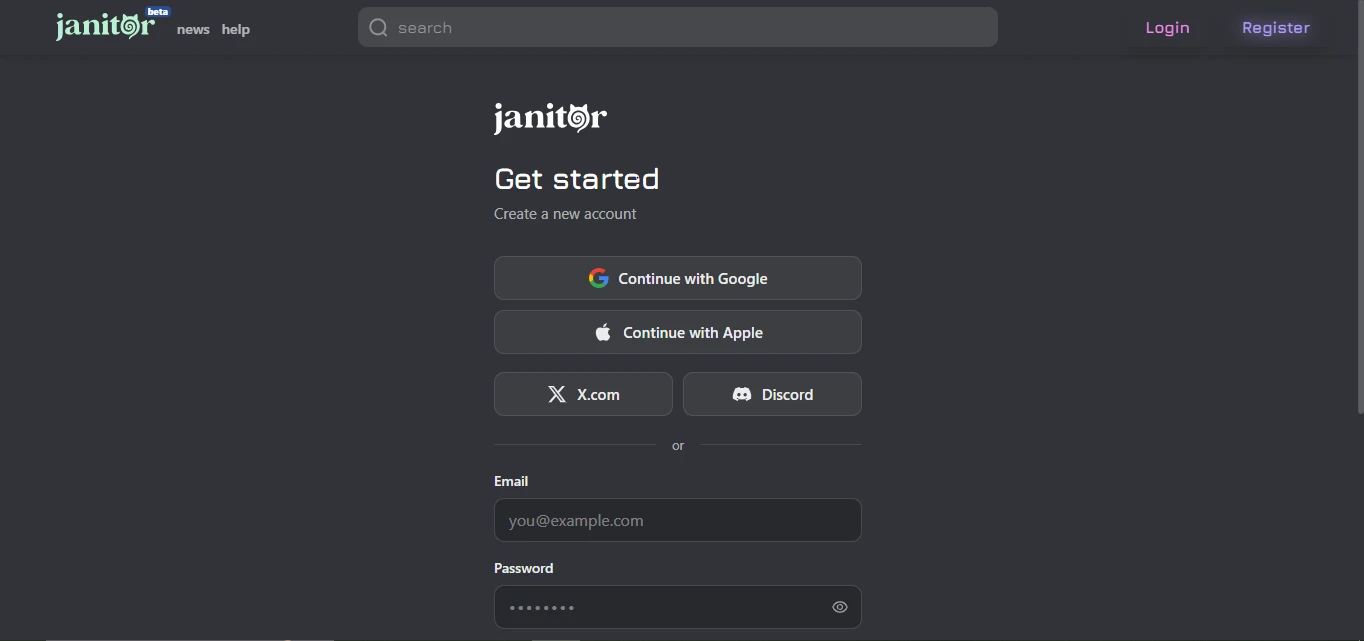
Then
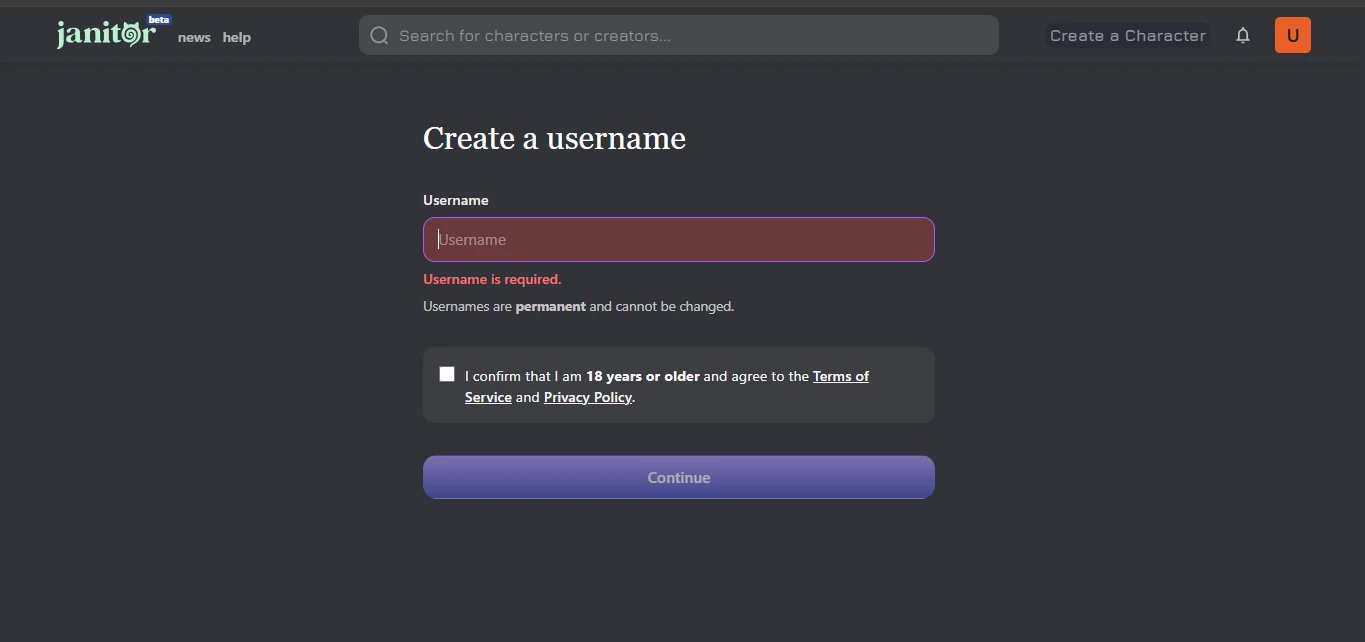
Then create a username of your choice –
*Also note that once you choose a username, it cannot be changed*
Once you write your username, tick the checkbox and continue.
You can then access the character library and available chatbot features.
Step 2: Choose a character
Browse the available characters or search for a specific type. Open a character profile to review its description, personality, and scenario.
Step 3: Start a conversation
Select the option to begin chatting with your chosen character.
Your messages provide the conversational input. The AI then generates responses based on the character setup and available context.
Step 4: Create your own character
If you want more control, create a custom character. Add a name, personality, background, scenario, and dialogue examples.
Review the character instructions before publishing or using the character.
Step 5: Refine the conversation
You can guide the conversation by adding more context.
Specific prompts usually provide clearer direction than vague instructions.
For example, instead of writing: “Tell me a story.”
You could provide a scenario, character goal, setting, and desired tone.
This gives the AI more information to work with.
Janitor AI for creative writing
Janitor AI has several applications beyond casual conversations. Creative writing is one example.
Writers can use character-based AI to explore:
- Character personalities
- Dialogue ideas
- Story conflicts
- Alternative scenarios
- Fictional relationships
- Scene development
You are allowed to create two fictional characters and place them inside the same scenario.
The resulting conversation could reveal new dialogue ideas or conflicts.
However, AI-generated content still requires human editing.
AI can produce inconsistent details, repetitive dialogue, or unexpected plot changes. Writers should therefore treat the output as creative input rather than finished writing.
Can Janitor AI help project managers…if yes, how?
Janitor AI is not a dedicated project management platform. You would not use it as a replacement for –
- Project management software
- Project documentation
- Formal stakeholder processes
However, the underlying idea of AI-driven simulation has interesting applications for project managers. You can create fictional stakeholder personas and simulate different conversations.
For example –
- You can create a demanding client persona and practice handling a scope change.
- You can also simulate a project sponsor who challenges the business case.
These exercises could help you think through communication strategies before an actual stakeholder meeting. This connects with a broader shift in project management.
AI is now being used for planning, analysis, reporting, risk identification, decision support, and other project activities.
If you want to explore practical AI applications for project work, read this article on AI for project managers.
Janitor AI and generative AI skills
Janitor AI is one example of how generative AI has expanded beyond traditional productivity tools. You are no longer limited to asking an AI assistant for information.
You can define personas, construct scenarios, provide context, and evaluate generated responses. These capabilities connect with broader generative AI skills.
Project professionals now need to understand how AI tools work. You also need to understand prompting, data, evaluation, governance, and responsible AI use.
For example, a project manager uses generative AI to summarize meetings. You can also use AI to analyze risks, generate draft reports, or explore project scenarios.
The important skill is not simply knowing one AI tool. The more valuable skill is understanding how to apply AI effectively within your work.
How AI is changing project management
AI adoption is also changing what project managers need to know. Project managers increasingly work with AI-enabled products, automation initiatives, data projects, and AI transformation programs.
That creates two different requirements.
First, you need to know how to use AI in project work.
Second, you need to know how to manage projects that involve AI.
These are not exactly the same skill.
PMI’s current AI guidance addresses both sides of this shift. Its AI standard focuses on applying AI within project work and managing AI-driven initiatives.
PMI-CPMAI and managing AI projects
If you want to move beyond experimenting with AI tools, you can explore PMI certified professional in managing AI (PMI-CPMAI).
PMI-CPMAI is designed around the skills needed to manage AI implementations. PMI states that the certification focuses on AI project delivery rather than general project management knowledge.
The certification covers areas such as:
- Matching AI solutions with business needs
- Identifying data requirements
- Preparing data for AI projects
- Iterating AI development and delivery
- Testing and evaluating AI systems
- Operationalizing AI
- Managing responsible AI practices
PMI currently lists no experience required for PMI-CPMAI.
This makes it relevant for professionals who want structured AI project management knowledge.
Janitor AI vs chatGPT
Janitor AI and ChatGPT serve different primary purposes.
ChatGPT works as a general-purpose AI assistant. You can use it for writing, analysis, research, brainstorming, coding, and many other tasks.
Janitor AI focuses more heavily on character-based interaction.
| Feature | Janitor AI | ChatGPT |
| Primary focus | Character conversations | General AI assistance |
| Custom characters | Yes | Custom GPTs and instructions |
| Roleplay | Strong focus | Supported |
| Creative writing | Supported | Supported |
| General productivity | Limited compared with assistants | Strong |
| External model flexibility | Available through supported integrations | Model options controlled by OpenAI |
| Character library | Community-focused | GPT ecosystem |
The right platform depends on your objective. If you want structured character interaction, Janitor AI is designed around that experience.
If you need research, writing, analysis, coding, or productivity support, a general-purpose AI assistant is usually more suitable.
Janitor AI SFW and NSFW modes
Janitor AI has been associated with both SFW and mature conversational experiences.
SFW means “Safe for Work.” This generally refers to conversations that avoid explicit adult content.
NSFW means “Not Safe for Work.” This refers to mature or explicit content.
Availability, restrictions, age requirements, and content policies can change over time. You should review Janitor AI’s current rules before using or creating mature content.
You should also avoid sharing sensitive personal information with any AI chatbot. AI conversations should not be treated like private conversations with a human professional.
Is Janitor AI free?
Janitor AI has offered free access to parts of its platform, while certain configurations or services can involve additional costs.
The total cost can depend on the features you use and whether an external AI model or API is involved.
External model providers can have separate pricing. API usage can also depend on the provider, model, and amount of usage.
Because pricing, limits, and available plans can change, check the current Janitor AI pricing information before making a purchase decision.
For casual users, the free functionality might be enough. For advanced users, model integrations and additional features can affect the total cost.
Pros and cons of Janitor AI
Pros
- Strong focus on AI characters
- Extensive customization options
- Useful for roleplay and storytelling
- Community-created character library
- Flexible conversational scenarios
- Useful for creative experimentation
Cons
- Response quality depends on the underlying model
- Character behavior can become inconsistent
- Long conversations can lose important context
- Advanced configurations can require technical setup
- It is not designed as a full project management tool
- AI-generated responses still require human judgment
Safety tips for using Janitor AI
AI character platforms require sensible privacy practices. Avoid entering sensitive information such as passwords, financial details, confidential business information, or private client data.
You should also review the platform’s current content policies before creating or sharing characters.
AI-generated conversations can sometimes produce inaccurate, inappropriate, or unexpected responses.
Treat generated content as AI output rather than verified information.
For professional use, keep confidential project information outside public AI platforms unless your organization has approved the tool and its data practices.
What is the future of character based AI?
Character-based AI represents a broader change in human-computer interaction. Traditional software usually gives you fixed interfaces and predefined workflows.
Generative AI allows you to interact through natural language. Character-based platforms add another layer by giving the AI a defined identity and behavioral context. This creates possibilities for entertainment, education, training, simulation, and creative work.
The technology will continue to evolve alongside improvements in language models, memory, multimodal AI, and personalization. For project professionals, the larger lesson is broader than Janitor AI.
AI tools are becoming part of everyday professional workflows. PMI’s latest AI standard highlights the need for responsible AI adoption, human oversight, governance, and value delivery.
Conclusion
Janitor AI’s one of the strongest applications remain creative storytelling and character-based interaction.
However, its underlying technology also demonstrates an important shift in AI. Modern AI systems are becoming more contextual, customizable, and interactive.
You do not need to become an AI developer to understand AI. You do need to understand how AI tools work, where they add value, and where human judgment remains necessary.
If you want to build practical AI skills for project work, explore our AI for Project Managers resources. If you want structured training for managing AI initiatives, explore our PMI-CPMAI training.
FAQs about Janitor AI
Here are some commonly asked questions regarding Janitor AI.
1. What is Janitor AI used for?
Janitor AI is mainly used for character-based conversations, roleplay, storytelling, and creative experimentation. You can interact with existing characters or create custom AI personalities.
2. Is Janitor AI an AI model?
No. Janitor AI is primarily a platform and interface for character-based AI conversations. The underlying language model generates the responses.
3. Can you create your own character on Janitor AI?
Yes. You can create characters with custom names, personalities, backgrounds, scenarios, and dialogue instructions.
4. Is Janitor AI similar to ChatGPT?
Both platforms use conversational AI, but their primary purposes differ. ChatGPT is a general-purpose AI assistant, while Janitor AI focuses more heavily on character-driven conversations and roleplay.
5. Can project managers use Janitor AI?
You can use Janitor AI for informal simulations, brainstorming, and stakeholder roleplay. It is not a replacement for project management software or formal project management processes.
6. Is Janitor AI free?
Janitor AI has offered free access to parts of its platform. Costs can vary based on available plans, features, and external AI model usage.
7. Does Janitor AI use generative AI?
Yes. AI language models generate responses based on your messages, character instructions, and conversation context.
8. Why should project managers learn about AI?
AI is increasingly used across project planning, analysis, reporting, decision support, and AI-driven initiatives. Learning AI helps PMP project managers evaluate tools, use AI responsibly, and manage projects involving AI.
9. Where can you learn more about AI in project management?
You can explore PMI’s resources on AI in project management, including practical AI learning, AI project patterns, and PMI-CPMAI resources.