
Key Takeaways for Quality Assurance
- Quality assurance is a preventive approach that focuses on improving processes to meet requirements and stakeholder expectations.
- Quality assurance creates the conditions for optimal quality.
- Quality assurance and quality control are different but complementary and work together.
- Quality assurance focuses mainly on processes, while quality control focuses on evaluating outputs.
- Quality assurance methods involve TQM, Failure Testing, PPQA, CMMI, and SCP.
- Quality assurance and quality control professionals work across industries and can pursue various beneficial career opportunities.
- Quality management is an important aspect in all industries while measuring the success of a product, service, or project.
Quality assurance is the process that focuses on building reliable standards that help prevent quality problems before they reach the customer.
It is crucial as a project can be completed on time and within budget but still be considered unsuccessful if its final deliverable does not meet the required standards.
So today we’ll learn the quality assurance definition and meaning, how the quality assurance process works, the difference between quality assurance and quality control, along with quality assurance methods. So let’s begin!
What Is Quality Assurance?
The quality assurance definition can be understood as a systematic approach that ensures the products, services, and processes consistently meet established quality requirements. It is implemented across industries.
The easiest way to remember the quality assurance meaning is to think about prevention rather than inspection.
Instead of waiting until a product is finished to discover problems quality assurance asks:
- Are the right processes being followed?
- Are quality standards clearly defined?
- Are team members using approved procedures?
- Are risks being identified early?
- Are processes producing consistent results?
- What can be improved before the next cycle?
Quality assurance is therefore broader than just simple testing of a finished product. It creates a framework in which quality becomes part of everyday work.
Quality Assurance Examples
Quality assurance looks different depending on the industry.
- Software development – Quality assurance can include coding standards or automated testing procedures and continuous integration checks.
- Manufacturing – Organizations may use standardized production procedures and process audits.
- Healthcare – Quality assurance can involve clinical procedures and documentation standards, safety protocols, etc.
- Construction – Quality standards may include safety procedures, inspections, project documentation.
- Project management – A project team may establish acceptance criteria, quality metrics, review procedures and a quality management plan before work begins.
The common idea stays the same: to build quality into the process rather than added at the very end. Now let’s see the difference between quality assurance and quality control.
Quality Assurance vs Quality Control
One of the most common questions about quality management is the difference between quality assurance and quality control. Quality assurance is generally proactive and process oriented. Quality control focuses on identifying defects or nonconformities in the resulting product or service.
- Quality assurance asks, “Are we using the right process?”
- Quality control asks, “Does the finished output meet the requirements?”
Let’s understand the difference between quality control and quality assurance in the table below:
Difference between Quality Assurance & Quality Control |
||
|---|---|---|
| Factors | Quality Assurance | Quality Control |
| Approach | Preventive | Detective |
| Main objective | Prevent defects | Identify defects |
| Timing | Throughout the process | During or after production |
| Examples | Audits, standards, process reviews | Testing, inspection, defect identification |
| Responsibility | Broader project or organizational team | QA/QC professionals and relevant team members |
Quality Control and Quality Assurance: How Do They Work Together?
Quality assurance and quality control should not be treated as competing activities. They are both integrated and implemented to ensure the quality of a product or service.
Quality assurance and quality control example:
A software company may establish a standard process for developing and reviewing code. That is quality assurance. Testing the completed feature to find bugs is quality control.
The relationship can be summarized as:
Quality Planning → Quality Assurance → Quality Control → Feedback → Continuous Improvement
Quality control provides evidence about whether the output meets the required standard. The findings from quality control can then be used to improve the quality assurance process.
Why Is Quality Assurance Important in Project Management?
Quality assurance in project management is a fundamental practice. Because a project manager cannot simply measure success through schedule and budget.
The quality of the final output and deliverables matters to guarantee stakeholder satisfaction. Quality is one of the factors that can determine that. Quality assurance helps project teams:
-
Prevent Problems Early
Finding a process problem early is usually easier than correcting a major defect after the deliverable has been completed.
-
Reduce Rework
Poor quality work often creates additional testing, corrections, revisions plus approvals. Effective quality assurance can reduce unnecessary rework.
-
Improve Customer Satisfaction
Organizations are more likely to build customer trust when deliverables consistently meet agreed requirements.
-
Support Compliance
Many industries operate under regulatory nd industry specific safety requirements. Quality assurance helps teams establish processes for meeting those expectations.
-
Create Consistency
Standardized processes make it easier for different teams and projects to produce predictable results.
-
Support Continuous Improvement
Quality assurance is not a one time activity. Audits, reviews, and feedback can reveal opportunities to improve processes over time.
This makes quality assurance particularly valuable during planning and execution for project managers. As quality should be considered throughout the project lifecycle rather than treated as a final inspection step.
Now that we’re aware of quality assurance in project management and its importance, let’s check out some of the best quality assurance practices.
Best Practices in Quality Assurance
A strong quality assurance approach should be practical and measurable. Some useful best practices include:
- Define quality requirements before execution begins.
- Establish measurable acceptance criteria.
- Document important processes and responsibilities.
- Build quality checks into the workflow.
- Track quality metrics consistently.
- Conduct regular process reviews and audits.
- Encourage team members to report problems early.
- Use customer and stakeholder feedback.
- Analyze the root cause of recurring defects.
- Continuously improve processes based on evidence.
One principle is particularly important: quality is everyone’s responsibility. Quality cannot be maintained if the wider project team ignores established standards. A dedicated quality assurance team can provide expertise.
Next we’ll look at some of the quality assurance processes.
What are Quality Assurance Processes
A typical quality assurance process can be divided into several stages. They are as follows:
1. Define Quality Objectives and Standards
First, identify what the standard quality means for your project or product. Requirements may come from customers, stakeholders, regulations, or technical specifications.
2. Develop a Quality Plan
The quality plan explains how the project will achieve its quality objectives. It can define:
- Quality standards
- Responsibilities
- Review activities
- Quality metrics
- Acceptance criteria
- Audit requirements
- Testing procedures
3. Design and Implement Quality Processes
Quality standards must then be incorporated into everyday workflows. For example, a software team may establish coding standards and peer review procedures, while a manufacturing team may define standardized production procedures.
4. Monitor Quality
Teams should track appropriate metrics to determine whether processes are working as expected. Depending on the project, these could include defect rates, rework, test pass rates, customer complaints or process compliance.
5. Test and Evaluate Outputs
Testing and inspection help identify problems in the actual product or service. Testing is an important quality activity. But it should not be confused with the entire quality assurance function.
6. Conduct Audits and Reviews
Quality audits evaluate processes, documentation and results against established requirements. They can reveal nonconformities as well as opportunities for improvement.
7. Take Corrective Action and Improve
Finally, teams should address the causes of problems rather than repeatedly fixing the symptoms. Lessons learned can then be incorporated into future processes.
How to Perform Quality Assurance
A project manager or quality assurance professional can use the following practical sequence:
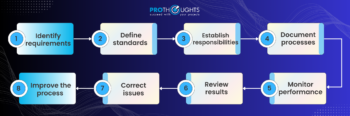
How to perform quality assurance example:
Suppose a team is developing an online payment feature.
→ The quality assurance team may first define development and security standards.
→ Review procedures may then be established to ensure the team follows those standards.
→ Once the feature is developed, quality control activities would test whether payments actually work under different conditions.
The example demonstrates that quality assurance establishes and improves the process. In contrast, quality control evaluates the resulting output. Now let’s look at what are the quality assurance methods.
Quality Assurance Methods
Organizations can use different quality assurance methods depending on their industry and objectives. Some of the most effective and trending quality assurance methods are as follows:
1. Total Quality Management (TQM)
- Total Quality Management (TQM) is an organization wide approach to quality.
- Continuous quality improvement is treated as a responsibility shared across departments and teams.
- TQM encourages employees at different levels of an organization to identify problems and improve processes and requirements.
- The approach emphasizes long term improvement rather than relying only on inspections at the end of a process.
2. Failure Testing
- Failure testing involves the deliberate placing of a product or process under demanding or unusual conditions to identify weaknesses.
- The purpose is not to make something fail but to understand how and why it fails so that improvements can be made.
- The findings can help strengthen the product while also revealing weaknesses in the underlying development.
- It can be used to improve the testing process too.
3. Process and Product Quality Assurance (PPQA)
- Process and Product Quality Assurance (PPQA) focuses on evaluating whether organizational processes and products conform to established standards.
- It can involve reviewing project activities, documentation, procedures and deliverables to identify gaps between what is expected and what is being performed.
- PPQA is particularly useful when organizations need greater visibility into process compliance
- Or when they want to identify areas where established practices are not being followed.
4. Capability Maturity Model Integration (CMMI)
- Capability Maturity Model Integration (CMMI) provides a structured approach for assessing and improving organizational processes.
- It helps organizations understand the maturity of their processes
- It further identifies opportunities to make them more consistent, capable and predictable.
- CMMI is particularly associated with software, systems and product development environments
- But its process improvement principles can be applied more broadly.
5. Statistical Process Control (SPC)
- Statistical Process Control (SPC) uses statistical techniques to monitor process performance and identify unusual variation.
- It helps teams analyze process data to determine whether a process is operating within expected limits
- This process works throughout rather than waiting till the final product is done.
- This makes SPC particularly useful in environments where consistency and repeatability are important.
- Six Sigma is another widely used process improvement approach that uses data and statistical analysis to reduce defects and process inefficiencies.
The right approach ultimately depends on the type of work being performed and the level of quality control required. Let’s check out quality assurance jobs next.
Quality Assurance Jobs
So far, we can form a consensus that quality assurance is a crucial part of most industrial protocols. This importance has given rise to multiple quality assurance jobs.
Quality assurance offers career opportunities across all industries.
Quality assurance jobs include:
- Quality Assurance Analyst (LinkedIn Portal)
- Quality Assurance Engineer (LinkedIn Portal)
- Quality Assurance Tester (LinkedIn Portal)
- Quality Assurance Specialist (LinkedIn Portal)
- Quality Manager (LinkedIn Portal)
- Quality Auditor (LinkedIn Portal)
- Software Test Engineer (LinkedIn Portal)
- Quality Control Inspector (LinkedIn Portal)
- Process Improvement Specialist (LinkedIn Portal)
A quality professional may be responsible for developing standards, reviewing processes, auditing, managing testing activities, analyzing quality data, and commencing improvements.
Average Salary of a Quality Assurance Professional in India
Quality assurance professionals are valued across industries. The employment opportunities and pay vary based on the qualification, experience, location, and company.
But below is the average salary of a quality assurance professional in India:
Quality Assurance Job Salary by Experience Level |
|
|---|---|
| Entry-Level (0–1 years) | ₹2.2L – ₹3.5L per year |
| Mid-Level (1–4 years) | ₹3.5L – ₹6L per year |
| Senior-Level (5–9 years) | ₹6L – ₹12L per year |
| Late Career / Management (10+ years) | ₹12L – ₹30L+ per year |
The figures above may differ given career and expertise. Please do your own research, too.
Average Salary of a Quality Control Professional in India
Quality control jobs are just as important in all industries as quality assurance jobs. The career opportunities are plenty. But compensation can vary based on experience, industry, location, specialization, and organization.
Below is the average salary of a quality control professional in India:
Quality Control Job Salary by Experience Level |
|
|---|---|
| Entry-Level (0–1 years) | ₹2.7L – ₹3.2 L per year |
| Mid-Level (1–4 years) | ₹3.5L – ₹4.0L per year |
| Senior-Level (5–9 years) | ₹4.5L– ₹5.0L per year |
| Late Career / Management (10+ years) | ₹6L – ₹20L+ per year |
The figures above may differ given career and expertise. Please do your own research, too.
Conclusion
Quality assurance is much more than testing a finished product. It is a systematic approach to building quality into processes from the beginning. Quality control is another aspect that ensures the optimal quality of the final product or deliverable outcome.
The difference between quality assurance and quality control is that quality assurance focuses on preventing problems by improving processes and standards. In comparison, quality control focuses on identifying problems in products or outputs.
The core principle is that quality should be designed into the process and not just an inspection at the end.
FAQs on Quality Assurance
Here are some of the frequently asked questions answered on quality assurance, methods, and QA vs QC:
1. What is quality assurance?
Quality assurance establishes and improves processes and standard procedures that help ensure products or services meet defined quality requirements.
It focuses primarily on preventing quality problems rather than simply detecting them after completion. Hence, it is implemented across all industries.
2. What is the difference between quality assurance and quality control?
Quality assurance is mainly process oriented and preventive. Quality control is output oriented and focused on identifying defects. Quality assurance establishes processes that support quality, whereas quality control evaluates whether the resulting product or service meets requirements.
3. Is quality assurance a difficult job?
Quality assurance can be challenging because it requires analytical thinking, attention to detail, communication and problem solving skills. The difficulty also depends on the industry and role.
Software QA, manufacturing QA and quality management can each require different technical knowledge.
4. What is the role of quality assurance?
Quality assurance professionals are responsible for ensuring that the final deliverable meets the standards and requirements of stakeholders. They also define the:
- Quality standards
- Review processes
- Conduct audits
- Monitor quality metrics
- Coordinate testing
- Investigate recurring problems
- Recommend process improvements
The success of the entire project or process depends on the quality of the outcome. Without the expertise of a quality assurance professional, the effort may be a waste.
5. Is quality assurance replaced by AI?
AI is unlikely to completely replace QA. Instead it can automate repetitive testing and analysis to help professionals. It can identify defects, anomalies, and patterns more quickly. Human judgment remains important for risk assessment, compliance and for making final quality decisions.