PERT and CPM: Key takeaways
- PERT and CPM are project scheduling techniques.
- Both help estimate project timelines and plan activities.
- PERT uses three time estimates for each activity.
- CPM uses fixed durations for predictable project activities.
- PERT is suitable for uncertain or first-time projects.
- CPM works best for predictable and well-defined projects.
- PERT focuses on uncertainty and schedule forecasting.
- CPM focuses on critical paths, scheduling, and resources.
- Both techniques help identify task dependencies and critical activities.
- PERT and CPM can work together on projects.
- The right technique depends on project uncertainty and complexity.
PERT and CPM are two majorly used project scheduling techniques in project management. Both of these help teams in planning activities and estimating the project duration. With that, they help to identify the sequence of tasks required to complete a project successfully.
Although both PERT and CPM share similar objectives. They differ in how they estimate time depending on the types of projects.
Understanding the difference between PERT and CPM helps project managers in choosing the right technique.
In this blog, you will learn the difference between PERT and CPM. With practical examples and elaborated explanations. Please read along to know more!
Understanding PERT in project management?
PERT in project management is all about project scheduling and planning techniques used to estimate the time required to complete projects with uncertain or unpredictable task durations.
It helps project managers to identify any task dependencies. Estimate project timelines and determine the critical path to ensure timely project completion.
Unlike traditional scheduling methods that rely on a single time estimate. PERT uses three time estimates for every activity –
- Optimistic time (O): The shortest possible time to complete the task under ideal conditions.
- Most likely time (M): The expected time required under normal circumstances.
- Pessimistic time (P): The longest time the task could take if delays occur.
These estimates are used to calculate the expected duration of each activity using the formula:
Expected Time (TE) = (O + 4M + P) ÷ 6
Understanding CPM in project management?
Critical Path Method – CPM is a project scheduling technique. It is used to plan, schedule, and monitor projects with well-defined and predictable activities. It helps project managers identify the critical path.
Which is the longest sequence of dependent tasks that determines the minimum time required to complete a project.
Unlike PERT, which uses multiple time estimates. CPM assumes that the duration of each task is known and fixed. This makes it ideal for projects with repetitive activities and predictable schedules – where accurate time estimates are available.
The critical path method helps to:
- Identify all the project activities and the dependencies they have.
- Calculate the earliest and latest start and finish times for each task.
- Determine the critical path – if any delay directly delays the entire project.
- Identify tasks with float (or slack) – which can be delayed without affecting the project completion date.
PERT vs. CPM at a glance
Before you decide which technique suits you the best. It is important to understand their core differences.
The table below highlights the major differences between PERT and CPM.
| Basis of Comparison | PERT | CPM |
| Full form | Program Evaluation and Review Technique | Critical Path Method |
| Nature | Probabilistic | Deterministic |
| Time estimates | Three estimates: Optimistic, Most Likely, and Pessimistic | Single estimated duration |
| Best suited for | Projects with uncertain timelines | Projects with predictable schedules |
| Primary focus | Estimating project duration and managing uncertainty | Scheduling tasks and identifying the critical path |
| Project type | Research, software development, innovation, R&D | Construction, manufacturing, infrastructure |
| Cost consideration | Focuses mainly on time | Considers both time and cost optimization |
| Critical path | Estimated using expected activity durations | Calculated using fixed task durations |
| Flexibility | High, accommodates uncertainty | Lower, assumes fixed activity durations |
| Common use case | First-time or unique projects | Repetitive and well-defined projects |
How do PERT and CPM actually work?
PERT and CPM begin by breaking a project into individual activities and identifying the dependencies between them.
How PERT Works
PERT is designed for projects where activity durations are uncertain. It estimates the time required for each task using three values:
- Optimistic time (O): The shortest possible completion time.
- Most likely time (M): The expected completion time under normal conditions.
- Pessimistic time (P): The longest likely completion time if delays occur.
Using these estimates, project managers calculate the expected duration of each activity. Then accordingly map task dependencies and identify the critical path.
Example – Imagine a software company developing a new mobile application.
| Activity | Dependency | Time Estimate |
| Gather requirements | None | O = 5, M = 8, P = 12 days |
| Design UI | Requirements | O = 4, M = 6, P = 9 days |
| Develop application | UI Design | O = 12, M = 18, P = 25 days |
| Testing | Development | O = 5, M = 7, P = 10 days |
| Deployment | Testing | O = 2, M = 3, P = 5 days |
Since development involves uncertainty. PERT helps estimate realistic timelines and evaluate the impact of possible delays.
How CPM Works
CPM is used when task durations are predictable and well-defined. Every single activity that happens has a single estimated duration.
This makes it easier to calculate the project’s critical path. Also, it helps in identifying tasks that cannot be delayed without affecting the completion date.
Example – consider a residential construction project.
| Activity | Dependency | Duration |
| Site preparation | None | 5 days |
| Foundation | Site preparation | 7 days |
| Framing | Foundation | 10 days |
| Roofing | Framing | 4 days |
| Interior finishing | Roofing | 12 days |
In this case, every task has a fixed duration. CPM identifies the critical path and helps the project manager allocate resources efficiently. This ensures that the project stays on schedule.
When should you use PERT in project management?
PERT is best suited for projects where the activity durations are generally uncertain. When the accurate time estimates are difficult to determine.
Using PERT helps project managers to account for risks and estimate realistic timelines – plan for unexpected delays.
You should use PERT when:
- The project is new and has little to zero historical data.
- Activity durations are uncertain or difficult to estimate.
- The project involves research, innovation, or product development.
- Risk assessment and schedule forecasting are critical.
- Multiple outcomes and completion times need to be evaluated.
Example –
- Developing an AI-powered application
- Conducting pharmaceutical research
- Launching a new product
Here the task durations are unpredictable.
When should you use CPM?
The critical path method is the preferred choice for projects with clearly defined activities. As they have very predictable task durations.
You should use CPM when:
- Task durations are known and well documented.
- The project follows a fixed sequence of activities.
- Time and cost optimization are important.
- Resources need to be planned and managed efficiently.
- The project involves repetitive or standardized processes.
Example –
- Constructing a commercial building
- Manufacturing a product
- Managing an infrastructure
Project with fixed schedules and well-defined workflows.
Advantages and disadvantages of PERT
PERT is particularly useful for projects that have – uncertain timelines or complex task dependencies.
It improves planning accuracy by considering multiple time estimates. With that, it also requires more effort to create and maintain.
Advantages of PERT
- Improves project planning when task durations are uncertain.
- Helps estimate realistic project completion timelines.
- Identifies the critical path and task dependencies.
- Supports better risk assessment and contingency planning.
- Encourages coordination across teams working on complex projects.
- Works well for research, software development, and innovation projects.
Disadvantages of PERT
- Requires three time estimates for every activity, making it time-consuming.
- Relies heavily on estimation accuracy.
- Becomes difficult to manage for very large projects.
- Does not focus on project costs or resource optimization.
- Requires regular updates when project assumptions change.
Advantages and disadvantages of CPM
CPM is ideal for projects that have predictable schedules and well-defined activities. It helps optimize project timelines and resource allocation – but is less effective when project requirements keep on changing frequently.
Advantages of CPM
- Identifies the critical path and activities that affect project completion.
- Helps optimize schedules and reduce project delays.
- Supports efficient resource allocation and utilization.
- Assists in balancing project time and cost.
- Simplifies project monitoring and progress tracking.
- Works well for construction, manufacturing, and infrastructure projects.
Disadvantages of CPM
- Assumes task durations are fixed and accurate.
- Is not suitable for projects with high uncertainty.
- Requires a detailed project plan before scheduling begins.
- Changes to activity durations can require recalculating the schedule.
- May overlook risks if task estimates are overly optimistic.
Can PERT and CPM be used together in project management?
Yes! PERT and CPM can absolutely be used together. Various organizations combine both techniques to improve project planning and scheduling. Since the two methods complement each other. Using them together allows project managers to handle uncertainty – while maintaining an optimized project schedule.
A common approach is to use PERT during the planning phase to estimate activity durations for uncertain tasks.
Once the estimates become more reliable. CPM is used to identify the critical path, allocate resources, and monitor project progress.
For example – in a software implementation project, the research and design phases may use PERT
For example, in a software implementation project, the research and design phases may use PERT because task durations are uncertain. After the requirements are finalized, the development, testing, and deployment phases can be managed using CPM with fixed schedules.
By combining PERT and CPM, project managers can:
- Estimate project timelines more accurately.
- Identify the critical path early.
- Improve resource planning.
- Reduce scheduling risks.
- Track project progress more effectively.
Which is better, PERT or CPM?
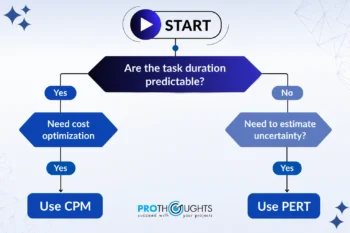
Neither PERT nor CPM is inherently better. The right choice depends on the type of project. The availability of time estimates and the level of uncertainty involved.
Choose PERT if:
- Your project has uncertain or variable task durations.
- You are working on research, product development, or innovation projects.
- Risk analysis and schedule forecasting are priorities.
Choose CPM if:
- Your project has predictable and well-defined activities.
- Task durations are known in advance.
- You need to optimize schedules, costs, and resource allocation.
For modern projects, the best approach is to use both techniques. PERT helps estimate uncertain activities during the planning stage. While CPM provides a structured schedule for execution and control.
Conclusion
PERT and CPM are two essential project scheduling techniques. Both aim to improve project scheduling and identify the critical path. They differ in how they estimate activity duration.
PERT is best suited for projects with uncertain timelines – such as research, software development, and product innovation.
CPM, on the other hand, works best for projects with predictable schedules, including construction, manufacturing, and infrastructure projects.
Understanding these differences enables project managers to choose the right technique based on project complexity.
Frequently asked questions on PERT and CPM
Here are some commonly asked doubts regarding PERT and CPM.
1. Is CPM better than PMP?
There’s no “better” certification as such, but PMP is generally considered better for career growth. But if you are looking for entry-level alternatives. Then make sure you are comparing PMP certification with CPAM certification. Because CPM refers to an entirely different credential.
2. What do PERT and CPM mean?
Both PERT and CPM are network-based project management techniques. These techniques are used to plan schedules and control complex projects.
PERT stands for program/project evaluation and review technique.
CPM stands for critical path method.
3. Is CPM the same as PERT?
No. Although both CPM and PERT fall under network-based project management techniques. They are different project management tools. Both map out tasks to find the shortest project timeline.
PERT handles uncertain and first-time projects using three time estimates.
CPM manages predictable, repetitive tasks with a single known time estimation.
4. What are the differences between CPM and PERT in software engineering?
In software engineering, PERT is used for complex, uncertain R&D projects. With probabilistic time estimates (most likely to happen).
CPM – is used with predictable projects with fixed or known durations. Focusing on time-cost trade-offs and optimizing resource allocation.
5. What is the main difference between PERT and CPM?
The major difference between PERT and CPM is that –
PERT is used when the task times are uncertain – like a brand new or unpredictable project.
While CPM is used when task times are known and predictable – like routine construction work.
6. What is PERT in Six Sigma?
PERT is a project management and statistical tool. Which is used in Six Sigma to plan, organize, and analyze the tasks required to complete a complex project.
It helps teams to minimize delays, identify any challenges, and accurately forecast the time needed to achieve project milestones.
7. Is PERT still used today?
Yes, PERT is still very relevant and used today. It remains a really valuable methodology for managing complex projects.
It is quite frequently integrated into modern project management software. Also, combined with CPM and statistical risk analyses.
8. Can PERT be used in agile projects?
Yes, you can definitely use PERT in agile projects. Although it requires a shift from its traditional waterfall usage.
Agile prioritizes flexibility, and PERT is immensely useful for macro-level planning. Predicting release dates for large or complex initiatives.