How to become a project manager in Thane: Key takeaways
- A project management career often progresses through several roles.
- Project coordinators support daily project activities and tracking.
- Project managers lead projects from planning through delivery.
- Senior project managers handle larger, more complex projects.
- Program managers oversee multiple related projects and teams.
- PMO and portfolio leaders focus on governance and strategy.
- Each stage requires stronger leadership and decision-making skills.
- Certifications can support career growth at different stages.
Project management is not limited to people with “Project Manager” in their job title.
Many professionals start managing projects long before they receive that designation. An engineer coordinates vendors and deadlines. An IT professional manages a software release. A team lead handles resources, risks, and client expectations.
These are already parts of project management.
For professionals in Thane, the career path can take several directions. The city has a strong presence across IT, engineering, manufacturing, finance, consulting, construction, and other project-driven sectors.
This guide explains how to get PMP certification training in Thane and get PMP certified.
What does a project manager actually do?
A project manager is responsible for bringing different parts of a project together. That sounds simple until you look at what happens inside an actual project.
The role usually involves:
- Defining project scope and objectives
- Building and maintaining project schedules
- Coordinating project teams and resources
- Managing risks, issues, and dependencies
- Communicating with stakeholders
- Tracking costs and project performance
- Managing changes to the project
- Supporting quality and delivery
- Keeping teams aligned with business objectives
The balance changes from one industry to another. The tools differ. But the project management principles are usually similar.
Do you need a project management degree?
Not necessarily. There is no single academic route into project management. Professionals move into the field from several backgrounds like – engineering, technology, finance, operations, business, etc.
What matters is how your existing experience connects to project work.
Consider someone working as a software developer. If that person starts coordinating a release, managing dependencies, communicating with clients, and tracking delivery, the role is moving beyond technical execution.
The same applies to an engineer who starts managing contractors, budgets, schedules, and project risks.
This is why aspiring project managers should look beyond their job title. Your responsibilities tell a better career story than your designation.
You may not be a project manager right now. But you may be having project manager responsibilities without the title.
How do you gain project management experience?
This is usually the first major challenge for aspiring project managers.
You cannot simply decide to become a project manager and expect the experience to appear. You need to start taking ownership of project-related responsibilities.
Your current role could provide those opportunities.
Start by asking for responsibility around areas such as:
- Project planning
- Team coordination
- Client communication
- Status reporting
- Risk tracking
- Vendor coordination
- Resource planning
- Process improvement
- Project documentation
- Delivery tracking
You could begin with a small internal project.
For example, you might coordinate the implementation of a new internal software system. You could manage the timeline, coordinate departments, track issues, and report progress to management.
That experience becomes valuable because you are no longer simply completing assigned tasks. You are coordinating work toward a defined outcome.
Which skills do project managers need?
Project management has a technical side, but the job is not purely technical. A strong project manager needs to understand the work while also managing people, expectations, and business priorities.
Here are some basic project management skills a project manager should have –
1. Planning and scheduling
A project needs more than a deadline. You need to understand the work required, dependencies between activities, available resources, and potential constraints.
You need to have familiarity with project management tools. Also, tools like Microsoft Project, Excel, Jira, and other project management platforms can support this work.
2. Risk management
Projects are not always followed as per the original plan. You need to have a backup if the project goes haywire.
As a project manager,, you need to identify any potential risk early on. Then decide how the team should respond.
Good risk management is therefore more than maintaining a risk register. It involves anticipating what could affect delivery.
If you want to learn more about risk management, refer to our blog on the same – project risk management.
3. Stakeholder management
Project managers don’t work in a single team. They have to coordinate with internal teams, clients, senior management, vendors, etc.
With different groups and people, different expectations arise. A project manager needs to communicate the right information to the right people at the right time.
This becomes increasingly important as project complexity increases.
4. Leadership
The entire role of a project manager revolves around the term “leadership,” which is equivalent to “responsibility” and “ownership.” A project manager is responsible for how the projects turn out.
Project managers lead people without directly managing them.
A developer, designer, finance professional, or external vendor might report to someone else.
The project manager still needs their contribution. That requires communication, negotiation, influence, and accountability.
This is one reason project management is not simply an administrative role.
These are just 4 skills that are mentioned above. A project manager needs to have more than these. These are just the basic project manager skills expectations.
However, if you want to know about all the skills a project manager must have. Go through our blog, which covers the same comprehensively – project management skills.
What certifications should you consider in Thane?
Certifications are like a supporting rock to your validity and authenticity. But certification should not be a substitute for your practical experience.
If you are just starting out and are keen on getting into the project management side of economic production/business.
* CAPM is best for you to gain foundational project management knowledge.
If you are an experienced professional who already leads projects.
* PMP is a more relevant certification for you.
Professionals working heavily with agile approaches should consider – PMI-ACP certification.
The right choice depends on what you are doing today and where you want your career to go.
When does PMP make sense?
This is where many professionals make the wrong comparison. PMP is not simply another project management course.
It is a professional certification designed for people who already have project leadership experience.
PMI currently provides different eligibility pathways based on educational background and project experience.
- Candidates with a bachelor’s degree generally need 36 months of project leadership experience.
- Candidates with an associate-level qualification need 48 months
- Those with a secondary qualification need 60 months.
- PMI also has a separate pathway for graduates of GAC-accredited programs.
- Candidates also need 35 hours of project management education unless they hold an active CAPM certification.
So, if you see yourself meeting any of these terms listed above, PMP can easily fit your career stage.
However, if you are completely new to project management. Your main goal should be to build experience first.
What does PMP actually add to your career?
A certification does not automatically make someone a better project manager. Its value comes from combining formal knowledge with professional experience. PMP preparation covers project management concepts across PMP domains and approaches.
The current examination also reflects areas such as –
- Business value
- Sustainability
- AI
- Stakeholder engagement
This broader perspective is useful because project managers rarely work in exactly the same environment throughout their careers.
One organization might use a traditional project lifecycle. Another might use Scrum. A third could combine predictive planning with agile delivery.
Understanding the project management principles behind these approaches helps professionals adapt.
Should you take PMP training in Thane?
If you live or work in Thane, the choice between local classroom training and online learning depends largely on your routine.
Classroom training gives you direct interaction with the trainer and other professionals. It also creates a fixed learning schedule.
The more important question is what the training actually provides.
Before enrolling, look at:
- Whether the program provides the required training hours
- Trainer experience and project background
- Current PMP examination material
- Practice questions and mock exams
- Application guidance
- Doubt-solving support
- Access to study resources
- Support after the training sessions
A lower course fee does not necessarily mean lower value. The reverse is also true. Compare the actual learning support rather than comparing prices alone.
What is the career path after becoming a project manager?
There is no single project management career ladder. A professional might start as a project coordinator before moving into project management. Another person could move directly from a technical or functional role into project leadership.
A typical progression could look like:
However, career paths differ across organizations. Some professionals move toward program management. Others specialize in PMO, agile delivery, transformation, operations, or project controls. Your industry also influences the opportunities available.
Project management careers in Thane
Thane professionals do not need to limit their search to companies with “project management” in their job descriptions.
Many project-related roles exist under different titles.
You could find relevant responsibilities in:
- IT and software delivery
- Engineering projects
- Manufacturing
- Banking and financial services
- Consulting
- Construction
- Operations
- Telecommunications
- Business transformation
Look at the responsibilities rather than just the title.
A role called “Implementation Manager” could involve significant project management work.
A “delivery lead” could manage teams, schedules, stakeholders, and project risks.
This approach helps you identify more relevant career opportunities.
How can you prepare for a project management career?
Start with your existing experience.
Identify the projects you have already worked on.
Then document what you actually did.
- Did you manage a timeline?
- Did you coordinate different teams?
- Did you handle risks?
- Did you communicate with clients?
- Did you manage vendors?
- Did you report project progress?
- Did you make decisions when requirements changed?
These examples help you understand your existing project management experience. The next step is to identify your gaps.
Perhaps you have strong technical knowledge but limited stakeholder management experience. Perhaps you coordinate teams well but have limited exposure to project financials.
Once you understand those gaps, you can choose relevant training, responsibilities, or certification.
This approach is more useful than collecting certifications without a clear career objective.
A practical roadmap to becoming a project manager
There’s no universal timeline as such to become a PMP project manager. But the career journey can follow a simple structure.
Step 1: Build project exposure
First off, you need to step up in your team and start taking more responsibility for project-related activities within whatever your current role is.
Step 2: Develop core skills
Focus on strengthening your soft as well as hard skills. Like –
- Planning
- Communication
- Risk management
- Stakeholder management
- Leadership
Step 3: Take ownership
Once you start taking ownership of the domain you work in. You need to move from just supporting projects to owning the defined outcomes.
Step 4: Document your experience
Every task or major idea that you do and keep forward. Needs tracking!
You need to keep track of projects, responsibilities, teams, outcomes, and timelines.
Step 5: Choose relevant training
Once you are sure you have the relevant experience and are qualified for the PMP certification. Select a decent and reputable PMP certification training in Thane. Start with the PMP exam preparation.
Step 6: Get PMP certified
After meeting the requirements, prepare yourself for the PMP exam. Give and clear the PMP exam successfully. Become a PMP-certified project manager.
Step 7: Target project roles
Once certified, look for positions where you get greater leadership roles.
These are usually the roadmap/steps to getting PMP-certified.
Conclusion
If you are already managing projects informally, start by documenting that experience. Then identify the skills you need to strengthen.
For experienced professionals, PMP can provide a structured way to formalize project management knowledge and prepare for broader project leadership responsibilities.
If you are based in Thane and meet the eligibility requirements. You can explore PMP training in Thane as part of your preparation.
Frequently asked questions
We have listed all the doubts about becoming a project manager in Thane. Feel free to reach out to us if you have further doubts via info@prothoughts.co.in.
1. Can I become a project manager without PMP?
Yes. You can definitely become a project manager without PMP. PMP certification is not a mandatory requirement for every project management position. But to become a project manager without a PMP may take you longer.
Getting PMP certified makes you officially (on paper) qualified for the role. 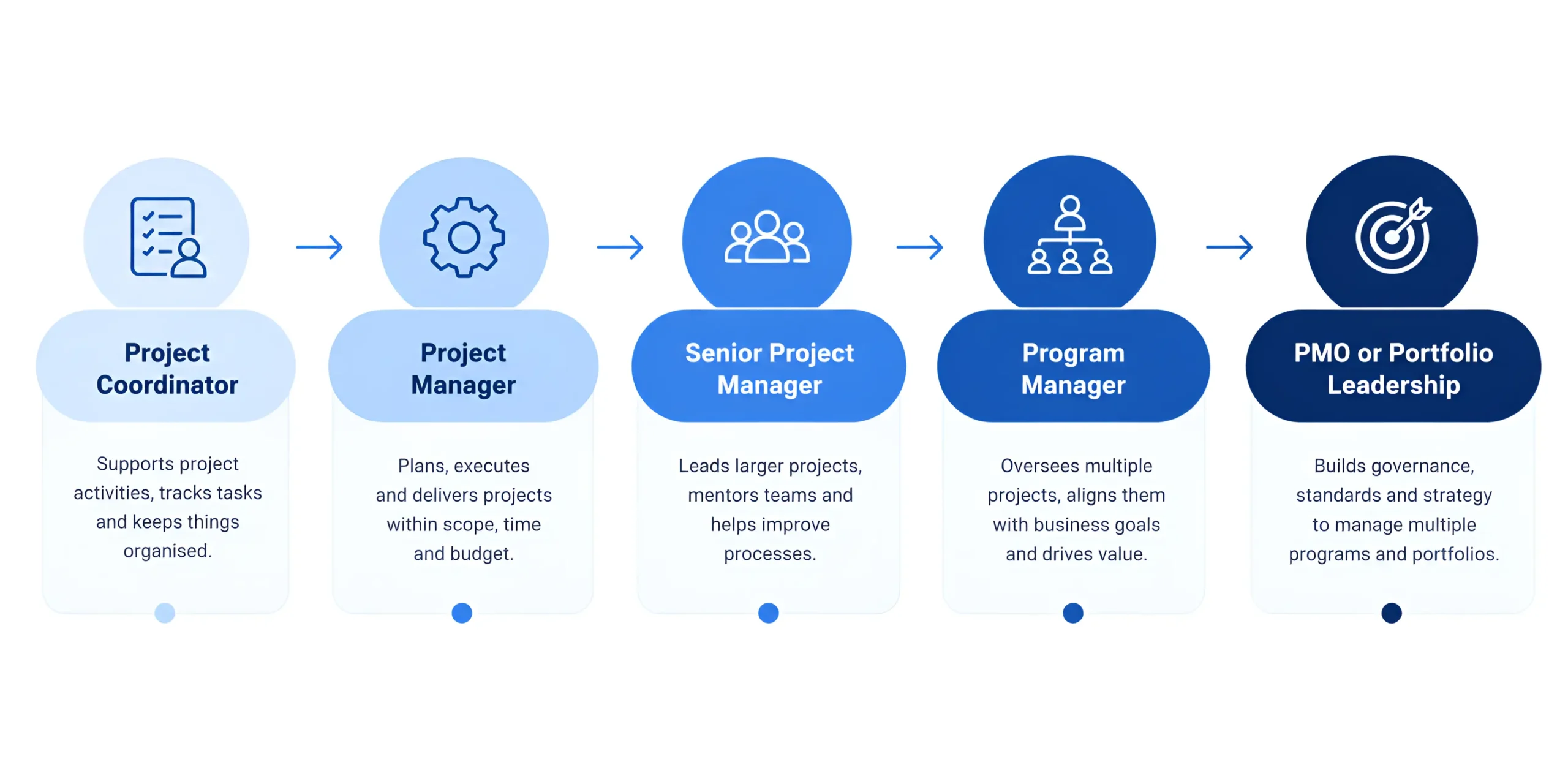
2. Is PMP suitable for someone with no project experience?
No. PMP is created only for professionals who have project experience for at least 3 years. Because PMI has set some leadership experience requirements in order to gain the certification.
If you are a beginner and want to get into leadership roles already. You should first build relevant experience or consider an entry-level certification like CAPM.
3. Which skills should an aspiring project manager develop first?
As an aspiring project manager, you need to develop some strong collaboration and communication skills. These skills can easily be developed in any environment. Even if you are just at the executive level, you still need to communicate with your team members and collaborate on work.
You can just start documenting these skills and how they made an impact on something. There are more skills that you can work on like – planning, stakeholder management, risk management etc.
4. Is PMP training available in Thane?
Yes. ProThoughts offers classroom training in Thane. It is completely up to you to choose between the classroom and online PMP training format.
We recommend our candidates opt for the classroom training. As it gives more opportunity to interact with the training one-on-one.
Before opting in, compare the trainers, course content, and support before enrolling.
5. Is project management a good career option?
Project management is a good career option if you actually see yourself leading teams and helping reach organizations to their full potential.
Project management exists in literally every industry. Career opportunities vary by sector and experience.
If you are having doubts about project management being a good career option. You should evaluate the roles based on your interests, skills, industry, preference, and long-term career goals.
If you still have doubts on the same, please connect with our consultant – Priyanka Via Phone no – 98676 73113.