Root cause analysis – Key takeaways
- Root cause analysis finds the underlying cause of a problem.
- RCA focuses on causes rather than only treating symptoms.
- Teams use several techniques to investigate problems.
- The 5 Whys and Fishbone Diagram are common RCA techniques.
- Good RCA should lead to corrective and preventive actions.
- RCA works best when teams use facts and evidence.
Problems are part of every process and business project. Systems fail, and deadlines tend to slip. Some customers give the wrong output. Fixing the immediate problem is not enough every time.
The same issue can possibly happen again if the underlying cause is still present. This is where root cause analysis (RCA) helps.
Root cause analysis gives teams a structured way to investigate problems. It helps project teams move ahead. Find out the symptoms and identify what actually caused an issue.
What is root cause analysis?
Root cause analysis is a structured process used to identify the underlying cause of a problem.
Instead of asking only, “What went wrong?” RCA asks, “Why did this happen?”
For instance – imagine a project misses an important deadline. The immediate problem is the missed deadline.
However, the root cause is a bit unclear:
- Requirements
- poor estimation
- Delayed approvals
- Limited resources.
RCA helps the team investigate these possible causes before deciding on a solution.
The goal is not to find someone to blame. But to understand the problem and reduce the chance of it happening again.
Before getting into root cause analysis, let’s understand what a root cause is first.
What is a root cause?
A root cause is an underlying factor that contributes to a problem. It is different from the visible symptom.
Consider a simple example.
A company notices that several customer orders are shipped late. “Late delivery” is the problem. It is not necessarily the root cause.
After investigation, the team discovers that orders are often entered incorrectly. Further investigation shows that employees use an outdated order-entry process. In this case, the outdated process is most likely the root cause here.
This distinction matters because fixing only the symptom does not always prevent recurrence.
Here’s a table explaining the –
- Problem
- Cause
- Root cause
Problem vs cause vs root cause
| Term | Meaning | Example |
| Problem | What went wrong? | Customer order shipped late. |
| Cause | Factor that contributed. | The order was entered incorrectly. |
| Root cause | Underlying reason behind the cause. | Outdated order-entry process. |
Now that we have understood what the root cause is and how we identify it. Let’s understand why it is important in project management.
Why is root cause analysis important?
RCA helps organizations solve problems at their source.
Without RCA, teams apply quick fixes. These fixes address the immediate issue but do not necessarily prevent another occurrence.
For instance – a project team adds extra staff after missing a deadline. If the real issue is unclear requirements, additional staff may not solve the problem.
A proper RCA helps the team identify where the process failed.
It also helps teams:
- Prevent recurring problems
- Improve processes and workflows
- Support better decision-making
- Reduce waste and rework
- Improve quality
- Strengthen risk management
- Create clear corrective actions
The next section explains how a PMP project manager makes root cause analysis work.
How does root cause analysis work?
Project managers routinely use root cause analysis (RCA) to identify the underlying reasons behind project issues.
A typical RCA process follows a few practical steps.
1. Define the problem
Start by clearly describing what happened. Avoid vague statements such as “the project went badly.” Instead, use a specific statement.
Example: “The software release was delayed by five days. Because testing was not completed on schedule.”
A clear problem statement gives the investigation a defined starting point.
2. Collect evidence
Next, gather relevant information about the problem.
This includes –
- Project records
- Process documents
- System logs
- Customer feedback
- Performance data
- Team interviews
- Timelines
Use facts wherever possible. Avoid making assumptions about what caused the problem.
3. Identify possible causes
List the factors that could have contributed to the issue. At this stage, do not immediately choose one cause.
For a delayed software release, possible causes could include unclear requirements, insufficient testing resources, technical defects, or approval delays.
4. Analyze the causes
Now investigate why each possible cause occurred. This is where an appropriate root cause analysis technique becomes useful.
The team can use –
The 5 Whys, Fishbone Diagram, Pareto Analysis, or another method.
5. Identify the root cause
After reviewing the evidence, identify the underlying cause or causes. Sometimes there is one root cause. Complex problems can have several contributing causes. The conclusion should be supported by evidence.
6. Take corrective action
Once the root cause is understood, decide what needs to change. The action should address the cause rather than only the symptom.
For instance – updating a broken process could be more useful than repeatedly correcting individual errors.
7. Monitor the result
RCA does not end when an action is implemented. Track the results after the change. If the problem continues, the team needs to investigate additional causes.
The next section covers the common techniques in root cause analysis.
Common root cause analysis techniques
Project managers use common methods for conducting root cause analysis. Difference problems require different investigation approaches.
Here are some widely used root cause analysis techniques.
1. 5 Whys
The 5 Whys technique involves repeatedly asking “Why?” to move from a visible problem toward its underlying cause.
Example:
Problem: A project milestone was missed.
- Why? Testing was completed late.
- Why? Test cases were prepared late.
- Why? Requirements were finalized late.
- Why? Stakeholder approvals were delayed.
- Why? The approval process was not clearly defined.
The fifth answer points toward a process issue that needs attention. The technique does not always require exactly five questions. The number depends on the problem.
2. Fishbone diagram
A fishbone diagram, also called an Ishikawa or cause-and-effect diagram. Helps teams organize possible causes visually.
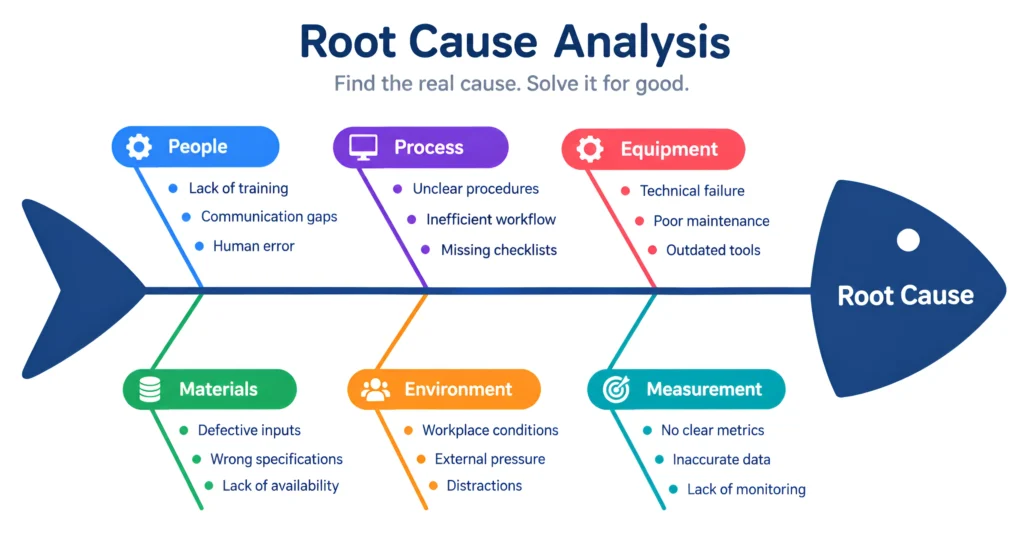
Teams commonly group causes into categories such as:
| People | Process | Equipment |
| Materials | Environment | Measurement |
For a manufacturing problem, the team investigates whether defective products relate to machinery, materials, employee training, or production processes.
This method works well when a problem has several possible causes.
3. Pareto analysis
Pareto analysis helps teams identify the causes that contribute most to a problem.
It is based on the idea that a relatively small number of causes can account for a large share of problems.
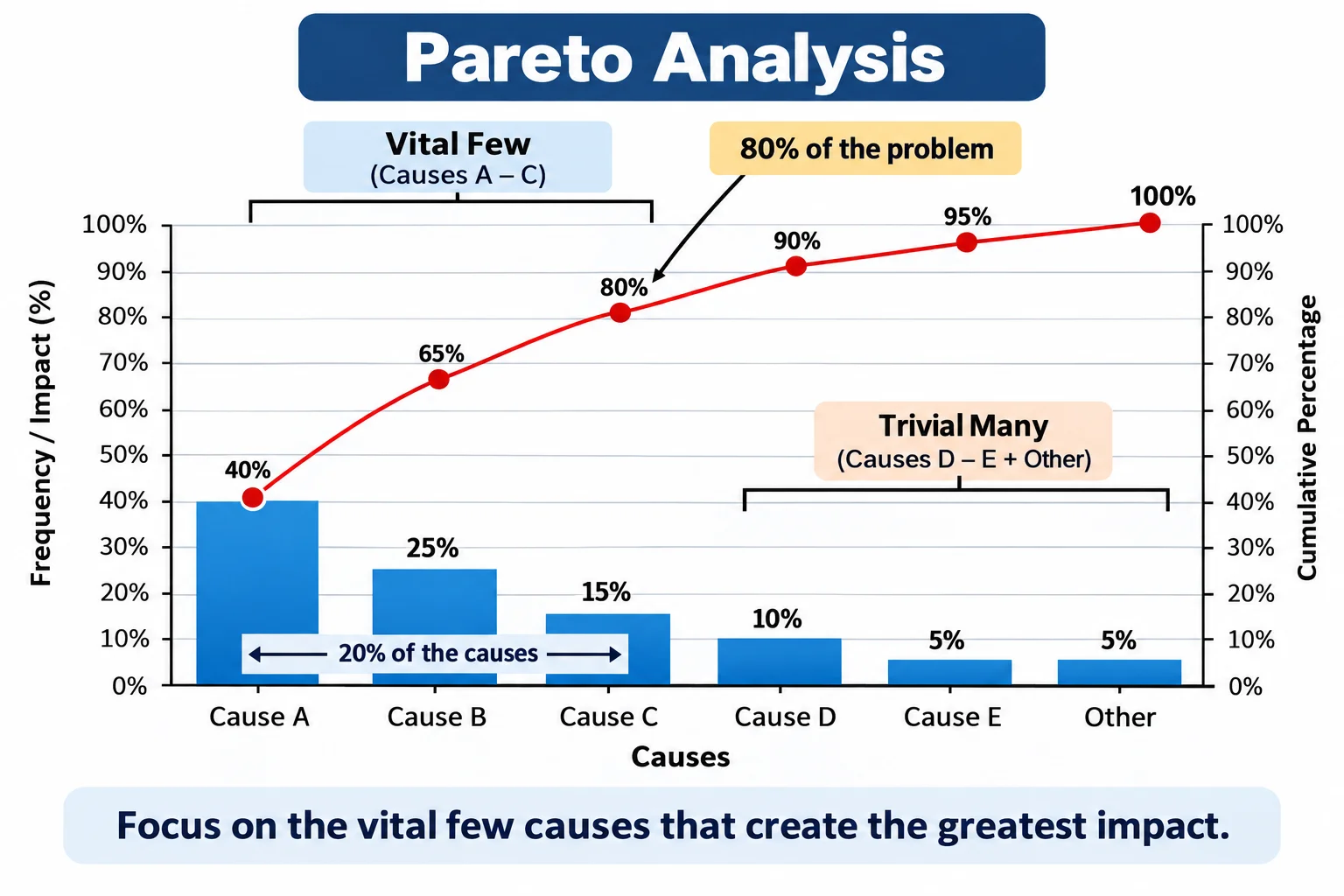
For instance – a customer support team finds that most complaints come from a few recurring issues.
The team can then focus its investigation on those major contributors first.
4. Fault tree analysis
Fault tree analysis, or FTA, starts with an undesirable event and works backward.
The team identifies the different conditions that could lead to that event.
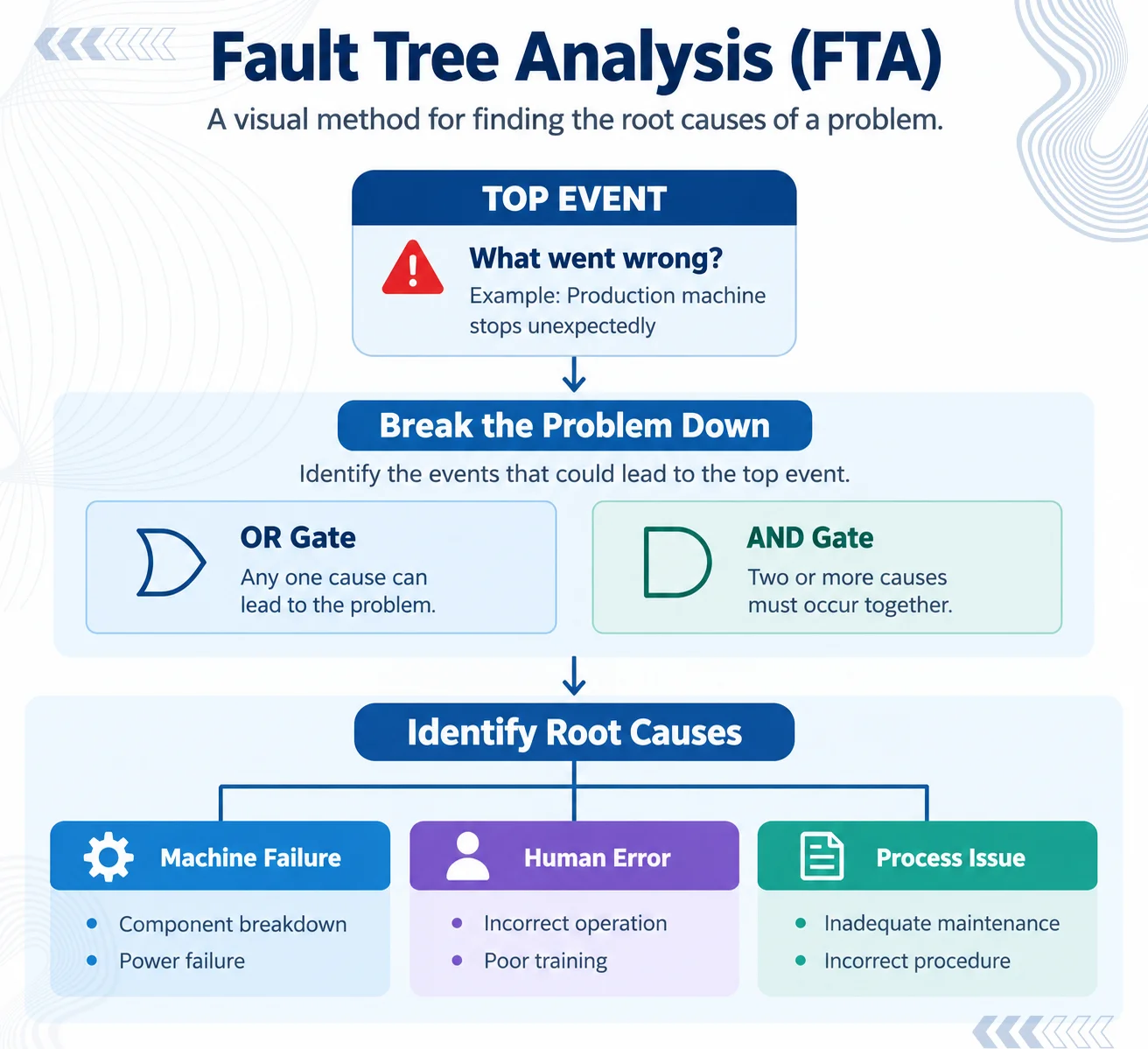
It often uses logical relationships such as “AND” and “OR” to show how different failures combine.
FTA is useful for complex systems where several failures can contribute to one major problem.
The next covers the difference between root cause analysis methods and techniques.
Root cause analysis methods vs. techniques
The terms “root cause analysis method” and “root cause analysis technique” are usually used interchangeably.
But there’s a small practical distinction.
- A method usually describes the overall approach used to investigate a problem.
- A technique is a specific tool used within that investigation.
For example – a team follows an RCA process that includes –
- Problem definition
- Evidence collection
- Analysis
- Corrective action
- Monitoring.
Within that process, the team can also use the 5 whys or fishbone diagram. In practice, organizations usually use a combination of multiple techniques.
Every technique and method has its own ups and downs. Similarly, root cause analysis can go wrong because of some common mistakes.
Common mistakes in root cause analysis
RCA becomes less effective when teams make assumptions too early. Some common mistakes include:
1. Stopping at the first cause
The first cause identified is not always the root cause. Keep investigating until the underlying reason becomes clear.
2. Focusing on people instead of processes
Blaming an employee rarely explains why the system allowed an error. Look at processes, controls, training, tools, and working conditions.
3. Using opinions instead of evidence
Team opinions can help identify possible causes. However, conclusions should rely on supporting evidence.
4. Choosing actions that only fix symptoms
Correcting one error does not necessarily prevent another. The corrective action should address the underlying cause.
Root cause analysis in project management
Project managers use RCA to investigate issues such as:
- Schedule delays
- Budget overruns
- Quality problems
- Resource issues
- Communication gaps
- Repeated defects
- Customer complaints
RCA also supports continuous improvement. When teams understand why a problem has occurred. They can improve the process rather than repeatedly reacting to the same issue.
RCA is also a useful skill for PMP-certified project managers. The PMP framework covers structured problem-solving, risk management, quality management, and stakeholder-related issues. Understanding RCA helps project professionals investigate recurring problems instead of relying on temporary fixes.
Learn more about PMP certification training and build practical project management skills for real project challenges.
Conclusion
Root cause analysis provides a structured way to understand problems. The process starts with a clear problem statement.
Techniques such as the 5 whys, fishbone diagram, pareto analysis, and fault tree analysis support this process. The most important point is simple. Do not stop at what happened. Find out why it happened!
Frequently asked question on root cause analysis
Here are some commonly asked questions on root cause analysis –
1. What is root cause analysis?
Root cause analysis is a structured process for identifying the underlying causes of a problem. It helps teams address the source of an issue instead of only fixing its symptoms.
2. What is a root cause?
A root cause is an underlying factor that contributes to a problem. Identifying it helps teams create corrective actions that reduce the chance of the same issue happening again.
3. What are common root cause analysis techniques?
Common techniques include –
- The 5 Whys
- Fishbone Diagram
- Pareto Analysis
- Fault Tree Analysis
The appropriate technique depends on the type and complexity of the problem.
4. What is the 5 Whys technique?
The 5 Whys technique involves repeatedly asking “Why?” about a problem. The purpose is to move beyond the immediate symptom and identify an underlying cause.
5. What is the difference between a cause and a root cause?
A cause contributes to a problem. A root cause sits deeper within the chain of causes. Addressing the root cause helps reduce the likelihood of recurrence.