Product owner – key takeaways
- A product owner maximizes the overall product value.
- They manage and prioritize the product backlog.
- Product owners represent customer and business needs.
- They work closely with scrum teams and stakeholders.
- Product owner responsibilities vary across organizations.
- Strong communication and prioritization skills are essential.
- Agile and Scrum knowledge helps product owners succeed.
- Product owner roles can lead toward product management careers.
A product owner (PO) plays a very essential role in agile product development. A product owner has to connect and translate the client’s requirements to the development team and get the work done by them. Although a product owner is mainly known for managing the product backlog. The PO also needs to understand the business goals, customer expectations, market needs, and product priorities.
Basically, the PO has to turn the inputs given by clients into clear requirements for the product development team. If you are currently exploring a career in the product management domain. Understanding the product owner role gives you a useful starting point.
In this article, we will understand what a product owner does, the responsibilities, the required skills, etc. Please read along!
Who is a product owner?
A product owner is the one who is responsible for maximizing the overall product value. They decide what the team should prioritize based on the product goals. In scrum, the product owner is accountable for effective product backlog management. Like :
- Develop and communicate the product goal
- Create and clearly communicate product backlog items
- Order backlog items
- Ensure the backlog remains transparent and understood.
This role doesn’t mean that the product owner solely works. To make it easier to understand, here’s an instance for you.
Image a company developing a project management application. Now here, the customers for this app are PMP project managers, and they raise a ticket that creating project reports takes too long.
This exact feedback is read and studied by the product owner. Then the product owner understands that this particular problem requires fixing. And creates a feature that supports the product goal and prioritizes improvement in reporting.
Then the development team works on delivering that capability. The product owner there helps to answer a critical question: “What should the team build next, and why?”
Next, let’s look at what role a product owner plays in agile.
What is a product owner’s role in agile?
As mentioned eariler, that the product owner has an important role in agile product development. Agile teams work through short development cycles – also known as agile sprints. This creates opportunities to adjust priorities based on feedback.
The product owner supports this process by keeping product priorities clear.
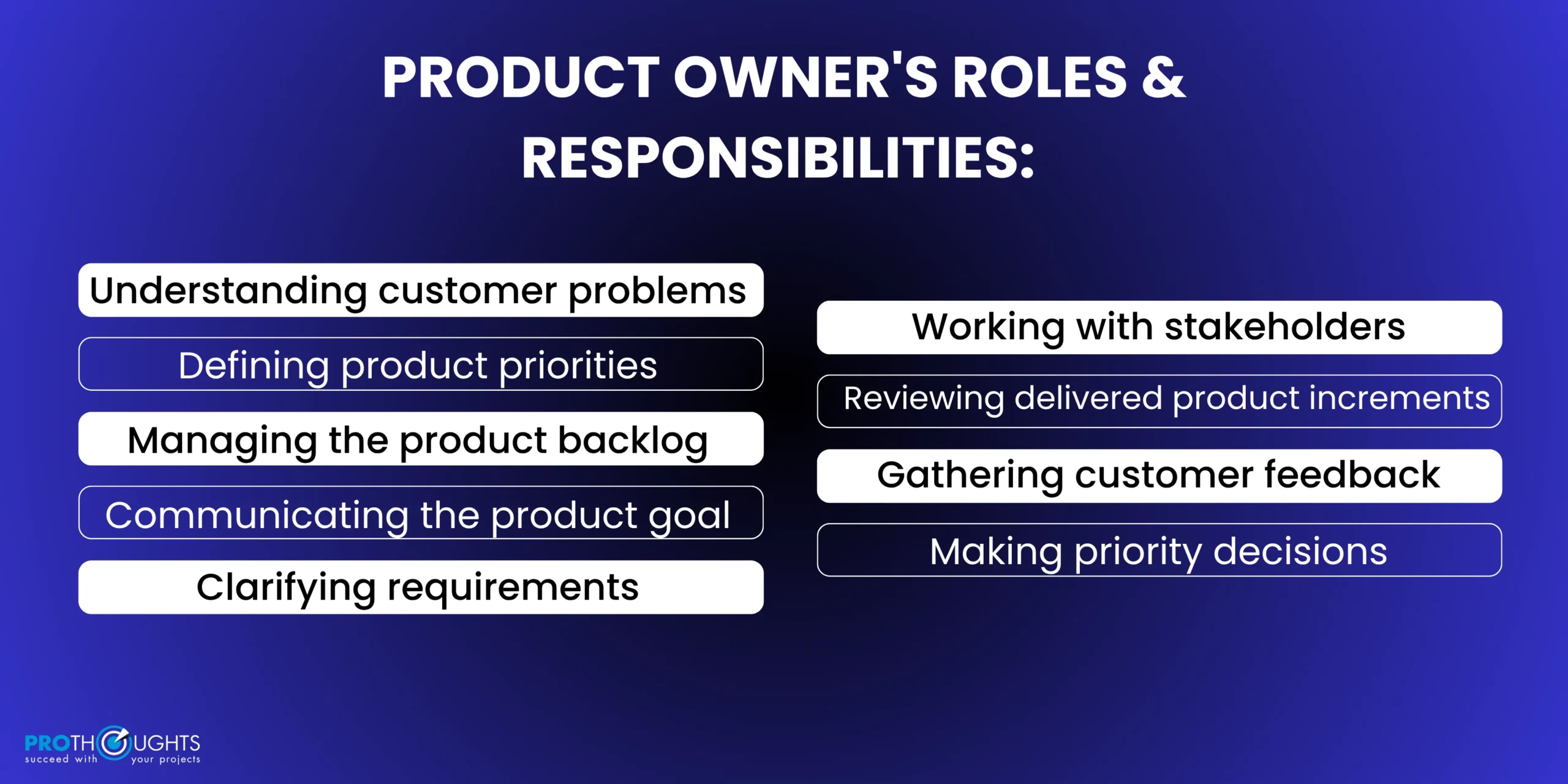
This image is just an overview of a product owner’s role.
The product owner also works closely with the Scrum master. However, their responsibilities are different. Next, let’s look at what are the roles and responsibilities of a product owner in detail.
Product owner roles and responsibilities in product development
Usually a product owner has a common set of responsibilities, but the exact responsibilities differ between organizations. However, as mentioned, there are several responsibilities that are common across product owner roles.
Here are some common roles and responsibilities in product development.
1. Define the product goal
The product owner has to be clear with the goal and should be able to describe the future state the product aims to achieve. This goal is developed and communicated by the product owner to the team. It provides a clear direction from the scrum team and helps explain why specific work matters.
For instance, an online learning platform has a goal to improve the course completion rates. Now, here the product backlog will contain work that supports this broader objective.
2. Manage the product backlog
The product backlog contains all the work that requires product improvement. The product owner is accountable for effective backlog management.
The product backlog contains the work required to improve the product. The product owner is accountable for effective backlog management.
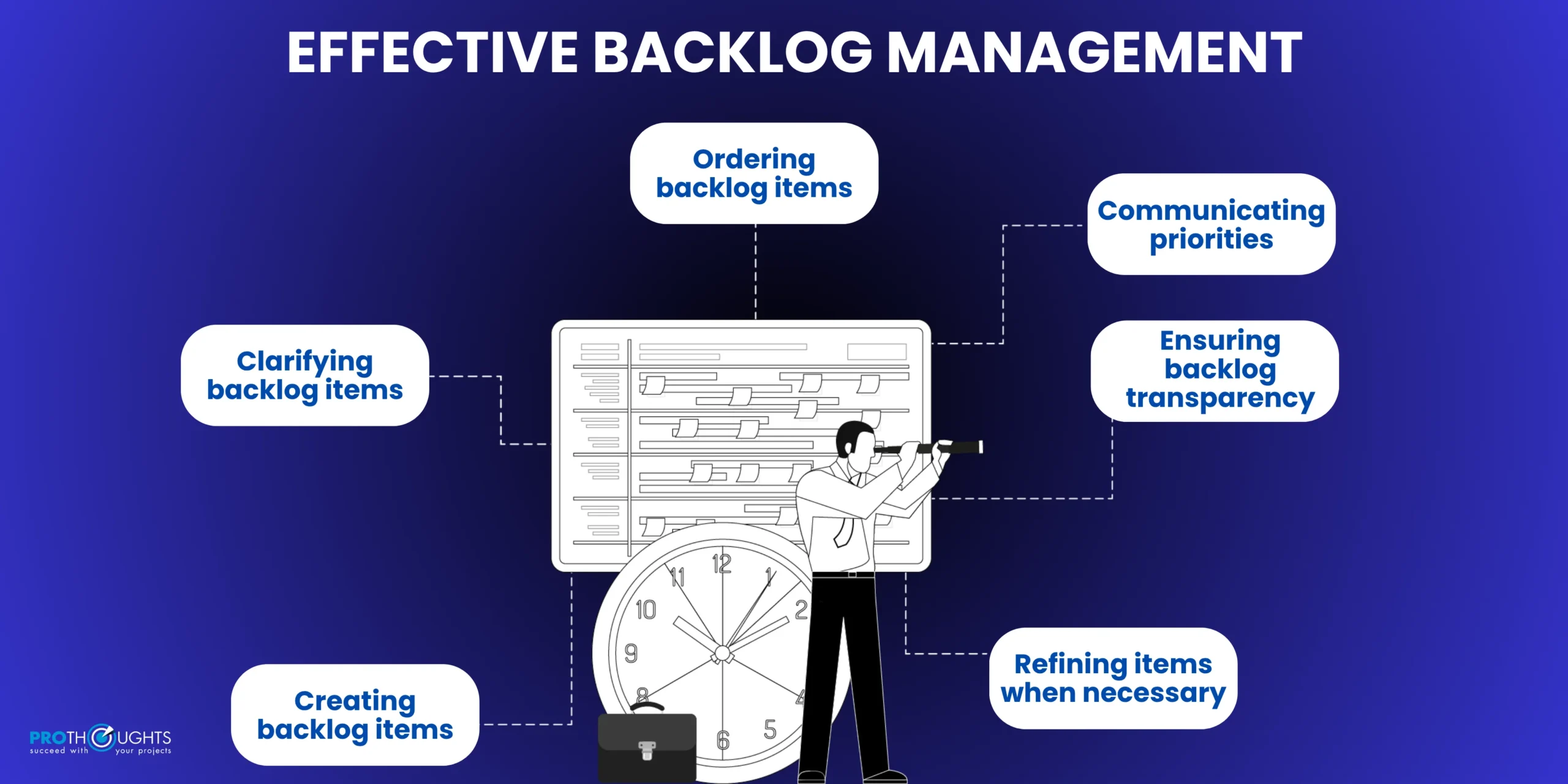
The backlog should give the team enough clarity to understand upcoming work.
If you want to know/learn more about the product backlog, give a read – product vs. sprint backlog.
3. Prioritize product work
As the name suggests, “product owner,” product prioritization is one of the most important responsibilities for a product owner.
A product owner has more potential work than the team usually has the bandwidth to complete. Therefore, the product owner needs to decide which work provides greater value.
Several factors can influence these decisions:
| Customer impact | Business value | Regulatory requirements |
| Product strategy | Risk | Development effort |
| Dependencies | Technical considerations | Priorities should connect back to the product goal. |
4. Understand customer needs
Product owners need a strong understanding of their users. They collect information through –
Customer conversations – Surveys – Product analytics – Support tickets – Market research – Stakeholder discussions
For instance, a customer might request ten completely different features. The product owner needs to understand the underlying problem that is causing the client to request those features.
By doing this, the team can focus on meaningful product outcomes rather than simply building all the requested features.
5. Work with stakeholders
Product owners regularly communicate with stakeholders. These stakeholders usually include – customers, business analysts, marketing teams, customer support, etc.
Different stakeholders have competing priorities. The product owner helps bring these inputs together, which leads the team to make more informed product decisions.
6. Clarify Requirements
Developers need sufficient context to understand what needs to be built. The product owner first needs to be clear on what needs to be done, so they can explain everything to the developer.
The product owner explains the desired outcome and answers questions about the product requirements.
Clarity requirements like – user needs, acceptance criteria, business rules, priority, etc., are needed.
Now the level of detail depends on the product and team.
7. Inspect the product increment
The product owner has to carefully review what the team produces. Then assess whether the increment is actually supporting the product goals and expected user needs. This does not necessarily mean the product owner performs all the testing. Testing still remains a broader team responsibility.
The main focus of the product owner remains on whether the work delivered provides the intended product value.
Product owner vs scrum master
Product owners and scrum masters have different accountabilities. We have created a table that distinguishes the roles of a product owner and scrum master.
| Product Owner | Scrum Master |
| Focuses on product value | Focuses on scrum effectiveness |
| Manages product priorities | Helps improve team effectiveness |
| Manages the product backlog | Helps facilitate scrum events |
| Understands customer needs | Coaches the team in scrum |
| Makes product decisions | Helps remove organizational impediments |
| Works heavily with stakeholders | Supports collaboration and improvement |
Both the roles have to work with the developers closely. Neither role is simply being a team lead/manager.
Next, let’s look at what skills are required to become a product owner.
Must have product owner skills
A successful product owner needs to have good knowledge of the business. Here are some essential product manager/owner skills.
1. Communication skills
Product owners communicate with different audiences every day. They need to explain product priorities clearly to developers. They also need to explain product decisions to business stakeholders.
Strong communication reduces misunderstandings and unnecessary rework.
2. Prioritization skills
Product owners constantly have to deal with loads of competing demands. They need to evaluate which work deserves the most attention first.
Prioritization becomes harder when the resources, deadlines, customer needs, and business are conflicting.
3. Customer understanding
A product owner needs to understand customer problems. This involves more than collecting feature requests.
They need to identify the underlying user need and determine whether solving it supports the product strategy.
4. Analytical thinking
Product decisions often require evidence. Product owners use:
- Customer feedback
- Product analytics
- Market research
- Conversion data
- Usage patterns
- Sales information
These inputs help product owners make better-informed decisions.
5. Business understanding
Another important skill a product owner should have is business understanding. The product owner should know the business in and out. Be very intelligible about the business objectives. As they need to connect product work with outcomes such as customer retention, revenue, operational efficiency, or market expansion.
6. Agile and scrum knowledge
A product owner who works within scrum should understand –
- Scrum principles
- Accountabilities
- Events
- Artifacts
- Commitments
Plus, agile knowledge also helps product owners to work effectively with iterative development teams.
Let’s understand the difference between a product owner and a project manager.
Product owner vs product manager
Although these titles are sometimes used interchangeably, they are not the same!
A product manager has broader responsibility for product strategy, marketing positioning, product vision, and business outcomes.
A product owner, on the other hand, works more closely with the development team and product backlog.
However, organizational structures vary. Some companies combine both roles into one position. Others clearly separate their responsibilities.
Therefore, candidates should always review the actual job description instead of relying only on the title.
How to become a product owner
If you want to become a product owner, start by building knowledge across product management and agile delivery.
Step 1: Understand agile and scrum
Learn how Agile teams work. Understand Scrum roles, events, artifacts, and principles. You should also understand concepts such as product backlog, product goal, sprint, product increment, and backlog refinement.
Step 2: Build product management knowledge
Learn how products move from customer problems to solutions.
Study topics such as:
- User research
- Product discovery
- Market research
- Product strategy
- Roadmaps
- Prioritization
- User stories
- Product metrics
Step 3: Develop business and communication skills
Product Owners work across departments. Build your ability to communicate requirements and explain decisions. Learn how to handle conflicting stakeholder priorities.
Step 4: Gain practical experience
You do not necessarily need a product owner title first.
Relevant experience can come from business analysis, project management, software development, customer success, UX, or product roles.
Look for opportunities to work with backlogs, requirements, customers, and Agile teams.
Step 5: Consider product owner certification
Certification is not the only route into Product Ownership.
However, a recognized certification can help demonstrate structured knowledge of Agile and Scrum.
Common options include:
- Professional scrum product owner (PSPO)
- Certified scrum product owner (CSPO)
- PMI agile certified practitioner (PMI-ACP)
Choose certification based on your existing experience and career goals.
Common challenges faced by product owners
The product owner role comes with several practical challenges. We have listed the challenges below –
1. Conflicting stakeholder priorities
Different stakeholders often want different outcomes. The product owner needs a clear method for evaluating these requests.
2. Unclear requirements
Incomplete requirements create confusion for development teams. Regular discussions and backlog refinement help improve clarity.
3. Changing customer needs
Customer expectations can change after product release. Product owners need feedback loops that help them respond to new information.
4. Limited development capacity
The team cannot deliver everything simultaneously. The product owner must therefore make trade-offs between competing priorities.
5. Balancing short-term and long-term needs
Some work provides immediate value; other work supports longer-term product strategy. Product owners need to consider both.
Conclusion
A product owner needs more than backlog management skills. They need product understanding, prioritization ability, customer insight, business awareness, and strong communication.
Agile and scrum knowledge provides the foundation for the role. Practical experience then helps develop better product judgment.
For professionals planning a move into product management. Product ownership provides a strong path into product-focused careers.
Product owner FAQs
Here are some commonly asked doubts regarding product owner.
1. What does a product owner do?
A product owner defines and communicates the product goal. Manages the product backlog, orders backlog items, understands customer needs, and works with stakeholders and developers.
2. Is a product owner the same as a project manager?
No. A product owner focuses primarily on product value and priorities. A project manager typically focuses on –
- Project delivery
- Planning
- Coordination
- Scope
- Schedule
- Resources.
The responsibilities depend on the organization.
3. Is product owner a good career option?
Product ownership combines product management, business analysis, customer understanding, and agile delivery. Career opportunities depend on your experience, skills, industry, and organization.
4. Do product owners need technical skills?
Product owners do not always need programming skills. However, understanding software development, technical constraints, data, and product architecture can help them communicate effectively with developers.
5. How do I become a product owner?
Start by learning agile and scrum. Build product management skills and gain experience with customer and business requirements.
If you already have a PMP certification, you can become a product owner. Although the PMP alone is not a direct or standard requirement for the role.
Supplement your PMP with an agile-specific certification like the PMI-ACP certification.