 Certain very important documents, like the Project Charter, Gantt Chart, Critical Path Method Diagram, and Work Breakdown Structure, guide the project from start to end.
One such example is Word Order. While work orders are often associated with maintenance teams or facility management, they are widely used in construction, manufacturing, IT services, and professional services as well.
In this blog, we cover the work order, its functional distinctions with other project documents, and the standard work order format. You will also find a free work order template at the end of this blog.
What is a Work Order in Project Management?
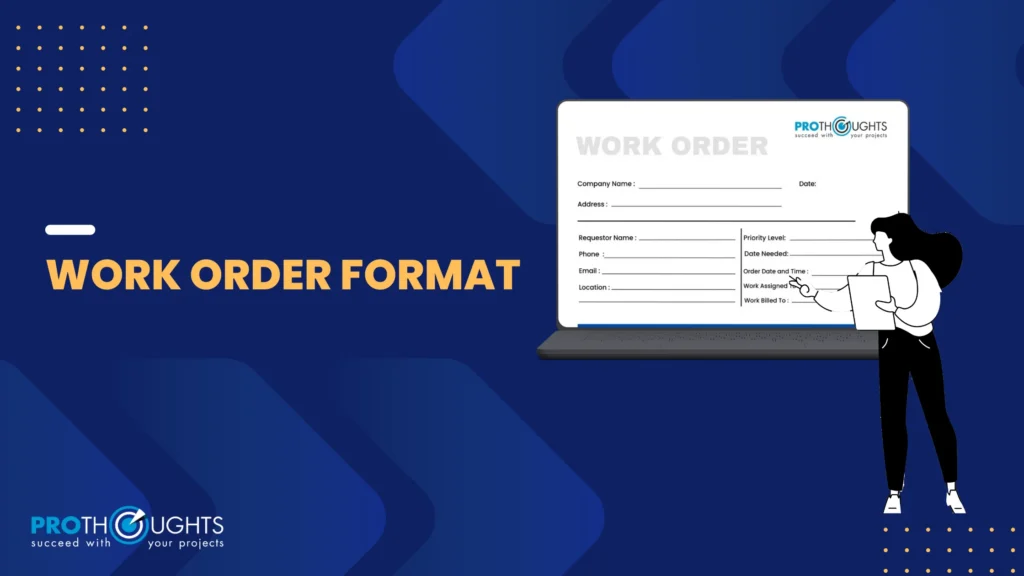
A work order is a formal document that establishes the required work within a project. It defines what work needs to be done, by whom, by when, and at what costs.
From a project manager’s perspective, a work order acts as an official instruction supported by a clear paper trail. A work order can help maintain accountability throughout the project lifecycle.
A word order also supports monitoring and controlling. As it is a formal documentation of the prescribed work, it can help you track progress, manage workload, and resources, all essential for successful project delivery.
What is the Work Order Format?
Just like all operations, Word order is also directed by certain standards. When such tools are used in industries, the document needs to follow the SOP required by the industry. When we say work order format, we mean the set standard of the document that is the work order.
The Project Management Institute (PMI) provides a project management framework for context through its terminology, which identifies standards that support the work order format. The following section will look at the key components that are supposed to be a standard for the work order format. Read Along!
Standard Work Order Format: Key Components
A professional work order structure must have numerous distinct sections to allow for the task’s entire lifecycle. Organizations are encouraged to adopt standard templates to provide uniformity across various sorts of maintenance and project duties.
A uniform work order format is required to avoid human error and guarantee that technicians get all necessary information before arriving on the job site.
The table below will establish important sections of a work order format along with their purpose for your reference.
| Section | Mandatory Data Fields | Operational Purpose |
|---|---|---|
| Identification | WO Number, Title, Type (PM, CM, Emergency) | Tracking and classification for reporting |
| Logistics | Precise Job Location, Asset ID | Minimizes technician travel time and confusion |
| Scope of Work | Detailed Task Description, Step-by-Step Breakdown | Defines clear objectives and prevents unauthorized work |
| Scheduling | Priority Level, Start Date, Deadline/Due Date | Aligns task with project timelines and urgency |
| Resources | Assigned Personnel, Required Tools, Parts List | Ensures the availability of materials before execution |
| Financials | Estimated Labor Hours, Material Costs, and Budget | Allows financial oversight and cost-benefit analysis |
| Safety & Compliance | PPE Requirements, Hazard Instructions (LOTO) | Ensures regulatory adherence and safety |
| Authorization | Requester Info, Supervisor Approval Signature | Establishes accountability and organizational mandate |
| Documentation | Attachments (Blueprints, Photos), Completion Notes | Builds a reliable history for predictive analytics |
The Descriptive Standard of WO Format
Vague descriptions represent one of the most significant pitfalls in work order management. Instructions such as “fix the machine” or “check the equipment” leave too much room for interpretation, leading to errors and inefficiencies.
A professional work order uses action-focused, precise language. For example, instead of “fix leak,” a high-quality order would state: “Service required on CNC Router in Hall B, Section 5; replace worn hydraulic seal on primary spindle and test under load”.
Detailed instructions often include diagrams, schematics, or reference numbers to ensure the technician knows exactly what is expected.
(This niche example is for your understanding; however, the scope of work orders varies as per industry.)
Word Order vs. Other Project Documentation (Functional Comparison)
To understand the unique positioning of the work order, it must be compared with other primary organizational documents used in procurement and project management. Additionally, to complete a project within the allocated time and budget, a work order is used alongside other project documentation. So to use each of them effectively, you must understand them and how they differ from each other.
Refer to the table below for a clear distinction between various project documents that can be confused with Work Order.
| Document Type | Primary Focus | Recipient | Legal/Financial Role |
|---|---|---|---|
| Work Order (WO) | Task execution and labor management | Internal team or service vendor | Operational authorization and tracking |
| Purchase Order (PO) | Acquisition of goods and materials | External supplier | Legally binding financial transaction |
| Work Request | Identification of a perceived need | Management/Maintenance Dept | Notification/Signal only; no authorization |
| Statement of Work (SOW) | Comprehensive project framework | Client or Contractor | Contractual narrative of all deliverables |
| Task Order | Specific services under a master contract | Contractor | Mechanism for IDIQ (Indefinite Delivery/Indefinite Quantity) |
Types of Work Orders (Classified)
Due to the complexity of current projects, different types of work orders are required, each of which is customized to the task’s requirements and level of urgency. As a project manager, you can assign resources based on risk and priority by using an advanced classification system.
Work Orders for Asset Management and Maintenance
For organizations that rely on assets, their functioning, work orders are primarily categorized by equipment failure, lifecycle, and maintenance. These work orders alongwith the format reflects the maintenance requirements of the organization. Some of the common work orders are as follows:
General Work Orders:
These address non-urgent tasks that do not fit into specialized maintenance categories, such as routine painting, facility setup, or decommissioning equipment no longer in use.
Preventive Maintenance (PM) Work Order:
These are scheduled, routine tasks designed to prevent equipment failure and extend asset life. They are often scheduled by time intervals (e.g., monthly), usage (e.g., every 10,000 hours), or specific events.
Compliance Maintenance (CM) Work Order:
Triggered when issues are discovered during inspections or routine tasks, CM work orders are planned interventions to fix developing problems before they escalate into serious failures.
Emergency Work Orders:
Also known as reactive maintenance, these are issued when critical assets fail, posing immediate risks to production or safety. They require immediate action and bypass standard scheduling to receive the highest priority.
Inspection Work Orders:
Focused on auditing the condition of an asset, these orders use standardized checklists to ensure compliance with safety and operational standards.
These categories frequently use risk-based maintenance (RBM) as their underlying technique. This project risk management methodology continuously optimizes the frequency and scope of work orders based on risk assessments, where risk is defined as the product of the possibility of failure and the severity of that failure.
Industry-specific Variations
Work orders vary in format depending on the business, but their goal remains the same: to translate plans into action without confusion. In manufacturing, they direct production and rework by specifying what to manufacture, repair, and how to do it. Variation or change orders in construction legally capture any changes in scope, cost, or schedules, allowing work to proceed in a transparent manner. Work orders exist in IT as service requests or tickets, which are prioritized and routed efficiently using smart systems.
Work Order Template (Free Downloadable Template)
For project managers, using standardized work order templates becomes essential as they guide the project, whether it’s in terms of resources, time, or scope. It is also a strategic necessity for establishing and enforcing a standard operating procedure to get the format right across the organization.
SOPs act as an instruction manual for any organization, and bridge the gap between strategy and application. Even using a work order template or modifying the template, you can ensure that every technician or contractor, a stakeholder, follows a consistent, repeatable system. This reduces administrative hours and virtually eliminates the need for constant status meets.
Your free Work Order Template (pdf) is ready to download and refer.
Grab Your Work Order Template
Conclusion
The work order is the foundation for translating organizational intent into outcomes. Whether through paper-based forms or AI-driven platforms, the structural format determines the efficiency and profitability of a project. By using standardized formats, clear language, and integrated technologies, project managers can ensure that required tasks are performed correctly, documented accurately, and analyzed for future optimization.
FAQs on Work Order Format
Q1. What is a Work Order Format?
A work order format is the standard structure used to document and manage a task. It includes key details such as the task description, job location, assigned personnel, priority level, required resources, and approval details. A clear format ensures that work is executed correctly and tracked properly.
Q2. What are the essential elements of a work order format?
A professional work order format should include:
- Work order number and type
- Job location
- Clear scope of work
- Priority and schedule
- Assigned personnel
- Tools, parts, and materials required
- Estimated labor and costs
- Safety instructions
- Approval and authorization
- Completion notes and documentation
These elements ensure the work order covers the full project lifecycle.
Q3. Is there a standard work order format for all industries?
No single work order format fits every industry. While the core fields remain similar, industries like construction, manufacturing, IT, and facility management customize the format based on their operational needs, compliance requirements, and risk levels.
Q4. Can a work order improve project performance?
Yes. A well-designed work order format improves communication, reduces delays, controls costs, and supports better decision-making. Over time, the data collected from work orders helps organizations optimize planning and reduce operational risks.
Q5. Does Project Management Certifications like PMP over work orders?
Yes, project management certifications do cover commonly used project management tools. Of course, standard credentials like PMP Certification, PgMP Certification are a best place to learn in detail about tools such as Gantt Chart, Work Orders, WBS, etc.