
Sprint retrospective – Key takeaways
- A sprint retrospective happens at the end of each sprint.
- The Scrum Team examines how the sprint went.
- The focus is on improving how the team works.
- Teams discuss successes, problems, and possible improvements.
- Action items should be specific and achievable.
- The sprint retrospective is different from the sprint review.
- Retrospectives support continuous improvement in Scrum.
- The scrum guide timebox is three hours for one-month sprints.
- Shorter Sprints usually have shorter retrospectives.
What is a sprint retrospective?
A sprint retrospective is used inside the scrum framework as the last event of every sprint conducted. Here the srcum team reflects on all the improvements that are needed to make in the next sprint.
It is one of the key events held in scrum, as it gives a dedicated amount of time for the team to examine and review the sprint. This discussion is mainly on the team’s way of working. The discussion primarily includes the definition of “Done.”
In this sprint retrospective guide, you will learn about everything you need to know about sprint retrospective.
Sprint retrospective example
For example, suppose several user stories were completed late because testing started near the sprint’s end. The team should explore the “why” behind it. Instead of just mentioning that the “testing was delayed.”
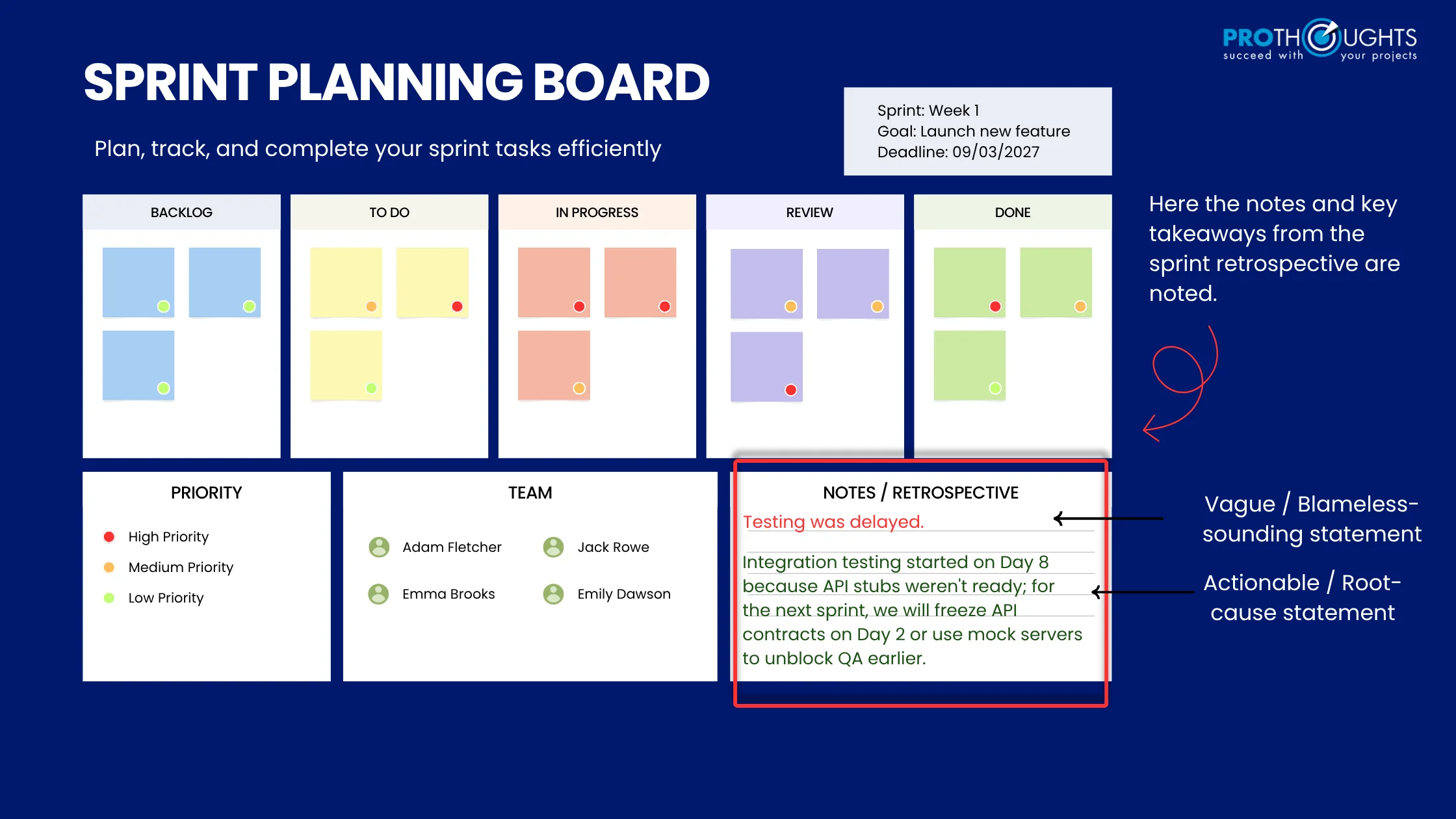
This creates an improvement based on evidence rather than blame.
Why is a sprint retrospective important?
A sprint retrospective creates a regular improvement cycle for the team. The retrospective creates a dedicated space to identify any repetitive patterns.
Here are some points that make sprint retrospective important.
1. Continuous improvement
Scrum has been built with 3 practical pillars:
- Transparency
- Inspection
- Adaption
Here both the product owner and team must be transparent about the product vs sprint backlog and increment. Frequent review (inspection) is mandatory to catch any undesirable variances early on.
If the process by any chance deviates from the acceptable limits. Adjustments are to be made as soon as possible to minimize any further risk.
Teams inspect their work throughout the sprint. But the sprint retrospective adds another layer of inspection by examining how the team itself worked.
The team can then change its approach for the next sprint.
2. Identifies recurring problems
One isolated issue may not necessarily be a major issue. But if any issue is being repeated multiple times, it deserves a much closer attention.
For instance, a team notices that the three consecutive sprints had unfinished stories. Because the requirements were unclear. This pattern shows a stronger proof than just one missed story.
3. Improves team collaboration
Holding sprint retrospectives gives the team members a structured time to discuss collaboration. A developer identifies communication gaps. A tester points out late handoffs. A product owner notices unclear acceptance criteria.
Bringing these observations together helps the team to understand the complete workflow.
4. Quality assurance
Any project or product needs quality assurance, and quality problems occurring don’t mean it’s because of the testing.
Even factors like unclear requirements, rush development, or poor refinement can lead to quality problems.
But, when a sprint is held regularly, it allows the team to investigate and eliminate such factors.
5. Ownership control
When a team is working together, it consists of many individuals, and taking ownership becomes difficult. With sprint retrospective, we understand who needs to own what. And an improvement is much for useful when someone owns the next step.
- Instead of saying, “Communication needs to improve.”
- The team could create an action such as: “Add acceptance criteria review during backlog refinement.”
The second statement gives the team something concrete to test.
What happens in a sprint retrospective meeting?
A sprint retrospective meeting usually follows a simple structure.
The exact format can vary between teams. Scrum defines the purpose and timebox, but it does not prescribe one mandatory retrospective technique. Let’s examine each step.
Step 1: Set the context
The facilitator starts by explaining the purpose of the meeting. The team should understand that the session focuses on improvement.
Useful context includes:
- sprint Goal
- sprint duration
- Major releases
- Significant incidents
- Important changes
- Major blockers
- Relevant metrics
This prevents the discussion from becoming disconnected from the actual sprint. The facilitator should also establish respectful discussion rules. People need enough psychological safety to discuss problems honestly.
Step 2: Gather observations
The team records what happened during the sprint.
A simple format works well:
| What went well? | What did not go well? | What did we learn? |
| Faster code reviews | Testing started late | Smaller stories help testing |
| Clear daily communication | Two external dependencies blocked work | Dependencies need earlier tracking |
| Good stakeholder feedback | Several stories lacked acceptance criteria | Refinement needs more detail |
The purpose is to collect observations before deciding solutions. This distinction matters. Jumping immediately to solutions often causes teams to solve symptoms instead of underlying problems.
Step 3: Identify patterns
Not every observation needs to be turned into an action item. The team should look for patterns and recurring themes.
For example:
- Three stories had unclear requirements.
- Two stories required rework.
- Testing was delayed twice.
- One external dependency blocked several tasks.
These observations might point toward a larger issue with backlog refinement. Patterns provide better evidence for improvement decisions.
Step 4: Discuss root causes
Root cause analysis is an important step when conducting sprint retrospectives. As the team gets to examine why important problems happened. Suppose the team experienced repeated testing delays.
Possible causes could include:
- Stories were too large.
- Developers completed work late.
- Test environments were unavailable.
- Acceptance criteria were unclear.
- Testing resources were shared elsewhere.
The team should investigate before selecting an action. A simple “5 Whys” discussion can help.
Example
Problem: Several stories entered testing late.
- Why? Development finished near the sprint deadline.
- Why? Stories were larger than expected.
- Why? Large stories were not split during refinement.
- Why? The team lacked a shared approach for story slicing.
Improvement: Introduce story-splitting checks during refinement.
The resulting action addresses the process instead of blaming individuals.
Step 5: Decide what to improve
A retrospective can generate many ideas. Trying to fix everything at once usually creates weak follow-through. The team should select a small number of meaningful improvements.
Consider:
- Impact
- Frequency
- Effort
- Urgency
- Team control
- Expected benefit
Step 6: Create action items
An action item should describe a specific change.
Weak action: “Improve communication.”
Better action: “Add a 10-minute dependency check during sprint planning.”
A useful action item should answer three questions:
- What will change?
- Who will help implement it?
- When will the team review it?
The team should also check whether the action actually happened. Otherwise, retrospective discussions become repetitive and useless.
Step 7: Close the retrospective
The facilitator summarizes the key points. The closing should include:
- Main observations
- Selected improvements
- Action owners
- Expected timing
- Follow-up method
The team can then carry the improvement into the next agile sprint.
Some improvements might become part of the sprint backlog. The scrum guide explicitly notes that impactful improvement actions can be added to the sprint backlog for the next sprint.
Sprint retrospective meeting format
There is no single mandatory sprint retrospective format. Teams often change the format to prevent repetitive discussions.
Here is a practical 45-minute structure.
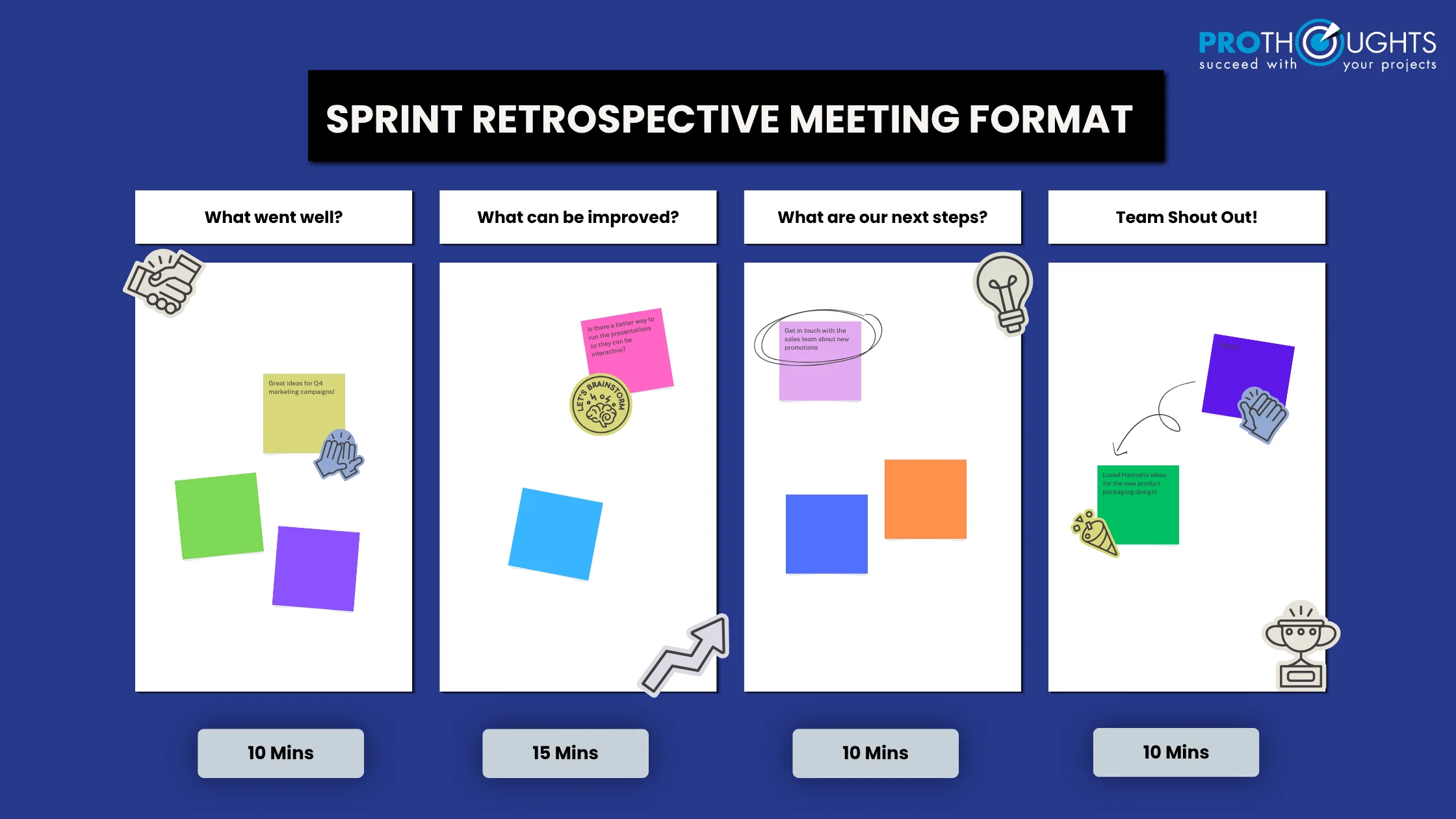
For a longer sprint, the discussion might need more time.
The scrum guide gives a maximum of three hours for a one-month sprint. Shorter sprints generally use shorter timeboxes.
Popular sprint retrospective techniques
Different teams need different retrospective formats. Changing the technique also helps avoid repetitive meetings. Here are 5 popular sprint retrospective techniques.
1. Start, stop, continue
This is one of the simplest formats. This format works well for teams new to retrospectives.
The team discusses three questions:
- Start: What should we start doing in the next sprint?
- Stop: What should we stop doing because it causes problems?
- Continue: What is working well and should continue?
2. What went well and what could improve?
The format is simple and useful for regular retrospectives. However, the facilitator should push beyond vague comments. “Communication was good” is difficult to act on. “Daily dependency discussions reduced blocked tasks” provides useful evidence.
3. 4L Retrospective
The 4Ls format uses four categories:
- Loved
- Learned
- Lacked
- Longed for
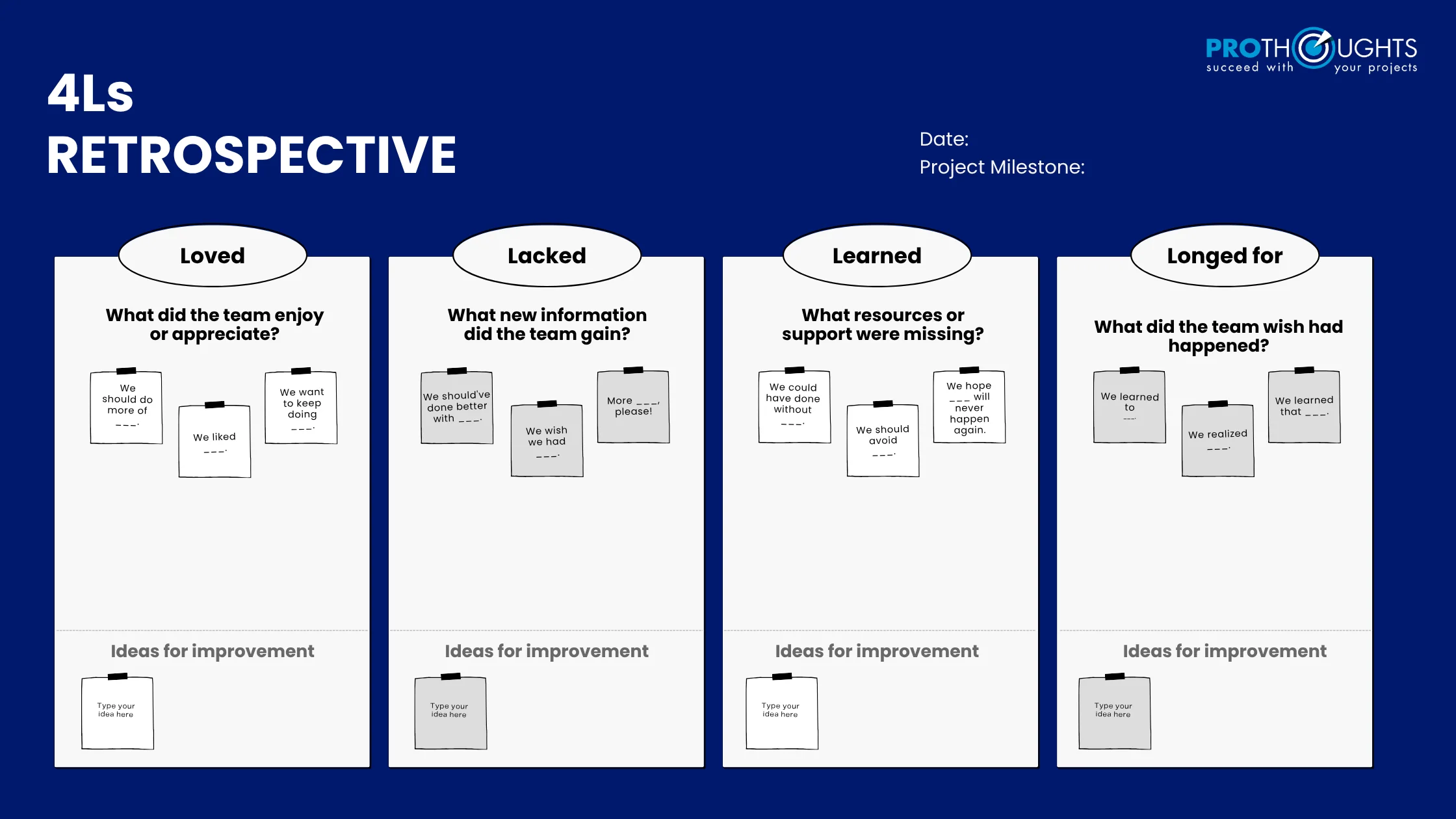
The format encourages both positive and negative feedback.
4. Mad, Sad, Glad
This format focuses on team experiences.
- What frustrated the team?
- What disappointed the team?
- What made the team feel positive?
The facilitator then identifies common themes. The emotional categories can help surface problems that traditional project metrics miss.
5. Sailboat retrospective
The sailboat format uses a visual metaphor.
The team identifies:
- Wind: factors helping progress
- Anchors: factors slowing progress
- Rocks: risks and obstacles
- Destination: the desired outcome
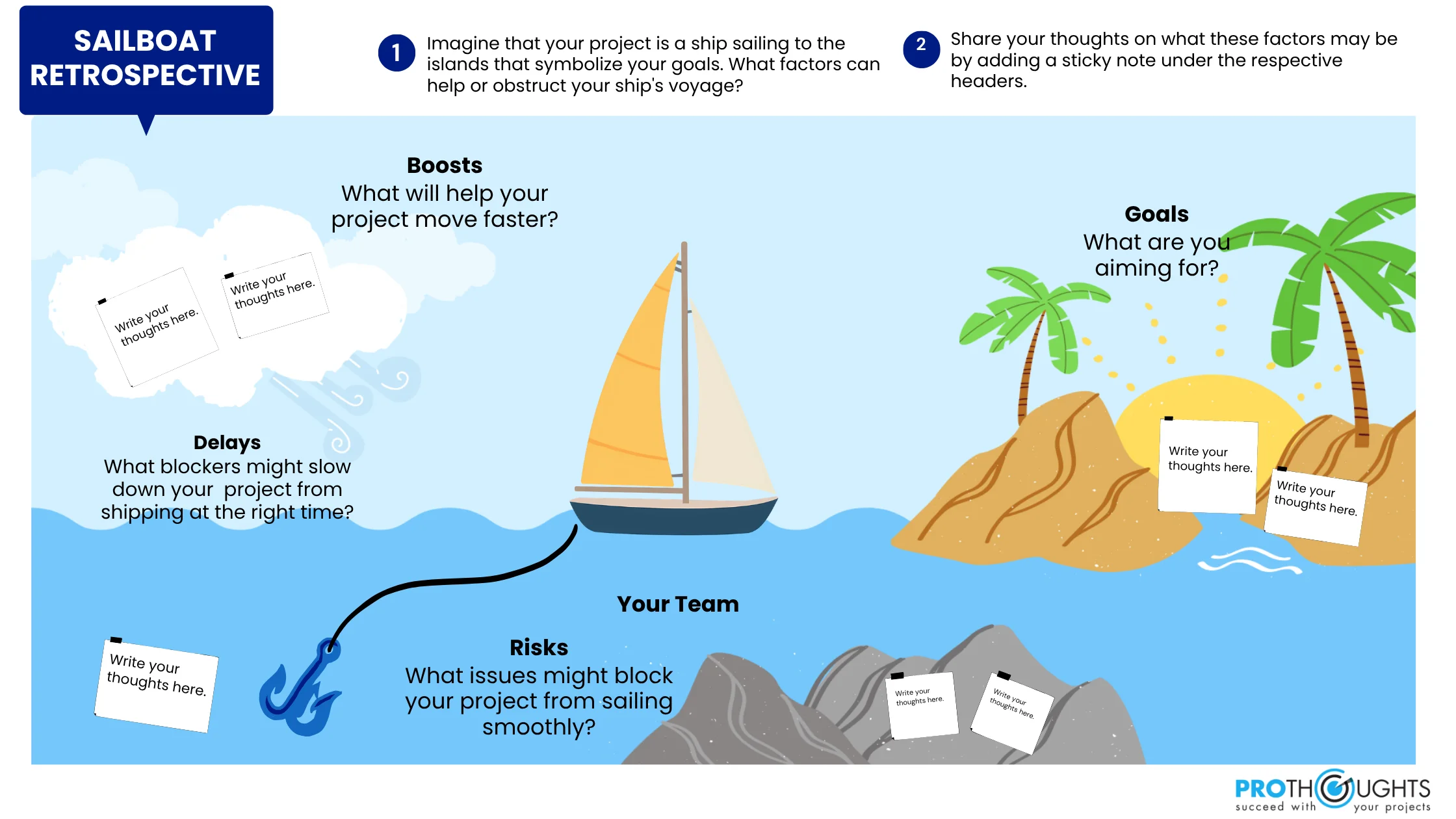
For example, strong collaboration could act as the wind. An unstable test environment could act as an anchor.
This method works well for visual teams.
Sprint retrospective vs sprint review
The sprint review vs. retrospective distinction often causes confusion. Both events happen near the end of a sprint. However, their purposes are different.
| Area | Sprint Review | Sprint Retrospective |
| Primary focus | Product and sprint outcome | Team and way of working |
| Main purpose | Inspect the product increment | Improve quality and effectiveness |
| Main participants | Scrum Team and stakeholders | Scrum Team |
| Main discussion | What was delivered? | How did we work? |
| Feedback | Product and market feedback | Process and team feedback |
| Output | Product Backlog adaptations | Improvement actions |
| Timing | Before Retrospective | Concludes the sprint |
| Main question | What should we do next? | How should we work better? |
A sprint review is not simply a product demonstration. The scrum guide describes it as a working session where the scrum team and stakeholders collaborate around what was accomplished and what should happen next.
Who attends a sprint retrospective?
The scrum team participates in the sprint retrospective.
The scrum team consists of:
- Product owner
- Scrum master
- Developers
The event is intended for the team to inspect how the sprint went and identify improvements.
Other people can contribute information when appropriate, but the retrospective should not become a broad stakeholder status meeting.
The discussion needs enough openness for team members to examine their own working practices.
Role of the scrum master in a sprint retrospective
The scrum master helps the team make the retrospective effective. They don’t necessarily need to provide every solution. Instead, the scrum master can:
- Facilitate the discussion
- Keep the conversation focused
- Encourage balanced participation
- Prevent blame
- Surface recurring issues
- Help identify actionable improvements
- Track agreed actions
- Encourage follow-through
A strong facilitator also watches the meeting dynamics. One person dominating the discussion can limit useful feedback.
Some participants might prefer writing feedback first. Anonymous input can also help teams surface sensitive concerns.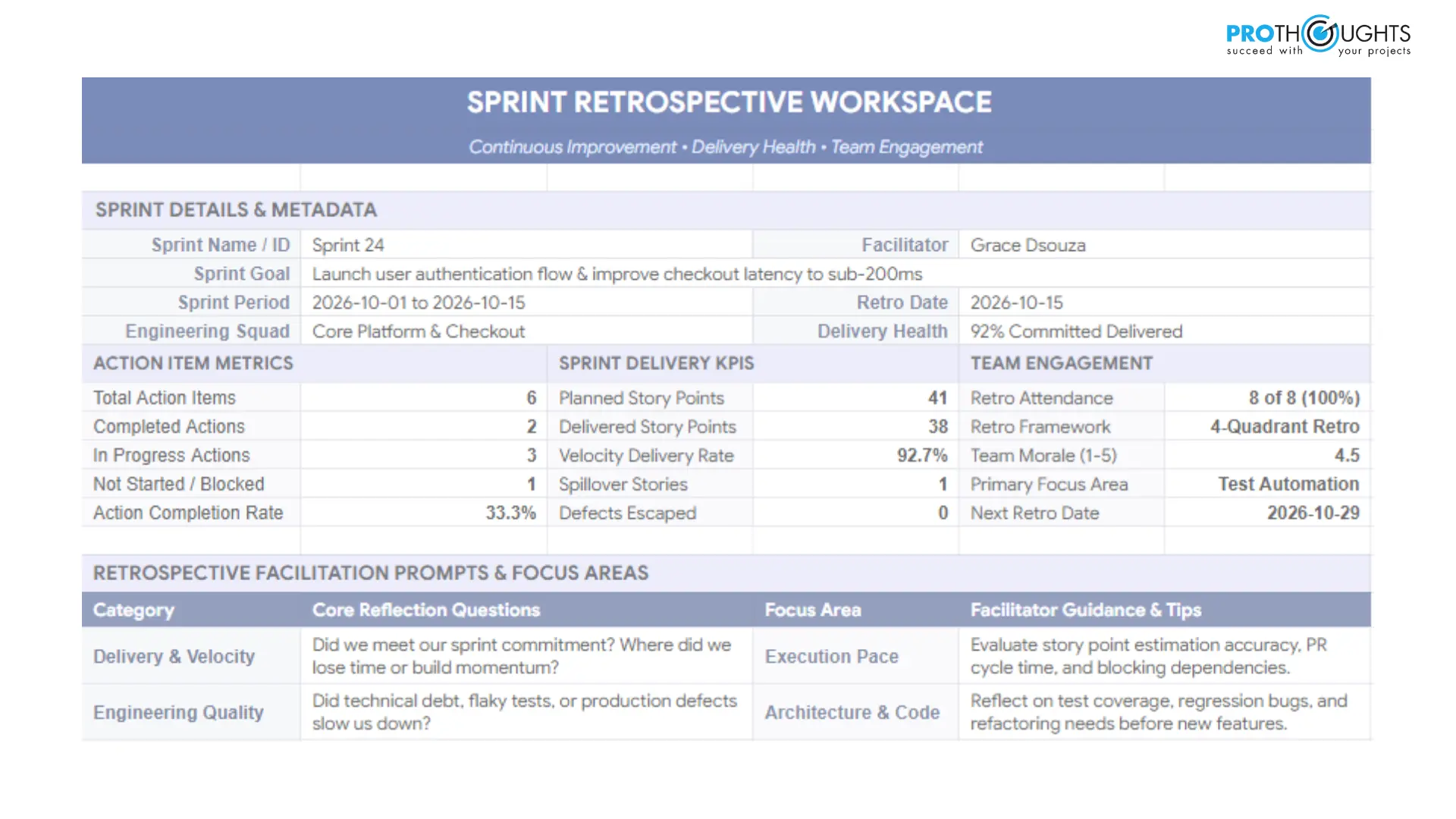
Your copy and make your next retrospective count!
We’ve put together a sprint retrospective template to track improvements that actually stick.
Sprint retrospective vs agile retrospective
Both these terms are related but not identical. A sprint retrospective specifically refers to the scrum event that is held at the final stage (end) of a sprint.
An agile retrospective is a much more broader term for a team reflection session. Even agile teams outside scrum use retrospectives.
For instance, a kanban team holds a retrospective right after a major delivery cycle. The underlying principle remains similar.
The team reflects on its way of working and identifies improvements.
Certifications covering the sprint retrospective
Scrum alliance certifications:
- CSM (Certified ScrumMaster)
- CSPO (Certified Scrum Product Owner)
Project management institute (PMI):
- PMI-ACP (PMI Agile Certified Practitioner)
- SAFe (Scaled Agile Framework):
- SAFe Scrum Master (SSM) or SAFe Advanced Scrum Master (SASM)
Conclusion
The meeting is not simply a discussion about problems. It is a structured opportunity to inspect team practices and decide what should change. The most useful retrospectives connect observations with action.
When both events are used properly, teams gain two different feedback loops. One improves the product. The other improves the process behind the product.
That makes the sprint retrospective an important part of continuous improvement in scrum.
FAQs regarding sprint retrospective
Here are some commonly asked questions regarding sprint retrospective.
1. What is a sprint retrospective?
A sprint retrospective is a scrum event where the scrum team examines how the sprint went. It is conducted to identify improvements or the future sprints.
2. When is the sprint retrospective held?
The sprint retrospective takes place at the end of the sprint. In scrum, it follows the sprint review and concludes the Sprint.
3. How long is a sprint retrospective meeting?
For a one-month sprint, the scrum guide sets a maximum timebox of three hours. Shorter sprints generally require less time.
4. Who attends a sprint retrospective?
The scrum team participates in the retrospective. This includes the product owner, scrum master, and developers.
5. What questions should be asked in a sprint Retrospective?
Useful questions include
- “what went well?”
- “what did not go well?”
- “what did we learn?”
- “what should we change next sprint?”
Teams can also examine recurring blockers and process problems.