A project manager resume isn’t something you can create in a few minutes, especially one that stands out. A project manager’s CV is more than just a summary of duties and responsibilities. It’s a project manager skills and techniques that enable them to position themself to get the next big opportunity.
But squeezing out the years of experience you’ve gained, n number of successful projects, and leadership skills into a small piece of paper or a document is where many professionals get stuck, isn’t it?
The good news is – we’re here to guide you on it! With the correct format, a strong emphasis on your accomplishments, and some professional advice, you can create a resume that accurately captures your influence and attracts the proper kind of attention.
Therefore, this blog will cover everything you need to know about how to write a resume for project managers, the skills that make a strong project manager resume, the elements in it, and of course, with a project manager resume sample and templates.
So here we go, first with what recruiters look for in a project manager resume.
What Recruiters Look For in a Project Manager Resume
Recruiters mostly spend only about 6 to 10 seconds to scan a resume, so make sure yours does not get rejected. Every word must demonstrate competence, clarity, and credibility – just like the work you do! Here are a few pointers that will help you know what recruiters look for in a project manager resume.
1. Appropriate Experience
Recruiters are more interested in knowing how many identical projects you have managed earlier. They usually search for experience that matches the role you have applied for. Highlighting the most important projects is more necessary than mentioning all of them. Quantity is never an option.
2. Proven Results
Recruiters look for proof of how you have managed the projects and what results you have given. Candidates who show how their work produced results, such as reducing costs, by delivering fast results, or improving quality, are valued by recruiters. They want to know how you made a difference.
3. Certifications That Matter
Certifications in project management are quite beneficial. Recruiters frequently use qualifications such as PMP, PRINCE2, ACP, Certified Scrum Master, or any Agile Project Management Certifications to filter candidates. It demonstrates that you have made an investment in your abilities and are aware of best practices. It is also a simple method to make a statement.
4. Specific Industry Knowledge
Recruiters look for specific industry expertise in any candidate’s resume. What works well in software does not necessary it will work the same for construction. Recruiters want candidates who know the procedures, resources, and difficulties specific to a particular business. This also reduces their risk and training time.
5. Leadership and Communication Skills
Recruiters look for strong project manager qualities, like leadership qualities, along with technical skills in the technical part too. They look for project managers with strong team leadership, stakeholder influence, and communication skills. This is specifically important for initiatives involving international teams or several divisions. They’re looking for someone who keeps everyone on the same page.
6. Problem Solving
Recruiters want candidates who can easily get along with the changing project situations. They respect project managers who remain calm under pressure and come up with different ideas when things don’t go as planned.
7. Tool Proficiency
It’s critical to be knowledgeable about widely used project management solutions. Recruiters look at your experience with Jira, Trello, or MS Project. They benefit from knowing you can get started right away. No need for drawn-out onboarding or training.
8. Attention To Details
Even minor mistakes, such as typos or irregular formatting, can raise concerns about your CV. Because the position requires it, recruiters seek out project managers with a keen eye for detail. A neat, error-free resume shows how you may approach planning, reports, and documentation. It quietly builds trust.
What Are the Elements of a Project Manager Resume?
A project manager’s CV must include certain structural elements so that it looks professional and hits all the checks in any resume ATS. We’ve listed all the things you need to mention, along with some resume examples, below:
1. Clear and Updated Contact Details
The contact section of your resume may seem like a basic part, but it’s often where mistakes are made. Keep it simple, current, and professional. This part guarantees that the recruiter can easily reach you. Avoid using outdated email IDs or adding unnecessary details like full home addresses. Focus on what’s essential and easily accessible.
Include:
- Full Name
- Mobile Number with Country Code
- Business Email Address, and
- Location (only the city and country will do).
- LinkedIn Profile Link
- Portfolio or Website (optional)
2. Proper Use of Bullet Pointers
Using bullet points improves the organization and readability of your resume (plus, a messy project manager resume doesn’t suggest anything good, right?) Moreover, pointers assist in emphasizing crucial details without overpowering the reader. This approach makes the job of recruiters much easier, because they usually scan resumes pretty quickly.
Tips for PMs:
- Use short, action-oriented statements
- Begin with strong verbs (e.g., Led, Delivered, Executed)
- Highlight measurable outcomes and success metrics
- Avoid listing responsibilities and focus on achievements
For example:
- Delivered 12+ enterprise IT projects with a 95% client satisfaction rate
- Reduced delivery time by 18% through improved sprint planning
- Spearheaded Agile adoption, boosting team efficiency by 30%
3. Professional Summary
This brief introduction should sum up your experience and crucial “wins” you bring to the table. Consider it your headline – one that is relevant, crisp, and role-specific. This is your opportunity to grab the recruiter’s attention right away. A strong synopsis arouses interest and motivates more reading.
What to Include:
- Years of experience
- Core specializations (e.g., Agile, Risk Management)
- Industries worked in
- Certifications (if relevant to the role)
- One standout achievement or leadership trait
For example:
Experienced project manager with 12+ years in Information Technology and Engineering domains. PMI-ACP® and PMP® certified. Adept at leading distributed teams and executing multi-million-dollar projects. Recognized for driving Agile transformation and delivering measurable business outcomes.
4. Work Experience
This section should focus on results, not job descriptions. Your goal is to showcase how you’ve solved problems, led teams, delivered outcomes, and added value. For each role, include the company name, title, and dates, followed by a few key highlights.
Emphasis on:
- Project types and size (budgets, teams, geographies)
- Methodologies used (Agile, Waterfall, Hybrid)
- Specific results achieved (cost savings, deadlines, ROI)
- Cross-functional or global team experience
- Stakeholder engagement
For example:
Project Manager | ABC Tech Pvt. Ltd. | Mumbai | 2020–Present
- Delivered 10+ high-priority software projects valued at ₹20 Cr+
- Cut project cycle time by 22% using Agile methodologies
- Managed 3 global teams across 4 time zones
- Improved stakeholder reporting using Power BI dashboards
5. Chronological Listing of Experience
To effectively demonstrate your career advancement, use the reverse chronological format. Work backward from your most recent position. This format makes it easier for recruiters to understand your most recent contributions.
Guidelines:
- Start with the latest job
- Include only relevant work history (past 10–12 years)
- Keep formatting consistent (Job Title, Company, Dates, Location)
- Remove short-term, irrelevant roles unless they add value
6. Educational Background
Keep this straightforward and focused. You don’t need to list every course or certificate, just the most recent and relevant ones. For project managers, this section is more of a formality, especially if you have strong work experience and certifications.
Include:
- Degree (e.g., B.E., MBA)
- Specialization
- University and Graduation Year
- Honors (optional, if recent and relevant)
For example:
Bachelor of Engineering (Mechanical)
University of Pune, 2012
7. Well-Structured Skills Sections
Both the technical and soft abilities you contribute should be covered in this area. Sort your skills so that they are easy to understand; it can be helpful to put comparable items together. Make sure this list reflects the qualifications needed for the position you are applying for. It demonstrates your readiness and suitability for the position.
Technical Skills:
- Agile, Scrum, Waterfall
- JIRA, MS Project, Trello
- Budgeting, Risk Management, Scheduling
Soft Skills:
- Stakeholder Communication
- Leadership & Conflict Resolution
- Time Management
- Strategic Thinking
Tip: Always tailor this section for the role you’re applying for.
8. Use of the Additional Section
Make good use of any available space by adding professional memberships, honors, or qualifications. These areas demonstrate your dedication to education and industry leadership. When applicants have comparable core experience, this section can help you stand out.
Example on What to Include:
- JIRA, MS Project, Trello, Asana
- Budgeting, Risk Management, Scheduling
- Certifications: PMP, PMI-ACP, PRINCE2, DASSM, Six Sigma
- Professional Memberships: PMI, APM, IPMA
- Industry Awards or Speaking Engagements
- Published work or contributions to journals
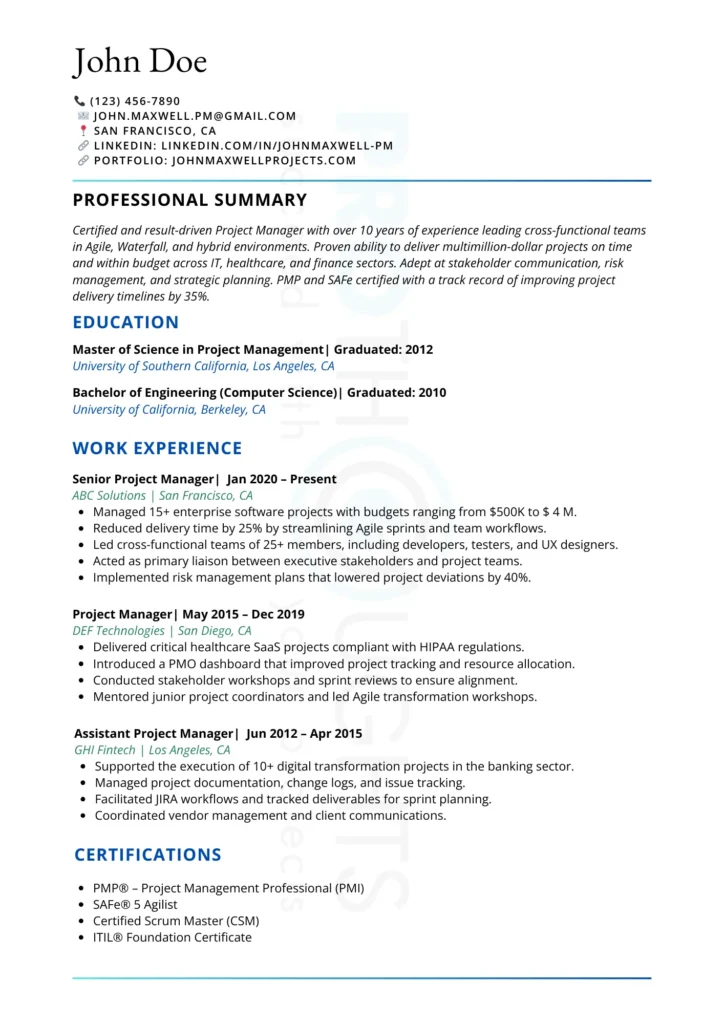
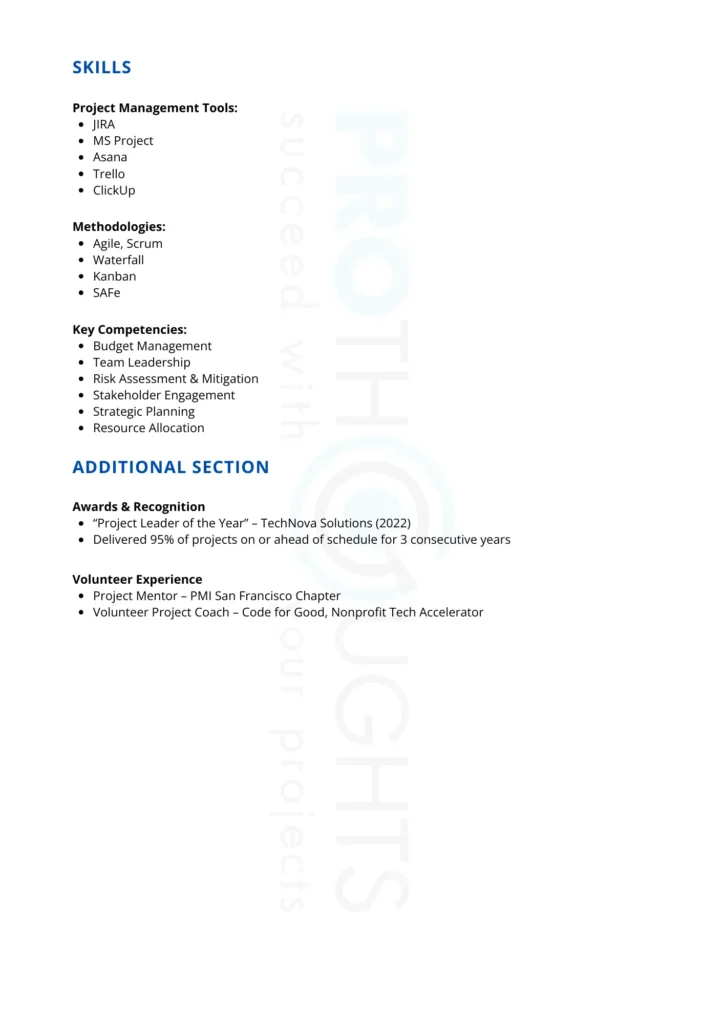
Project Manager Resume Sample:
Below is an example of what a project manger resume should look like or include.
Final Note:
A project manager resume is proof of what the candidate is capable of. It should be used to show what you have dealt with and how you have made a difference in a good way.
And for that final push — maybe add the PMP® right by your name! 😉